A good traveler has no fixed plans, and is not intent on arriving.
Lau Tzu

Random thoughts and photos of my journey through life…
A good traveler has no fixed plans, and is not intent on arriving.
Lau Tzu
10 Comments CherryPie on Nov 25th 2019

These extensive remains of the Roman period are among the most representative in the whole of Sicily. They consist of a long brick wall dating from the Imperial age, which was restored only in 1943. The Restoration also brought to light part of the original pavement. Although these Roman remains, running parallel to the upper stretch of Corsa Umbertico, are aesthetically diminished by the row of houses built above them, the monumental row of the 18 larger niches is nonetheless remarkable.*


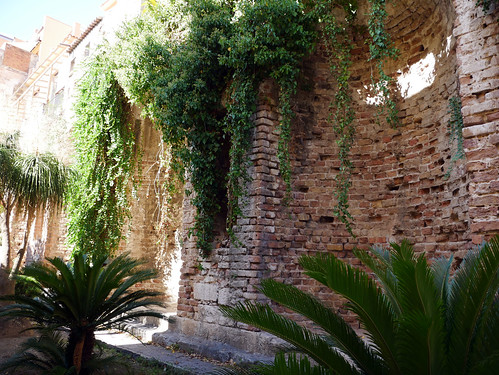
*From the book entitled ‘Taormina – The Pearl of the Ionian Sea”
10 Comments CherryPie on Nov 23rd 2019

Remains of a peristyle temple have been uncovered by excavations, incorporated into the foundations of the church of St. Caterina, located next to the south-western corner of Piazza Vittorio Emanuele II. In the absence of other evidence, fragments of the limestone geison (raking cornice) would permit to date the temple to the mid-3rd century BC. Later, in the 1st/beginning of the 2nd century BC, the temple was flanked on the south side by an odeion, abutting onto its colonnade. The odeion, partly uncovered in 1892-93, is entirely built using the brick-faced concrete technique except for the rear corridor, which is a later addition. The cavea, partly resting on a natural slope, has eleven rows of seats, divided by three staircases into four cunei or sectors. The eighth row up from the orchestra served as gangway, being slightly wider than the rest, and the two vomitoria or passages open onto it. Part of the brick-faced pulpitum (or stage) front survives with a semicircular niche, but the back wooden stage was laid on the steps of a third-century BC temple, which served as backdrop to the odeion. *

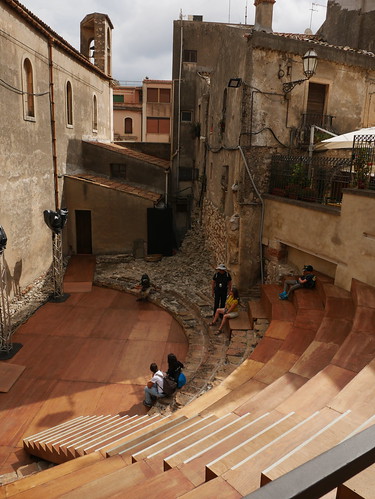


*from a signboard outside the odeon
14 Comments CherryPie on Nov 19th 2019
If you are seeking creative ideas, go out walking. Angels whisper to a man when he goes for a walk.
Raymond Inmon
20 Comments CherryPie on Nov 17th 2019

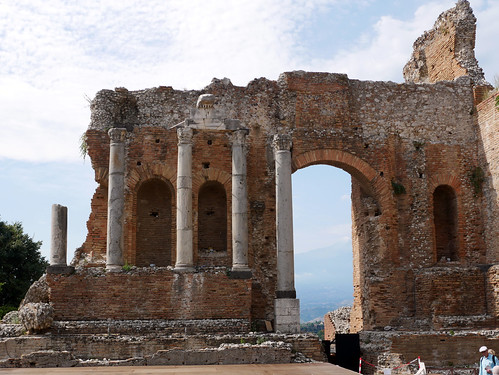
The construction of the amphitheater starts probably by the Greeks around the third century. BC, at the time of Hiero II.
To allow the construction was necessary to remove manually from the mountain over 100,000 cubic meters of rock.
The plant was later renovated and expanded by the Romans, who inserted columns, statues and ingenious covers.
The Greek theatre of Taormina, who was born to accommodate dramatic performances or musical, it was transformed during the Roman times to make room for games and gladiatorial battles. This involved the expansion of the orchestra, which in Greek times was destined to the musicians, in order to be adapted to the new function arena.
The theater is divided into several parts:
The scene
The scene is the most important part that remains of the theater and preserves, in part, its original form. But nothing remains of his ornaments and columns. According to many scholars, the first order was made up of nine columns arranged in groups of three, while the second was formed by sixteen columns lowest equidistant. It is said that these columns arrived by sea to Villagonia, were then attached with ropes and pulled by hordes of slaves to the Theatre. During the Middle Ages most of these columns were removed to build palaces and embellish places of worship, including the Cathedral. The scene is obviously where the actors used to perform.
The orchestra
The orchestra of the theatre was the area was for the musicians, but the choruses and dancers also performed there. In roman age it was trasformed in arena for the games of the gladiators.
The cavea
The cavea is all carved into the rock and could hold up to 5,400 spectators. The steps were separated into two parts; in one sitting spectators, who could also make use of the pillow; in the other half, slightly hollowed, rested his feet that sat on the top step. The first places were definitely reserved to the authorities. Even today, the auditorium is divided into nine sections cuneiform, served eight ladders.
The portici
Behind the wall of the upper closure of the cavea, to increase the number of places, were built brick two large porches that accompanied the whole development of the cavea. The vaults of the arcades supported a terrace each. The first porch supported the lower terrace, divided into several rows of wooden seats reserved for women, while the arc of the second porch, which claimed the highest terrace of the theater, without fixed seats, housed the most humble people.
Access stairs
The scale step makes three turns and narrowed as it rose. In the three carried out there were three doors that introduced the auditorium: the first gave the possibility of entry to the authorities and to the important people, the other spectators had to continue to go up in order to enter the auditorium.

6 Comments CherryPie on Nov 16th 2019
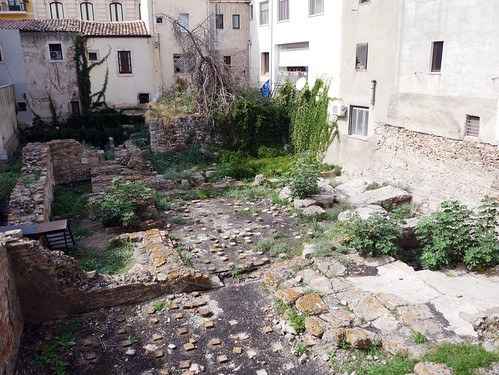
Probably, already in the advanced 1st century AD, this side of the forum seems to have already been occupied by the bath-building, which was enlarged in the 2nd century AD, superimposing and obliterating the Hellenistic public building. Excavations carried out in 1964-1966, and later in 1988 found a row of three heated rooms (calidaria) dated from Antanini era (2nd century AD). the ground plan of the baths does not appear to follow the canonical axial type. It has been assumed , that the tepidarium was also formed by three rooms in a row on the opposite side (north), now incorporated in the houses of Via della Zecca, which can approximately give the overall dimensions of the bath-building as about 38 x 27m. These considerable dimensions as well as the marble crustae of paretial coverings and the mosaic ceilings testify the public character of the baths. *

*from a sign board next to the baths.
8 Comments CherryPie on Nov 14th 2019
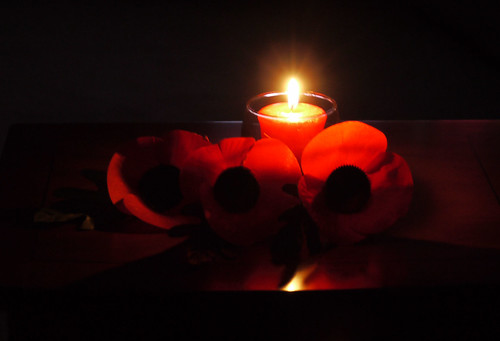
In Flanders Fields the poppies blow
Between the crosses row on row,
That mark our place; and in the sky
The larks, still bravely singing, fly
Scarce heard amid the guns below.
We are the Dead. Short days ago
We lived, felt dawn, saw sunset glow,
Loved and were loved, and now we lie
In Flanders fields.
Take up our quarrel with the foe:
To you from failing hands we throw
The torch; be yours to hold it high.
If ye break faith with us who die
We shall not sleep, though poppies grow
In Flanders fields.
Lieutenant Colonel John McCrae
1915
6 Comments CherryPie on Nov 11th 2019