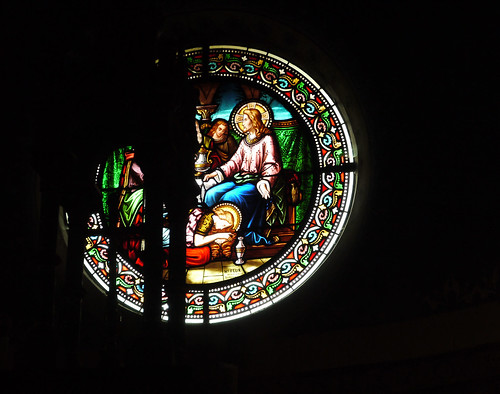
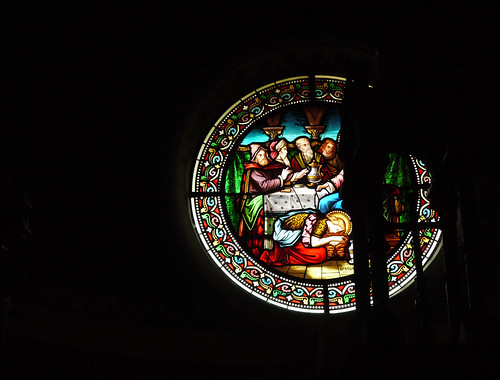
…whilst a lady with an alabaster jar washes his feet.
Random thoughts and photos of my journey through life…
…whilst a lady with an alabaster jar washes his feet.
8 Comments CherryPie on Jul 27th 2012
We are now going to go on a little detour from my French travels and Rennes-le-Chateau to a place more local to me, but which has a connection to yesterday’s post.
I mentioned that Sauniere had requested a copy of a painting from the Louvre. This is what the Cadogan Guide has to say about the painting:
Interest in the Razes began in the 17th century, after a humble shepherd found a gold treasure in the area, but never revealed exactly where; there is some evidence that artist Nicholas Poussin used landmarks of the region (including the hill of Rennes-le-Chateau) in the background of his enigmatic painting Et in Arcadia Ego (1638-40), generally understood to mean death is present, even in idyllic Arcadia. Or some say it is a rather juicier anagram: ‘l Tego Arcana Dei’ (‘Begone! I hide the Secrets of God!’).
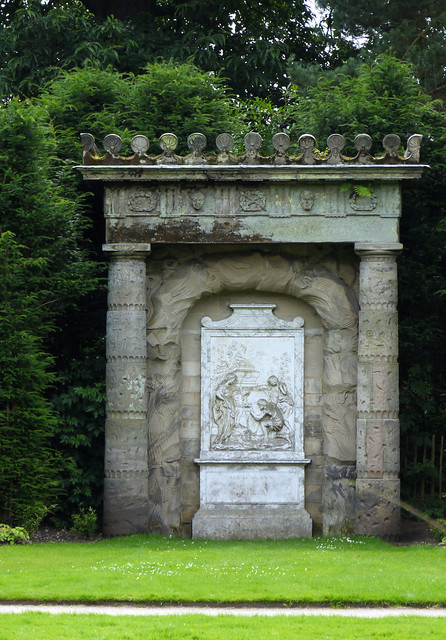
At Shugborough Hall in Staffordshire there is a monument called ‘The Shepherd’s Monument’ that is based on the original painting:
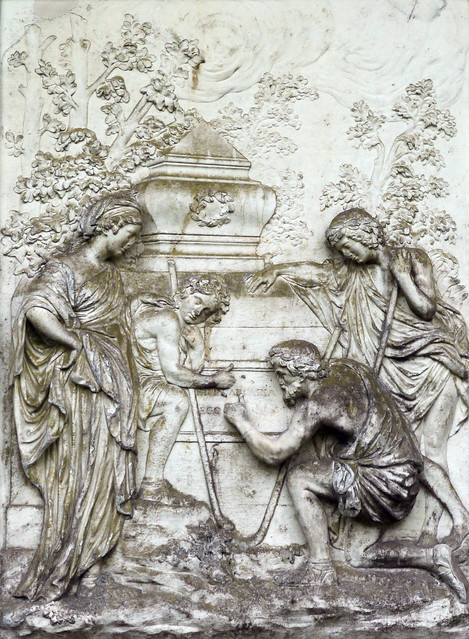
The Shepherd’s Monument has long posed an enigma as people have tried and failed to crack the mysterious code which sits beneath the sculpted relief. The code reads:
O. U. O. S. V. A. V. V.
D. M.
Many have drawn on the family’s associations with free-thinking groups and societies at the time of the monument’s building and some repute it to lead to the Holy Grail.
The sculpted relief is based on the 1642 painting Et in Arcadia Ego by Nicolas Poussin – a work which in itself has attracted much speculation. The Shugborough relief is a reversal of the original depiction with several key – and some would say deliberate – changes. The work was carried out by Peter Scheemakers and designed by Thomas Wright.*
18 Comments CherryPie on Jul 25th 2012
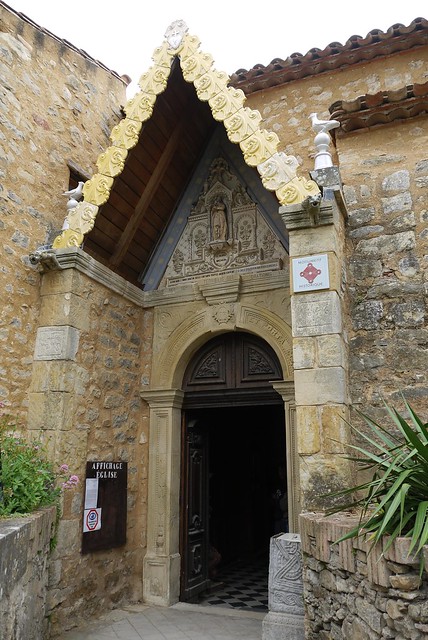
When Berengier Saunier was appointed priest of Rennes-le-Chateau the village and church were in a state of disrepair.
The tourist leaflet has the following to say about this little church of Dan Brown’s, Da Vinci Code fame:
In 1885 an unusual young priest arrived in the village, Berenger Sauniere. Over the next few years he created a magnificent estate, today known as Sauniere’s Domain, comprising the Villa Bethany, the Magdala Tower and a glazed orangery set in formal gardens. He also renovated the modest church of St Mary Magdalene in a highly original fashion. How was he able to afford such a lavish construction programme? The enigmatic priest lived the high life and spent a fortune. It was rumoured that he had found a treasure…
In the 1960s, treasure hunters began trying to uncover the secret of Father Sauniere. Books were published (today running into the hundreds) and excavations launched. The decoration of the church attracted particular interest, with some considering it to carry a coded message… The treasure hunters next turned their attention to Sauniere’s Domain, on the look-out for the tiniest clue…
Did Father Sauniere leave behind him a set of hidden signs leading to a fabulous treasure? The mystery remains to be solved.
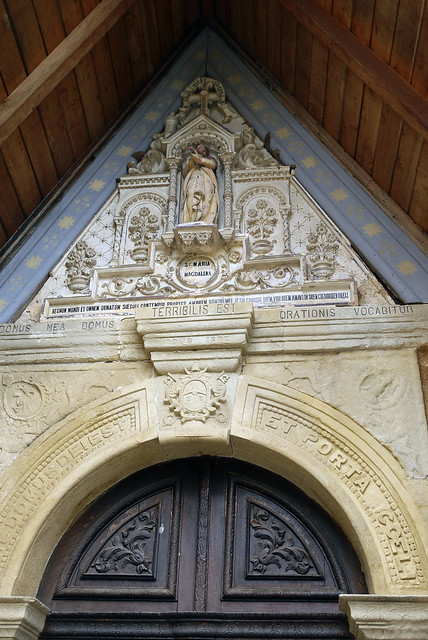
It is reputed that on his arrival Berenger Sauniere discovered a parchment in a glass phial and soon after that Sauniere was discovered digging in the local cemetery:
During the repairs in 1891, Sauniere supposedly found, somewhere in or around a pillar carved with Visigothic ‘Cross of Silence’, a parchement in a glass phial. Not long after, Sauniere was spotted digging futively in the local cemetery. One of his activities was the systematic defacement of the inscription on the tomb of the last Lady of Rennes-le-Chateau, Hautpoul de Blanchefort (d. 1781), not knowing that someone had already copied it out in the early 1820s (it had Greek letters reading ‘Et in Arcadia ego‘). Hautpoul, who died without heirs, had in her last hours of life confided some great secret to the parish priest, who left the enigmatic epitaph on her tomb.
After his nocturnal digs, Sauniere asked the Louvre for a copy of Poussin’s painting, then began spending money like nobody’s business (an estimated 2.5 million euro) paving the road up to Rennes, and redoing the church, dedicated (naturally) to Mary Magdalene, in a style the French have labelled ‘St-Sulpicien’ after the garish church in Paris.
Over the door he wrote Terribillis est locus iste (‘This is a terrible – or awesome – place’) – along with, around the arches below the rest of the inscription, hic domus Dei est et porta coeli (‘This is God’s house and the gate of heaven’), all part of the traditional entrance antiphon for the dedication of a church, and not a secret message.*
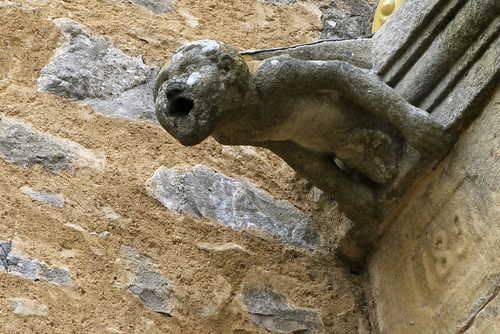
Sauniere’s activities eventually got him into trouble due to the unorthodox demonic figure that supports the font. Despite the statue’s appearance the figure is not Satan, the figure represents Asmodeus the guardian of the treasure of Solomon. Sauniere was eventually suspended from the priesthood due to his unwillingness to account for the source of his money…
There are many websites dedicated to the mysteries, so if you are curious a quick search in Google will inundate you with information.
*Quoted from the Languedoc-Ruossillon Cadogan guide.
16 Comments CherryPie on Jul 24th 2012
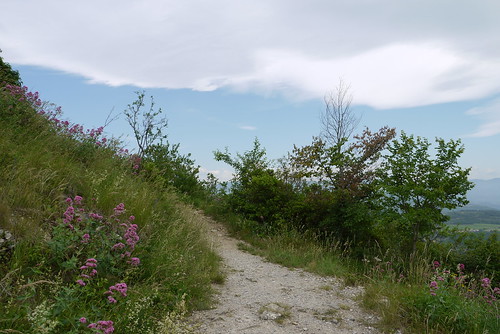

This pathway runs past the Magdala Tower that is shown in my post yesterday.
6 Comments CherryPie on Jul 24th 2012

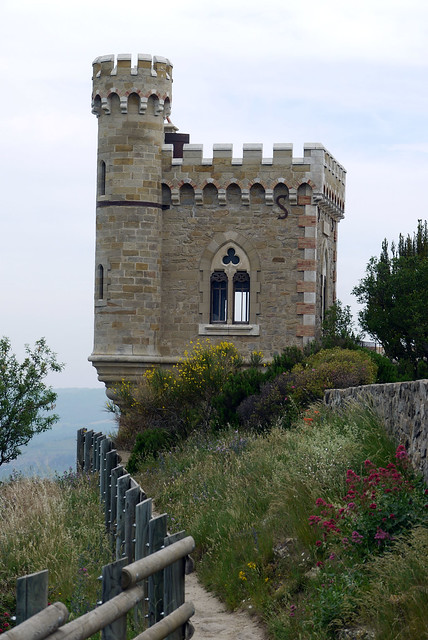
14 Comments CherryPie on Jul 23rd 2012
Be careful of your moods and feelings, for there is an unbroken connection between your feelings and your visible world.
Neville Goddard (1905 – 1972)

16 Comments CherryPie on Jul 22nd 2012