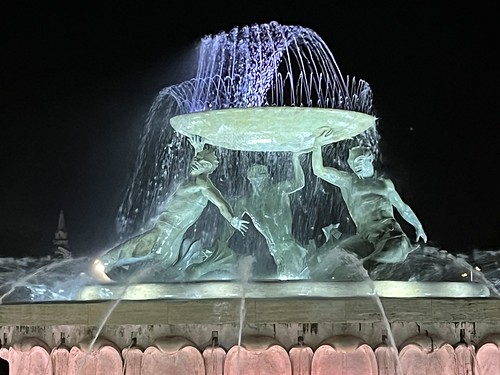
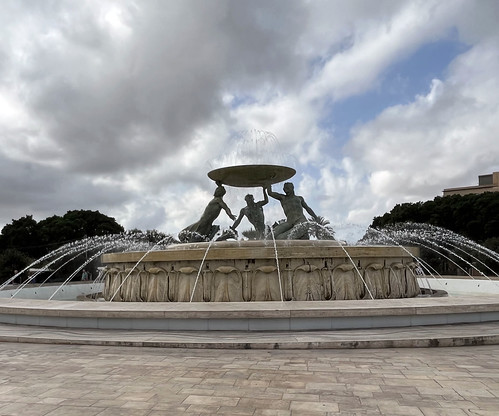
The fountain consists of three bronze figures of mythological Tritons holding up a platter. Two of the Tritons are sitting, while the third one is kneeling, and they are balanced on a seaweed base. The face of each Triton is visible when viewed from City Gate. Their posture gives a sense of strength as well as spiral movement, which contribute to the monumentality of the fountain. The water jets were also designed in order to convey the sense of movement.[4] The figures of the Tritons represent Malta’s links with the sea, and their design was inspired by the Fontana delle Tartarughe in Rome.[5] After the fountain’s platter was damaged in the 1980s, a bronze pillar depicting a flight of seagulls was added to the fountain to support its weight.[4] This was not included once the restoration was completed in 2018.[6]

Tags: City Gate, Fountain, Malta, Triton's Fountain, Vacation, Valletta
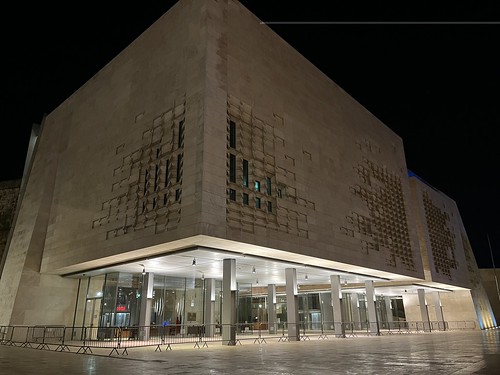
The Parliament House (Maltese: Dar il-Parlament) is the meeting place of the Parliament of Malta located in Valletta, Malta. The building was constructed between 2011 and 2015 to designs by Renzo Piano as part of the City Gate Project, which also included building a new City Gate and converting the ruins of the Royal Opera House into an open-air theatre. Construction of the Parliament House generated considerable controversy, mainly due to the modern design of the building and the cost of construction, which amounted to around €90 million.
From 1921 to 1976, the meeting place of the Parliament of Malta had been the Tapestry Chamber of the Grandmaster’s Palace, also in Valletta. In 1976, the former armoury of the same palace was converted into a new parliament, and meetings were held there until the opening of the purpose-built Parliament House on 4 May 2015.

Tags: Malta, Parliament House, Vacation, Valletta
Utopia lies at the horizon. When I draw nearer by two steps, it retreats two steps. If I proceed ten steps forward, it swiftly slips ten steps ahead.
No matter how far I go, I can never reach it. What, then, is the purpose of utopia? It is to cause us to advance.
Eduardi Gughes Galeano
Tags: Cherie's Place Thought, Hagar Qim, Malta, Vacation
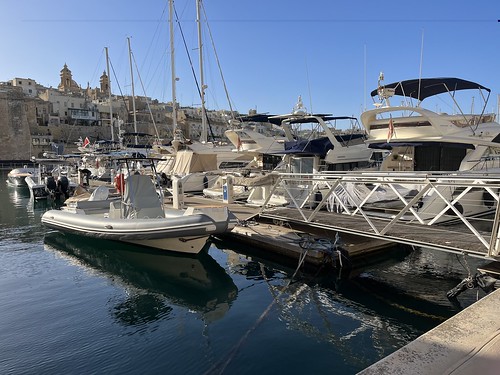
Birgu is also known by its title Città Vittoriosa (“Victorious City“).
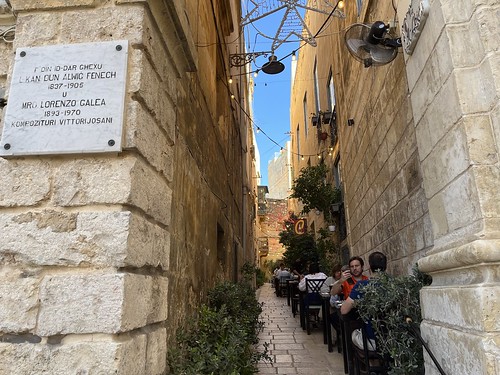
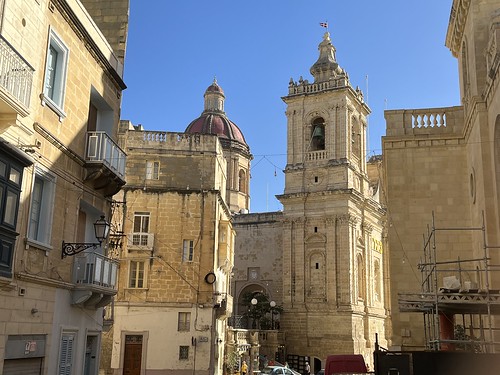
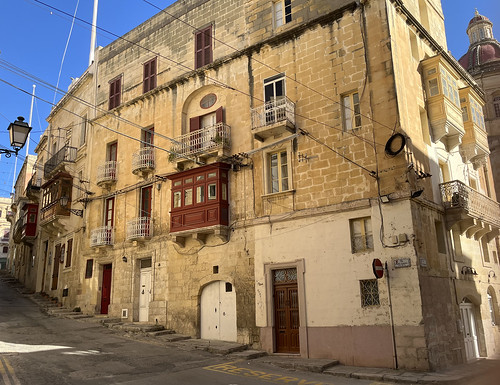
[Birgu] is an old fortified city on the south side of the Grand Harbour in the South Eastern Region of Malta. The city occupies a promontory of land with Fort Saint Angelo at its head and the city of Cospicua at its base. Birgu is ideally situated for safe anchorage, and over time it has developed a very long history with maritime, mercantile and military activities.
Birgu is a very old locality with its origins reaching back to medieval times. Prior to the establishment of Valletta as capital and main city of Malta, military powers that wanted to rule the Maltese islands would need to obtain control of Birgu due to its significant position in the Grand Harbour. In fact, it served as the base of the Order of Saint John and de facto capital city of Malta from 1530 to 1571. Birgu is well known for its vital role in the Great Siege of Malta of 1565.
Tags: Birgu, Grand Harbour, Malta, Vacation, Vittoriosa
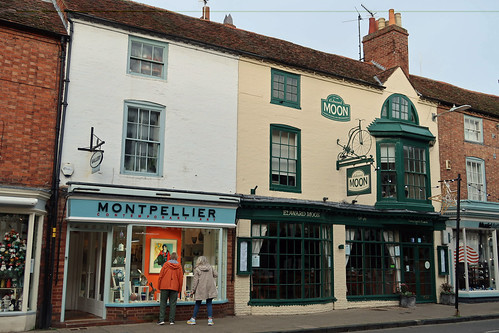
We are all booked up for a mini adventure for Valentines Day. The mini break includes a very belated 2022 Christmas gift from me to Mr C. At long last there is a RSC performance that captures his imagination.
Midsummer Night’s Dream and Edward Moon here we come…
Tags: Edward Moon, Edward Moon Brasserie, Stratford-upon-Avon, Vacation, Valentine's Break, Valentine's day, Warwickshire
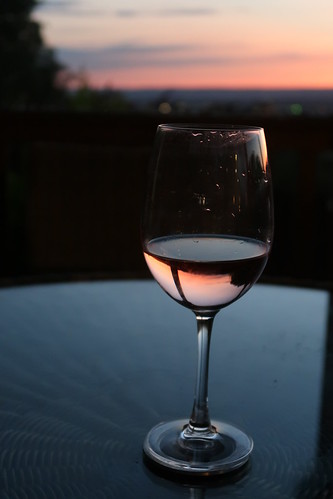
I raise my glass to you
I wish you, your family and friends a Happy,
healthy and peaceful 2024
Tags: 2024, Gloucester, Gloucestershire, Happy New Year, Hatton Court, Vacation