Shrieve's House

Shrieve’s House currently houses the Tudor World Museum. The museum shows historical settings to display the life and time of Tudors.*

The Shrieve’s House and Barn The oldest lived-in house in Stratford (First recorded building on this site is 1196) An inn during the 16th century run by William Rogers who it is said was the inspiration for Shakespeare’s much-loved character of Falstaff. Residence of John Woolmer in the 17th century, the first mayor of Stratford. Residence of Edward Gibbs in the 19th century who was responsible for renovating the Swan and Maidenhead in Henley Street into the Shakespeare Birthplace, who was known as The ‘Shakespeare’ Architect. Also documented as The most haunted building in England.**

Shrieve's House

Shrieve's House

Shrieve's House

Shrieve's House

Shrieve's House

16 Comments CherryPie on Jan 19th 2023

Holy Trinity Church

From Wiki:

William Shakespeare, poet and playwright, was baptised in Holy Trinity on 26 April 1564 and was buried there on 25 April 1616.[17] The church still possesses the original Elizabethan register giving details of his baptism and burial, though it is kept by the Shakespeare Birthplace Trust for safekeeping. He is buried in the beautiful 15th-century chancel built by Thomas Balsall, Dean of the Collegiate Church, who was buried within it in 1491. Shakespeare was eligible to be buried in the chancel owing to his position as a “lay rector” of the church; as Peter Ackroyd explains, this was due to his leasing of tithes from the church. This entitlement was taken either at his behest or on his behalf.[18] Shakespeare’s funerary monument is fixed on a wall alongside his burial place. The funerary monument was renovated in 1746 through proceeds from a production of Othello, the first recorded performance of a Shakespeare play in Stratford-upon-Avon.[19]

Shakespeare would have come to Holy Trinity every week when he was in town, i.e. throughout his childhood and on his return to live at New Place. His wife Anne Hathaway is buried next to him, along with his eldest daughter Susanna. The day after Shakespeare signed his Last Will and Testament on 25 March 1616 in a “shaky hand”, William’s son-in-law, Thomas Quiney was found guilty in the church court of fathering an illegitimate son, who had recently died in childbirth, by a Margaret Wheler. Quiney was ordered to do public penance within the church. Within a month Shakespeare was dead, his funeral and burial being held at Holy Trinity on 25 April 1616.

Above the grave, a badly eroded stone slab displays his epitaph:

Good frend for Iesvs sake forbeare,
to digg the dvst encloased heare.
Bleste be ye man yt spares thes stones,
and cvrst be he yt moves my bones.

It has been claimed by at least one textbook author that the warning has served to prevent both the removal of Shakespeare’s body to Westminster Abbey and the exhumation of his body for examination.[20]

The grave of Shakespeare’s wife Anne is next to her husband’s. The inscription states, “Heere lyeth interred the body of Anne wife of William Shakespeare who dep[ar]ted this life the 6th day of Avgv[st] 1623 being of the age of 67 yeares”. A Latin inscription followed which translates as “Breasts, O mother, milk and life thou didst give. Woe is me – for how great a boon shall I give stones? How much rather would I pray that the good angel should move the stone so that, like Christ’s body, thine image might come forth! But my prayers are unavailing. Come quickly, Christ, that my mother, though shut within this tomb may rise again and reach the stars.”[21] The inscription may have been written by John Hall on behalf of his wife, Anne’s daughter, Susanna.[22]

Shakespeare Memorial

Shakespeare's Grave

Shakespeare's Grave

Holy Trinity Church

Chained Bible

10 Comments CherryPie on Jan 17th 2023

The Royal Shakespeare Theatre

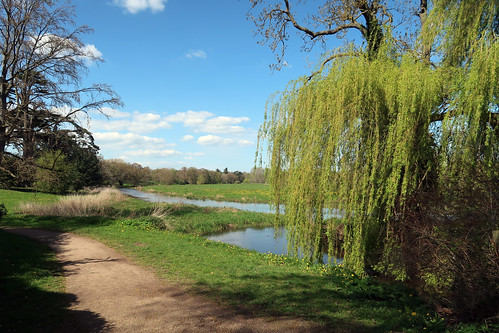
The route of our river walk can be found on the following link:

Stratford-upon-Avon walks leaflet

We walked all of the route although not from A to B because we ventured into town for lunch before returning to the route.

Stratford-upon-Avon

The Stratford Canal

The River Avon

Near Holy Trinity Church

Holy Trinity Church

Holy Trinity Church

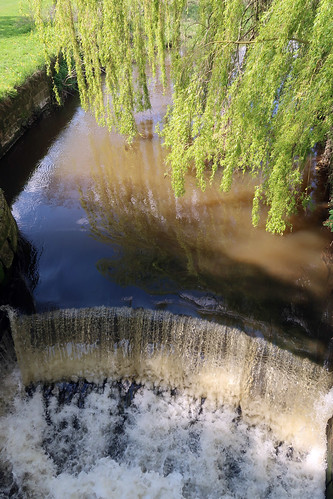
Lock Gates

Holy Trinity Church

7 Comments CherryPie on Jan 16th 2023

Iguanas Poo Here!

Have fun spotting our resident iguanas! Prudence & Bennie are green iguanas, originating from South America. Prudence was donated to the Butterfly Farm about 8 years ago, and Bennie was donated in 2020. They like to hide up in the trees and bask in the warmth on top of the heaters where they like to keep a watchful eye on the goings on below! Be cautious of droppings if you are walking underneath them! They are magnificent creatures and excellent swimmers and love to fed on leaves, flowers and fruit.

Prucence

Bennie

Bennie decided to come down from his high perch and pose for the visitors. Isn’t he gorgeous!

Bennie

Bennie

Bennie

16 Comments CherryPie on Jan 10th 2023

Butterfly Farm

Over 30 years ago Clive Farrell had a dream to create an attraction that would introduce visitors to the wonderment of butterflies. This dream became a reality in July 1985 when Stratford-upon-Avon Butterfly Farm opened its gates to the public.

The Stratford Butterfly Farm has been welcoming visitors to its tropical butterfly paradise for over three decades. The idea and setting up of the Butterfly Farm was the passion and dream of internationally renowned lepidopterist, Clive Farrell. The farm was officially opened on 24th July 1985 by botanist and naturalist, David Bellamy OBE.

Clive’s fascination with butterflies and nature began when he was five years old after finding a hairy caterpillar in his garden. He put it in a matchbox where it spun a cocoon and he watched it emerge as a beautiful Tiger Moth. It was a magical moment that has stayed with him. It is Clive’s hope that a visit to the Butterfly Farm will create such memorable moments for other generations to experience and be inspired by.

Behind the scenes an industrious team works tirelessly not only to bring pupae to Stratford Butterfly Farm but also to export and supply butterfly houses across the globe! To be able to do this we import from a variety of international butterfly farms, providing a sustainable income for the local community and conservation projects.

In 1991, following on from the successful launch of the Stratford Butterfly Farm, Clive joined forces with Ray Harbard to create the Fallen Stones Butterfly Farm in Belize.

The Belize butterfly farm is operated as a nature reserve that sustains local employment without having a negative impact on the local environment. The farm is treasured by the local Kekchi Maya villagers not just for the nature conservation benefits but for the considerable positive impact on the local community where so many young people would otherwise be out of work.

It has a highly successful breeding programme and supplies butterfly houses across the world. These Belizean butterflies can be seen as messengers from the fast dwindling rainforest, to you the visitor. They are infinitely precious and by protecting their natural habitat we protect all the other animals that live there, from jaguars to leaf cutter ants and everything in between!

Many of the beautiful butterflies that can be seen at Stratford Butterfly Farm are supplied by the Fallen Stones Butterfly Farm in the Maya Mountains of Belize. On its doorstep is the ancient Maya site of Lubaantun, which translates to ‘place of the fallen stones’, which is where the farm gets its name from. The people that work at the Fallen Stones Butterfly Farm are present-day Maya and this is the area where the ancient Maya once lived. It is the perfect environment for the types of plants that butterflies need to be able to feed and breed.

This fascinating connection between the Maya and Stratford Butterfly Farm has inspired us to exhibit throughout the farm, Maya and Mesoamerican replica sculptures and interpretation to inform our visitors of the amazing Maya civilisation and their culture.

Butterfly Farm

Butterfly Farm

Butterfly Farm

Butterfly Farm

Butterfly Farm

Butterfly Farm

Butterfly Farm

Butterfly Farm

Butterfly Farm

Butterfly Farm

Butterfly Farm

Butterfly Farm

Butterfly Farm

8 Comments CherryPie on Jan 10th 2023

Shakespeare's Birthplace

John Shakespeare – William’s father – lived and worked in the house known today as Shakespeare’s Birthplace. John married Mary Arden in about 1557 and William was born in 1564, the third of their eight children.

In 1568 John became the Mayor of Stratford, which was the highest elective office in the town. It was because of his father’s status as Mayor that William was privileged enough to have attended the local grammar school to begin his education.

In 1582, at the age of 18, William married Anne Hathaway. The young couple continued to live with his parents in the Birthplace. It is where their own children, Susanna, Judith and Hamnet were born.

John Shakespeare died in 1601 and being the eldest surviving son, William inherited the house. William leased the small, two-room cottage adjoining the main house to his sister, Joan Hart. The remainder of the family home was also leased and became an inn, called the Maidenhead. It was later renamed the Swan and Maidenhead Inn, which remain in operation until 1847. When Shakespeare died in 1616 he left the property to his elder daughter Susanna, and when she died she left it to her only child, Elizabeth.

Although she married twice, Elizabeth had no children. When she died in 1670 the house passed to a descendant of Joan Hart. The Hart family owned the property until 1806 when it was sold to Thomas Court, a butcher. The whole property was put up for sale in 1846, following the death of Court’s widow.

Shakespeare's Birthplace

Shakespeare's Birthplace

Shakespeare's Birthplace

Shakespeare's Birthplace

Shakespeare's Birthplace

11 Comments CherryPie on Jan 7th 2023

The Guild Chapel

Parts of the Guild Chapel may date back to 1269 when the Guild of the Holy Cross was given permission to build a hospital and chapel. The chancel was rebuilt in the 1450s and the nave, porch and west tower were reconstructed in the 1490s This later work was funded by Hugh Clopton (died 1496), a Stratford-born man who had prospered in London as a mercer – a dealer in textiles – and who served as Lord Mayor there in 1491. The interior was decorated with wall paintings, substantial parts of which survive.*

The Guild Chapel

The Guild Chapel

The Guild Chapel

The Guild Chapel

In the late 15th and early 16th centuries the walls were painted with a series of striking images. These all depicted the saints, the gates of heaven and hell, and other popular reflections on the afterlife. Following the Reformation, these images were banned, Elizabeth I passing Royal Injunction in 1559 demanding “removal of all signs of superstition and idolatry from places of worship”.

In Stratford, that Royal injunction was received by the Corporation of Stratford and John Shakespeare, father of the playwright, who was Chamberlain of the Corporation. Surviving council records show that in 1563 John Shakespeare authorised payment of 2s for ‘defasyng ymages in ye chappell’. Whether they were all covered at that time or at a later date is unknown. William Shakespeare was born in 1564 and it is quite possible the paintings, or some of them, were still visible during his lifetime. Speculation also surrounds John Shakespeare’s willingness to follow the orders he was given, with scholars long debating whether John and his family followed the Catholic faith the Reformation was out to suppress. What we do know is that rather than the paintings being defaced, they were largely limewashed over instead (only the face of the Archangel Michael in the Allegory of Death painting can be seen to have been clearly ‘defaced’ – literally scratched away). This limewashing actually served to protect the paintings, many of them in very fine detail.**

The Guild Chapel

10 Comments CherryPie on Jan 4th 2023

« Newer Posts - Older Posts »