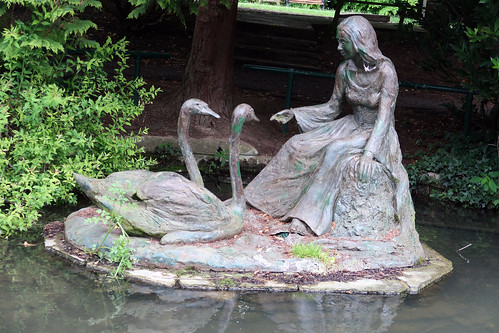
The island’s name dates from when the Ray family managed a flour mill here. Boulter’s weir is situated at one end of the small island.




The weir is the latest in a series built here over the last 600 years. Early weirs were solid banks of interwoven stakes filled with stones built across the river. No-one is sure who built these firs weirs bur millers, fishermen and boatmen all had reason to do so. Millers such as the Rays, needed to keep a head of water to power their mills. Weirs intercepted fish and allowed local fishermen to sieve them out in large quantities. The deeper water created by the weirs let boats through reaches previously to shallow. Early weirs were often multi-purpose; head water was supplied for the mill, fish nets were sometimes lowered into the weir in place of sluice gates, and boats could ‘flash’ through a central section which could be opened. A winch was sited at the head of the island to haul boats up through the weir.*


*information from signboard next to the weir
Tags: Boulter's Weir, Egyptian Goose, Maidenhead, Mandarin Duck, Ray Mill Island, Squirrel, Vacation, Windsor
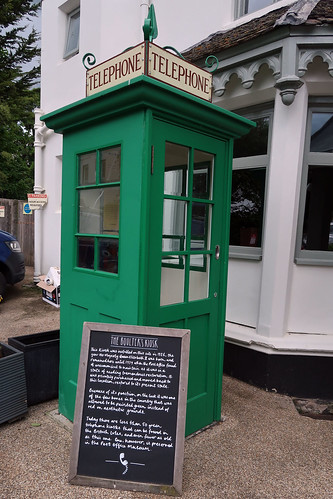
Situated near to Boulter’s Lock and the nearby Ray Mill Island is the Boulter’s telephone Kiosk.
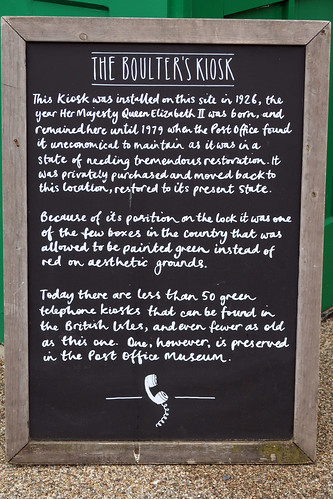
This kiosk was installed on this site in 1926, the year Her Majesty Queen Elisabeth II was born, and remained here until 1979 when the Post Office found it uneconomical to maintain as it was in a state of needing tremendous restoration. It was privately purchased and moved back to this location, restored to its present state.
Because of its position on the lock it was one of the few boxes in the country that was allowed to be painted green instead of red on aesthetic grounds.
Today there are less than 50 green telephone kiosks that can be found in the British Isles, and even fewer as old as this one. One, however, is preserved in the Post Office Museum.
Tags: Boulter's Lock, Rare, Telephone Box, Vacation, Windsor
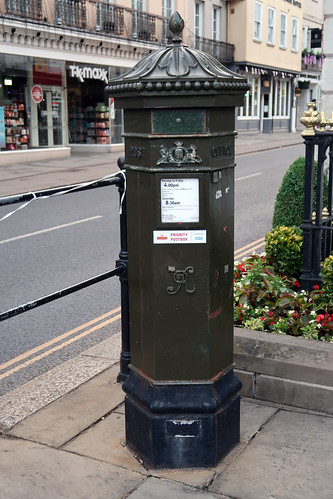
Located on Windsor High Street next to the Guild Hall is a green hexagonal Penfold post box.
This broke the standard pattern and so in 1866 the Post Office again produced a standard letter box. This time the box was designed by J W Penfold and came in three sizes. Problems were encountered with some of the early designs however and modifications were made, such as the inclusion of downward-pointing shoots to help prevent letters being caught up in the cap of the box. The ‘Penfold’ letter box while not particularly a success operationally was very popular with many people.
As a standard box however it was not to survive. In 1879 a further standard box was produced. This time more of the earlier lessons were taken on board. The new standard box at last resembled the letter box that is today the iconic image of Britain – cylindrical with round cap and horizontal aperture under a protruding cap with front opening door and black painted base.
The Postal Museum Website explains how the Pillar Boxes went from red to green and back again.
Tags: Green, Penfold, Pillar Box, Post Box, Vacation, Windsor

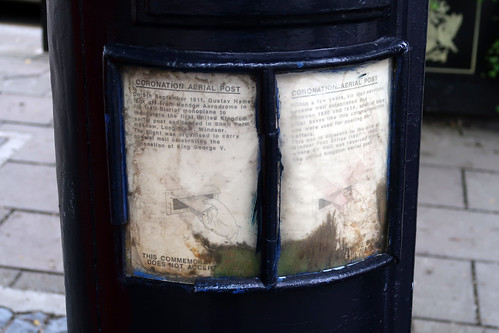
Near to Windsor castle, situated next to a more usual red pillar box is a blue George V pillar box. The blue pillar box displays the history of ’special’ blue pillar boxes:
On 9th September 1911, Gustav Hamel took of from Hendon Aerodrome to inaugurate the first United Kingdom aerial post and landed in Shaw Farm meadow, Long Walk, Windsor.
The flight was organised to carry special mail celebrating the coronation of King George V.
Within a few years, Air mail services became well established and between 1930 and 1938, special blue pillar boxes were used for posting Air Letters.
This box is adjacent to the site of Windsor Post Office (1887 – 1966) where Air Mail was received from the United Kingdom aerial post.
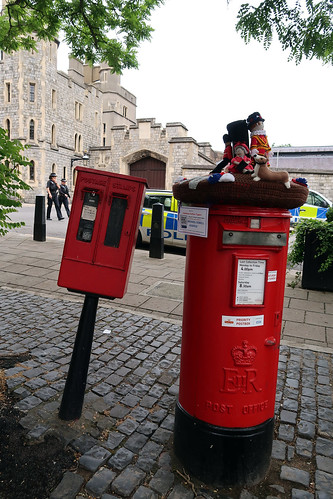
Next to the two pillar boxes is a historic stamp vending machine.

Tags: Airmail, Berkshire, Letters, Pillar Box, Post Box, Postbox, Stamps, Vacation, Windsor

I only had time for a quick walk without the opportunity to stop and take photos along the way. I took a couple of photos towards the end of my walk.

Over the month I walked 346,227 steps (139.51 miles).
Tags: #walk1000miles, #walk1000miles2022, Civil Service Walking Challenge 2022, Shropshire, The Silkin Way
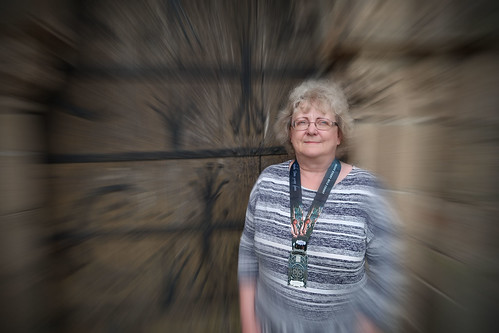
Tolkien’s inspiration for Durin’s Door was a little too far away for a Saturday afternoon excursion so I looked for inspiration in ‘The Churches of Shropshire & Their Treasures’ to find inspiration for suitable doorways that were fitting for the presentation of my medals for completing ‘The Fellowship’ and ‘Mines of Moria’ challenges.

Within the books pages I found St Mary’s Church, Edstaston which has Norman doorways that could quite easily have inspired the doorways to and within the Mines of Moria. The doors shown here are original and feature fine Norman iron-work.

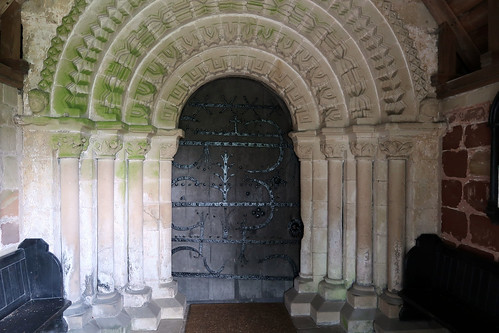


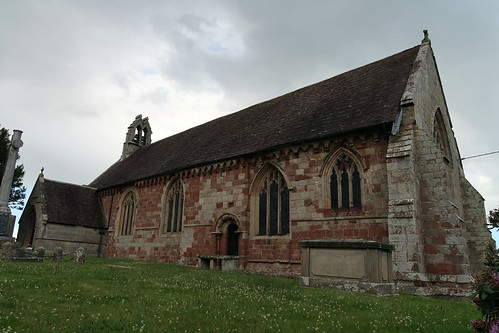


Unfortunately the church was not open so I was unable to go inside and share the treasures within.
Tags: #walk1000miles, #walk1000miles2022, Conqueror Challenges, Estaston, LOTR Virtual Challenge, Me by another, Portrait, Shropshire, St Mary's Church, Wem