Random thoughts and photos of my journey through life…
The garden of love is green without limit and yields many fruits other than sorrow or joy. Love is beyond either condition: without spring, without autumn, it is always fresh.
Rumi

4 Comments CherryPie on Oct 6th 2019

Filed under Faith Foundations, Heritage, Holidays, Sherborne 2019

In 1821 Mr William Dingley arrived in Sherborne from Launceston Cornwall.
He began worshipping in the Congregational Church in Long Street, but finding it too full and difficult to obtain a seat he decided to erect his own Wesleyan Chapel.So in 1824 he purchased land and a large outhouse in Cheap Street and converted it into a chapel which seated 200 people.
He laid the foundations of the present Methodist Church on the 23rd June 1841 and it opened in 1842 to a final cost of £3490.The architecture is in the Gothic style, and remains much as originally built. Galleries were added inside in 1862 owing to an increase in congregation. At the West end a polygonal apse was added in 1884. Three shops on the Cheap Street frontage were demolished in 1851 and two new ones erected, leaving a pathway from the main street to the front entrance for the first time.
Near the entrance gates is a family-sized shoe scraper, complete with hand hold, now hidden by dense foliage, but if you peer behind the branches you can still find its twisted iron form as sturdy as ever.
The walls of the burial ground to the rear (Hospital Lane/Abbey Road access) have beautiful carved numbers to indicate grave spaces.
In 1986 the original Sunday School was sold to Sherborne School and is now known as the Powell Theatre. In an interesting theatrical link, the noted Victorian actor William Charles Macready and his family were among the congregation at the Methodist Church between 1850-1860, and he would no doubt approve of the theatrical endeavours of the Boys.


4 Comments CherryPie on Oct 5th 2019

The Conduit at the bottom of Sherborne’s South Street.
The hexagonal 16th-century structure originally stood in the north cloisters of the abbey, where it was used for washing by the monks.
It was moved to this site after Henry VIII’s Dissolution of the Monasteries in 1539


8 Comments CherryPie on Oct 4th 2019

The Public Weighbridge House dates from the 1700s and is a Grade II listed property located within the Sherborne Conservation Area. It stands to the south and in front of Sherborne Abbey adjacent to Half Moon Street. Here, despite the small size of the building, it provides an important visual element to this part of the Conservation Area where it forms an intrinsic part of the public open space to the front of the Abbey and the streetscene along Half Moon Street. The weighing mechanism dating from before 1850 remains within the structure, but the weighbridge itself was removed for road widening in 1950.

4 Comments CherryPie on Oct 3rd 2019

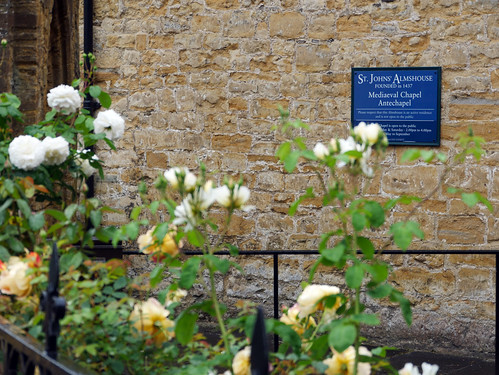
Originally built as St Johns’ Almshouse, the modern day St Johns’ House benefits from the unique surroundings of the original Almshouse buildings but residents now enjoy contemporary and comfortable accommodation in a relaxed and friendly environment. Applications are welcomed from all who wish to enjoy what life at St Johns’ has to offer, without many of the somewhat daunting constraints of the original Foundation Deed
The original Almshouse of S. John The Baptist and S. John The Evangelist is the best surviving example of a medieval Almshouse in Wessex. Its Foundation Deed is dated 10th January 1437 and provided for ‘Twelve pore feeble and ympotent old men and four old women’ to be cared for by a housewife whose duty was to ‘feeche in and dyght to the victaill wash wrying make beddys and al other things do’.
The Licence of King Henry VI to found the Almshouse is dated 11th July, 1437. The building was completed in 1448 and consisted of a Chapel (1442) and a hall with dormitories above. A fine doorway with niches and statues of the two Saints John provided the main entrance from Trendle Street.
Important to the street scene here are the Victorian iron posts and rails lining the kerb. Here the Almsmen would lean, smoke a pipe and chat to passers-by. The finials to the posts are a Bishop’s mitre, the badge of the Almshouse.
Through the Victorian gateway, noting the symbols of a lamb and flag for S. John the Baptist and an eagle for S.John the Evangelist, the present front door can be found tucked into a corner of the cloister. A brass plate declares ‘For the House’. Above the Chapel a bell rings to mark the various events in the life of this ancient community.
St Johns’ House and the original Almshouse buildings are governed, to this day, by the Master and Brethren who continue a body established in 1437.


6 Comments CherryPie on Oct 2nd 2019