10 Comments CherryPie on Nov 1st 2018
14 Comments CherryPie on Oct 31st 2018
18 Comments CherryPie on Oct 30th 2018
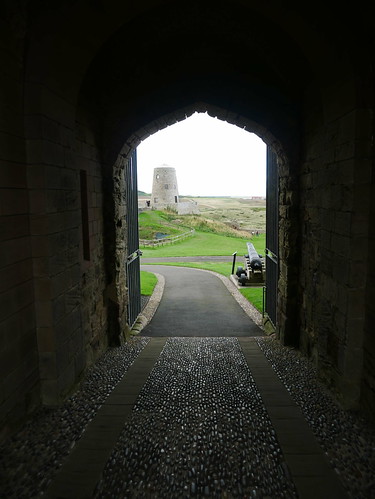
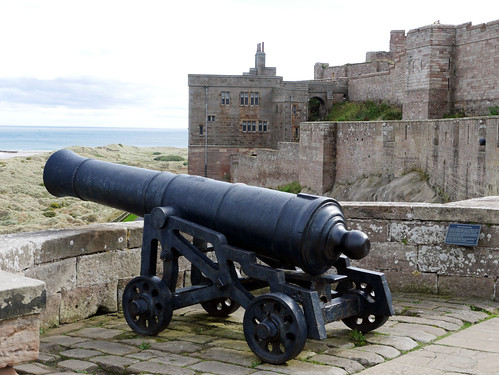
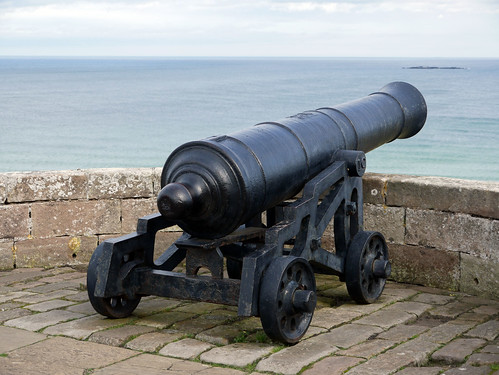
Dating from the late 1600s this gun was affectionately named the Armada Gun as it was believed to have come from the Spanish Armada vessel after the fleet was driven up the North Sea Coast. It was later confirmed as a Dutch trading vessel that was transporting cannons amongst a payload of other weapons. It was dated from 1660 and 1715 after the cannons and other artefacts were dated by experts.
The wreck was discovered to the east of Gun Rocks, part of the Farne Island group. It was so named because a ‘pile’ of cannons first found there in the 1700s. Archaeological work was carried out in the 1960s when sword hilts and a small brass cannon were recovered. It is believed that this cannon had been given to the castle by 1737.*
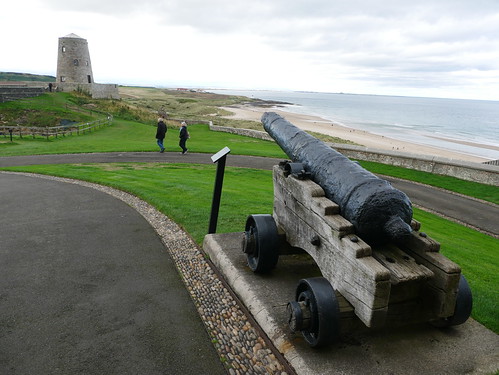
*From a signboard next to the cannon
15 Comments CherryPie on Oct 29th 2018
Time is given as a gift, and gifts should be received with gratitude.
Jonathan Bryan

Today, whilst reading a magazine I noticed an advert for a book; Eye Can Write, A memoir of a child’s silent soul emerging. A few hours later I picked up a booklet that has daily inspirational readings. For various reasons over the summer months I got out of the habit of reading it. I opened it up where I had left the bookmark some months ago and was surprised to see the inspirational reading was about Jonathan Bryan the author of the book! I quote the synopsis of Jonathon’s book below.
Can you imagine not being able to speak or communicate? The silence, the loneliness, the pain. But, inside you disappear to magical places, and even meet your best friend there. However, most of the time you remain imprisoned within the isolation. Waiting, longing, hoping. Until someone realises your potential and discovers your key, so your unlocking can begin. Now you are free, flying like a wild bird in the open sky. A voice for the voiceless.
Jonathan Bryan has severe cerebral palsy, a condition that makes him incapable of voluntary movement or speech. He was locked inside his own mind, aware of the outside world but unable to fully communicate with it until he found a way by using his eyes to laboriously choose individual letters, and through this make his thoughts known.
In Eye can Write, we read of his intense passion for life, his mischievous sense of fun, his hopes, his fears and what it’s like to be him. This is a powerful book from an incredible young writer whose writing ability defies age or physical disability – a truly inspirational figure.
You can find out more about this inspirational young man’s story on ‘Teach us Too‘ and Facebook.
The appearance of his story (randomly) twice in one day I consider to be one of what I call my ’strange coincidences’. A gift and a message? Jonathan’s story undoubtedly uplifted my spirits 
10 Comments CherryPie on Oct 28th 2018
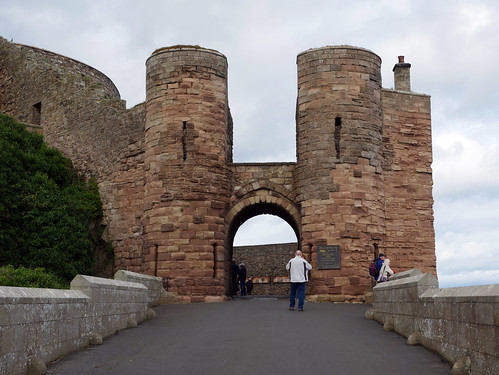
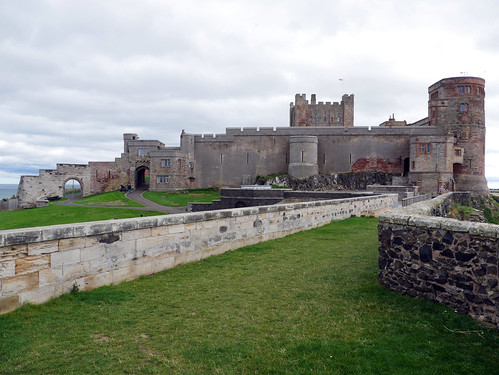
A brief history from the Bamburgh Castle website:
Spanning nine acres of land on its rocky plateau high above the Northumberland coastline Bamburgh is one of the largest inhabited castles in the country.
Bamburgh’s written history begins in the times of the Anglo-Saxons with one chronicler citing Bamburgh as probably the most important place in all of England. But even before this there were people living here, there is archaeological evidence that as early as 10,000 BC there were people here. There are Bronze Age (2,400 -700BC) burials nearby and pottery sherds dating to the Iron Age (700 BC – 43AD). With little evidence of their occupation only the name Din Guayrdi gives us a hint that Romans were sometime between 43AD and 410AD.
It was during the early medieval period between 411AD and 1066AD that Bamburgh grew in stature and importance. With the arrival of the Saxons, the creation of an important Christian site and the coming and going of the saints Oswald, Aidan and Cuthbert, it was a pivotal time. Following this period we saw the arrival of the Normans and the construction of our Great Tower, the culmination of the Wars of the Roses with the siege of 1464. The arrival of the Foster family, gifted the ruins by James 1 with the subsequent acquisition by Lord Crewe and the formation of the Crewe Trustees. A resurgence in stature as under the guidance of John Sharpe the castle became a leading surgery and dispensary for the poor and sick.
Finally the castle passed into the hands of the First Lord Armstrong, with the intention of creating a respite home he passed away before its restoration was complete and became the Armstrong family home. It is still owned by the Armstrong Family who opened it up to visitors in the mid 1900’s and remains to this day an icon of the North East of England.
8 Comments CherryPie on Oct 27th 2018
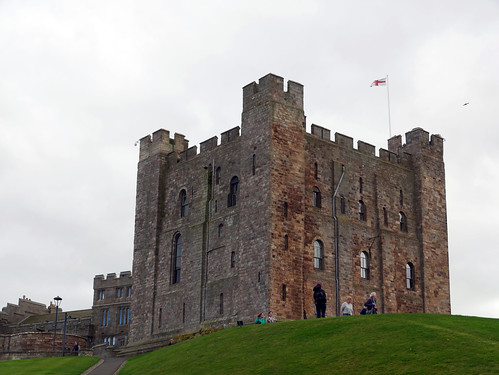
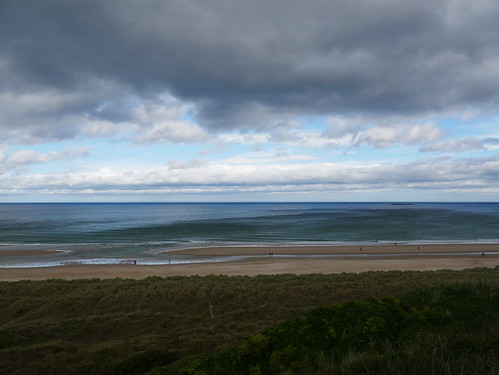
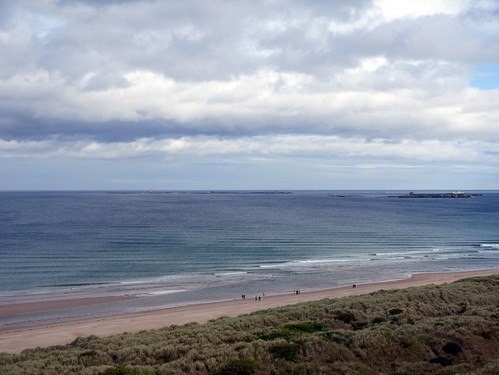
…as viewed from Bamburgh Castle
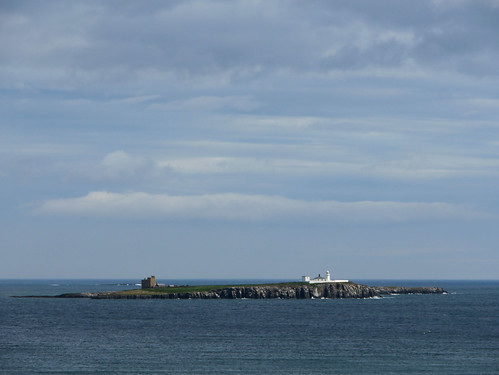
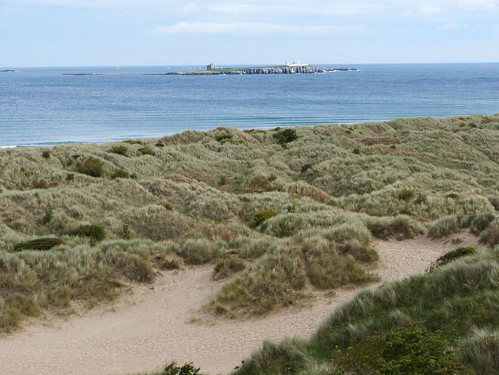
The Farne Islands are a group of islands off the coast of Northumberland, England. There are between 15 and 20 islands depending on the state of the tide.[1] They are scattered about 1 1⁄2 to 4 3⁄4 miles (2.4–7.6 km) from the mainland, divided into two groups, the Inner Group and the Outer Group. The main islands in the Inner Group are Inner Farne, Knoxes Reef and the East and West Wideopens (all joined together on very low tides) and (somewhat separated) the Megstone; the main islands in the Outer Group are Staple Island, the Brownsman, North and South Wamses, Big Harcar and the Longstone. The two groups are separated by Staple Sound. The highest point, on Inner Farne, is 62 feet (19 m) above mean sea level.
History:
Monks and hermits
The earliest recorded inhabitants of the Farne Islands were various Culdees, some connected with Lindisfarne. This followed the old Celtic Christian tradition of island hermitages, also found in Wales, Ireland and Scotland.
The islands are first recorded in 651, when they became home to Saint Aidan, followed by Saint Cuthbert.[2] Cuthbert isolated himself on the islands until he was called to the bishopric of Lindisfarne, but after two years he returned to the solitude of the Inner Farne and died there in 687, when Saint Aethelwold took up residence instead. Among other acts, Cuthbert introduced special laws in 676 protecting the eider ducks, and other seabirds nesting on the islands; these are thought to be the earliest bird protection laws anywhere in the world.[3][4]
The islands were used by hermits intermittently from the seventh century. These included Saint Bartholomew of Farne.[5] The last hermit was Thomas De Melsonby, who died on the islands in 1246.[2]
A formal monastic cell of Benedictine monks was established on the islands circa 1255. The cell was dependent on Durham Abbey, now Durham Cathedral. A very small cell, it was usually home to only two monks, although on occasion this rose to as many as six. The cell was dissolved in 1536 as part of King Henry VIII’s Dissolution of the Monasteries.[5]
Following the dissolution of the monastic cell on the islands, the islands became the property of the Dean and Chapter of Durham Cathedral, who leased them to various tenants. The islands remained a detached part of County Durham until 1844, when the Counties (Detached Parts) Act transferred them to Northumberland. In 1861 the islands were sold to Charles Thorp, who was at the time Archdeacon of Durham.[5] In 1894 the islands were bought by the industrialist William Armstrong, 1st Baron Armstrong.[2] The islands are currently owned by the National Trust.[5]
Remains still exist of the seventh-century anchorite cell used by Saint Aiden and Saint Cuthbert,[2] as do the remains of a fourteenth-century chapel associated with the cell. Known as St Cuthbert’s Chapel, the chapel is described as a “single-cell building of four bays”. The remains of a second chapel have been incorporated into a later building.[5]
Grace Darling
The Farne Islands are associated with the story of Grace Darling and the wreck of the Forfarshire. Grace Darling was the daughter of Longstone lighthouse-keeper (one of the islands’ lighthouses), William Darling, and on 7 September 1838, at the age of 22 years, she and her father rescued nine people from the wreck of the ‘Forfarshire’ in a strong gale and thick fog, the vessel having run aground on Harcar Rock. The story of the rescue attracted extraordinary attention throughout Britain and made Grace Darling a heroine who has gone down in British folklore.[6]
10 Comments CherryPie on Oct 25th 2018