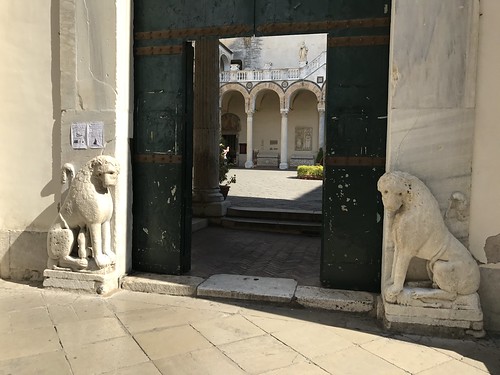
The Duomo (Cathedral) of Salerno is dedicated to St. Matthew the Evangelist and was founded at the request of Robert Guiscard in 1076, the year that the Normans conquered the town of Salerno after a 7 month siege.
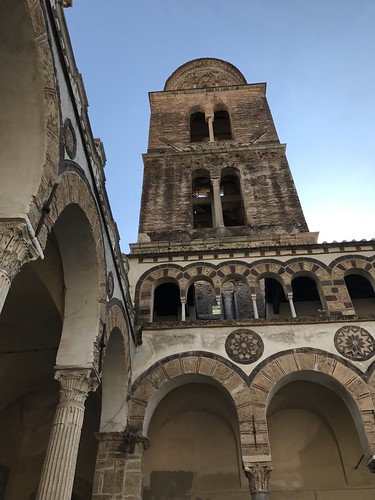
The current entrance, flanked with a sculptured lion and lioness is a modification of the former medieval entrance. The doorway leads to an atrium with bare columns and raised arches echoing Islamic style. Around the sides of the atrium is a series of Roman sarcophagi.
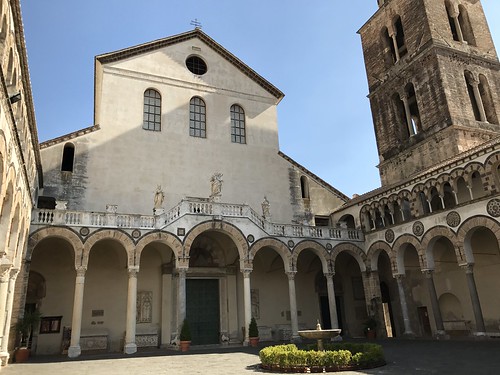
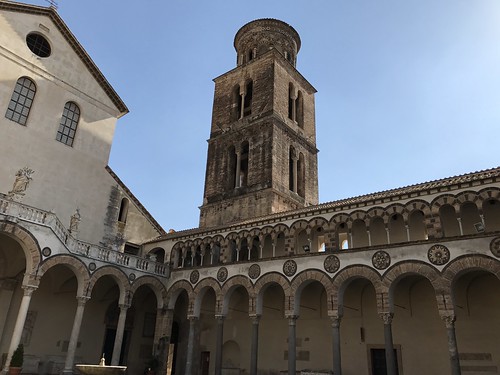
The campanile (bell tower), built in the middle of the 12th century at the request of William of Ravenna, archbishop of Salerno stands on the southern side of the atrium.
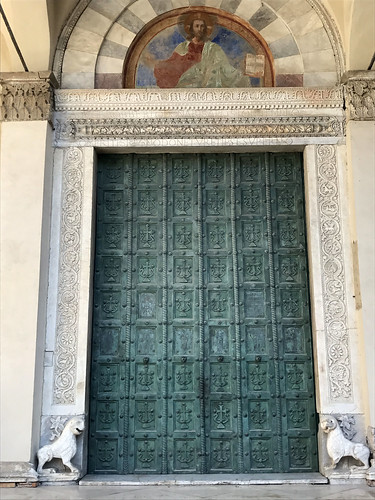
The main entrance to the church is a Byzantine Bronze door. The door was made in Constantinople consisting of 54 panels within a marble portal.
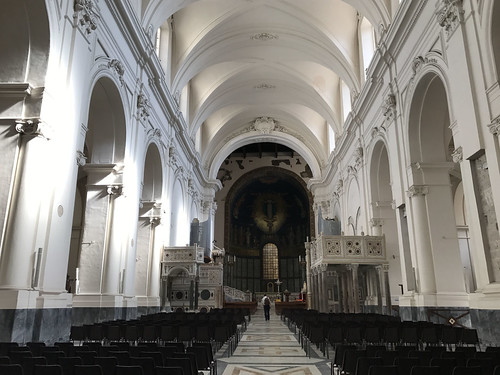
The layout of the church resembles that of other basilicas built during the early centuries of Christianity. The hall of the church is divided into three naves separated by two colonnades. The transept, which opens onto three apses, is slightly elevated due to the crypt underneath. The crypt houses the body of St. Matthew plus other saints and martyrs native to the town of Salerno. A century after the church was built a mosaic floor of marble tesserae forming geometrical patterns was laid in the presbytery area.
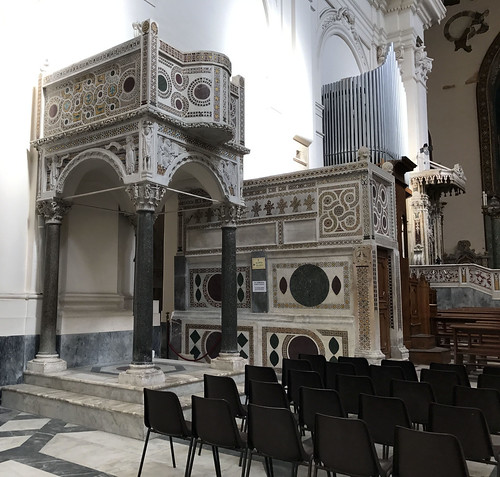
Situated in the main nave of the church are two ambos. The Guarna ambo, situated on the left of the nave was donated by archbishop of Romuald II Guarna in the second half of the 12th century. The ambo is decorated with phytomorphic and anthropomorphic elements. Above the arches, bas-reliefs depict an angel holding the Gospel (symbol of St. Matthew) and an Eagle (symbol of St. John).
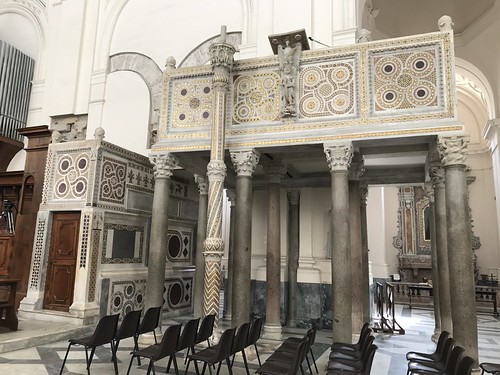
The Ajello ambo, situated on the right of the nave is twice the size of the Guarna one. The ambo is decorated with floral and zoomorphic capitals. There are two groups of sculpture, one depicting an eagle clawing at a man held by a snake and the other depicts two youths on two lions. A third piece of relief sculpture is the Paschal candle supported by four lions. The candlestick is decorated with three successive sculptured and mosaic bands with the top showing a dance of men, women and wild animals.
The church as it appears today is the result of work done during the baroque period. Neapolitan architect Guglielmelli worked on the church after the earthquake of 5th June 1688 and a few decades later Roman architect Carlo Buratti also worked on it. The roof reconstruction by Ferdinando Sanfelice also dates to those years.
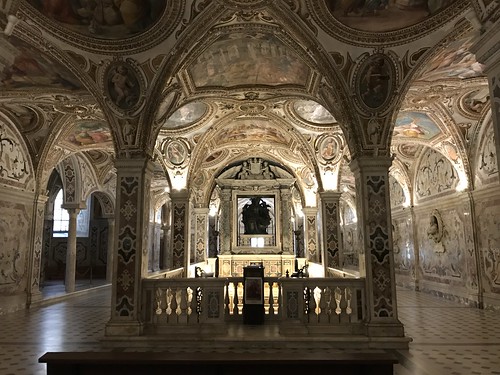
To the left of the nave some stone steps lead down into the crypt which was inaugurated in March 1081. The relics of apostle Matthew, patron saint of the city, were buried in in the presence of Alfano I, Emperor Michele and Duke Roberto il Guiscardo.
The crypt was transformed in the 17th century due to the degraded state in which it was built. The work was commissioned to Domenico Fontana who was also responsible for the crypt decorations.
The paintings depict the Storie di S. Matteo, by N. Haccherino in polychrome marble by Franceso Ragozzino.
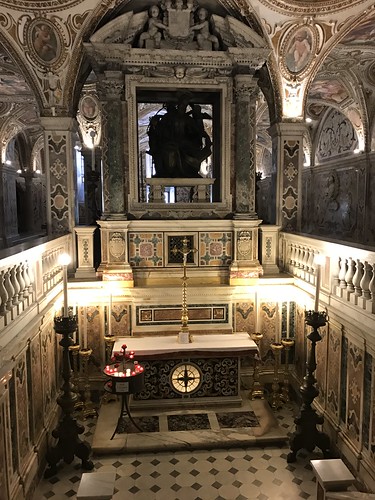
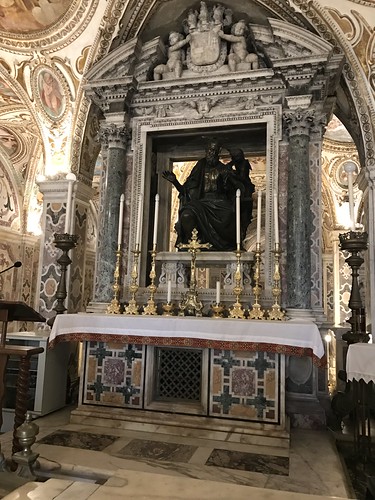
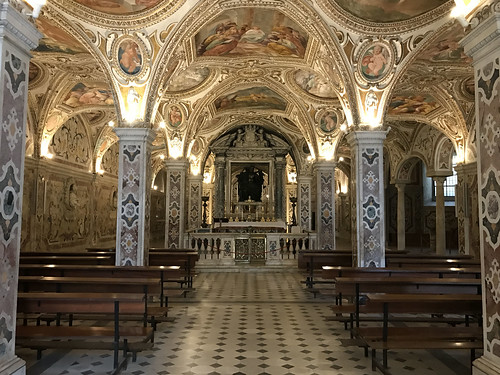
The tomb of St. Matthew is central to the crypt with altars on both the north and south sides. The northern altar has a small opening through which it is possible to see the sepulchre of St. Matthew. The tomb is covered by a double canopy with a centrepiece of two twin Statues of St. Matthew created by Michelangelo Naccherino in 1606. The Saint is depicted as he writes the Gospel with a book resting on his left knee and a pen on his right hand. At his side an angel hands him an inkwell.
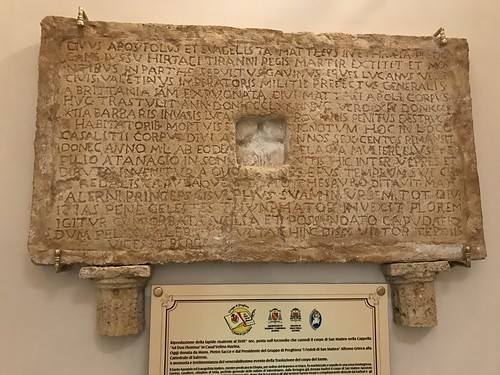
A sign at the entrance to the crypt tells the legend of how St. Matthew’s relics arrived in Salerno*.
The Holy Apostle and Evangelist Matthew, while he was preaching in Ethiopia, was martyred and buried in the mountainous area by the order of the king Irtaco. Gavino, a cavalier, a citizen of Vella and the prefect of the Valentinian militia, dislocated the body of Saint Matthew from Brittany in the year of our Lord 352. From the year of the Jesus Christ 412, after that Lucania and other territories had been occupied and completely destroyed by the barbarians and the inhabitants slaughtered and forced to escape, the body of Saint Matthew stayed in the land of Casalicchio for 600 years.
It stayed there until the Apostle appeared in the dream of the pious woman Pelagia and her son Atanasio, in which he gave them the right instructions to find him. After this happening they found the body of the Saint in a place between the ruins covered with oaks. Then the bishop Giovanni took this big and incomparable treasure to enrich his Cathedral in Capaccio.
Finally, Gisulfo, prince of Salerno, who triumphed against the Saracens had the precious relics transported his city, almost as a gift from heaven.
*I have used a combination of the English translation on the sign and a Google translation to English from the Italian original.
- Sources of information are a signboard outside the cathedral and the cathedral website.
Tags: Cathedral, Church, Crypt, Duomo, Duomo di Salerno, Relics, Salerno, St. Matthew, There's Always One, Vacation