4 Comments CherryPie on Jul 16th 2016
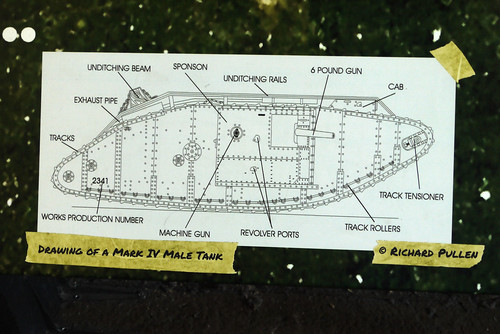
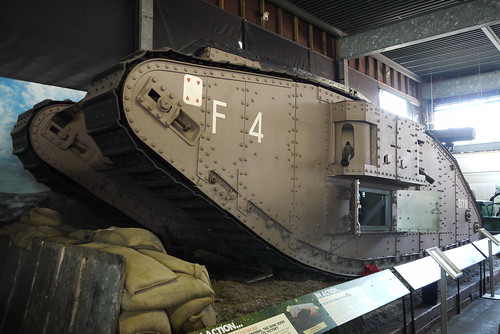
According to information at the Museum of Lincolnshire life, tanks are classes as either male or female. Daphne in the previous post is apparently female and the above diagram shows a male tank.
The information at the museum informed that a female tank has five machine guns whereas a male tank has three machine guns and two 6-pounder guns (cannon).
The difference would be easier to visualise if the diagram was in the same orientation as the tank display.
4 Comments CherryPie on Jul 15th 2016
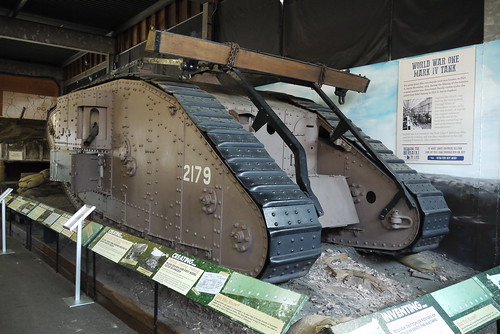
Lincoln was at the forefront of the invention of the ‘tank’, playing a vital role in the development of the fighting machine that changed the face of warfare.*
William Foster & Company was the pioneer of the tank. It was from the designs and drawings made by William A Tritton, then marketing director of the company , that all the tanks were made. The first prototype was known as Little Willie. The design was begun on 2 August 1915; construction started on 11 August; the machine was able to move by 8 September; and performance trials began on 14 September… only 45 days after Tritton first produced his sketches! Early trials proved less than successful. Fortunately Tritton had anticipated some of the problems and, with the assistance of Lieutenant WG Wilson, the Admiralty Overseer, was already working on the successor to Little Willie.
The design of Big Willie, was begun on 24 August 1915. Later re-christened Mother, Tritton’s revised tank was able to move under its own power by 6 January 1916. The design prove to be a tremendous success and almost one month later , on 2 February, a trial took place in the presence of a very distinguished audience that included Field Marshal Lord Kitchener. Following the trial an order was placed for 100 Big Willies. Throughout the war Tritton continued to improve on the design of the of the tank. Contracts were dispersed to other factories, including Marshall Sons & Company, of Gainsborough, for the production of the tank. By the end of the war, 2696 tanks had been delivered to the British Army, with a further 8000 more having been ordered. For his contribution to the development of the tank, William Tritton was knighted by King George V on 13 February 1917. The directors and workers of William Foster & Company presented Sir William with a magnificent illuminated address.*
The tank in the picture is named Daphne:
She was built in Wednesbury, West Midlands from plans drawn in Lincoln. For many years she was believed to be Flirt II, until her original serial number was discovered in 2013. Daphne was damaged by German artillery on 21st August 1917 at the Ypres Salient and taken away for repair.
At the end of the war Daphne was presented to the city of Gloucester, where she stood in Gloucester Park until 1940. During the Second World War Daphne served as a pillbox on Hucclecote airfield, until she was transported to Bovington Camp in Dorset in the mid 1940s.
Bovington Camp museum acquired Daphne in 1947 and, after being restored in 1983 by apprentices at Rustons Gas Turbines, loaned her to the Museum of Lincolnshire Life in 1989 where she remains today.*
*From signboards in the Museum of Lincolnshire Life
8 Comments CherryPie on Jul 14th 2016
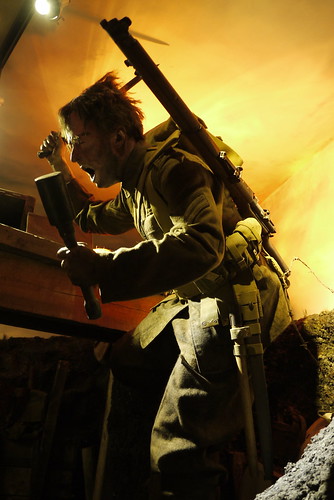
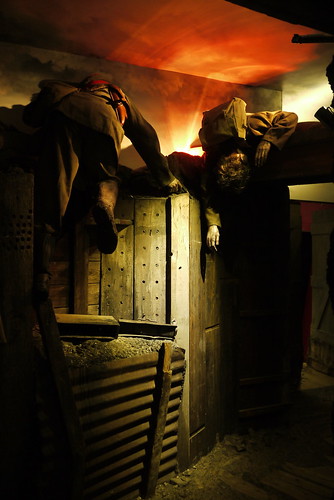
Lincoln Victoria Cross hero Charles Sharpe’s trench attack is immortalised in the Museum of Lincolnshire Life.
He [Corporal Charles Clarke] captured an enemy trench single-handedly and led a successful assault on another in the German lines near Rouges Bancs in northern France during the Battle of Aubers Ridge in May 1915.
The official citation published in the London Gazette on 29th June 1915 states –
‘When in charge of a blocking party sent forward to take a portion of the German trench, he was the first to reach the enemy’s position and using bombs with great determination
and effect, he himself cleared them out of a trench fifty yards long. By this time all his party had fallen and he was then joined by four other men with whom he attacked the enemy with bombs and captured a further trench 250 yards long.’
6 Comments CherryPie on Jul 13th 2016
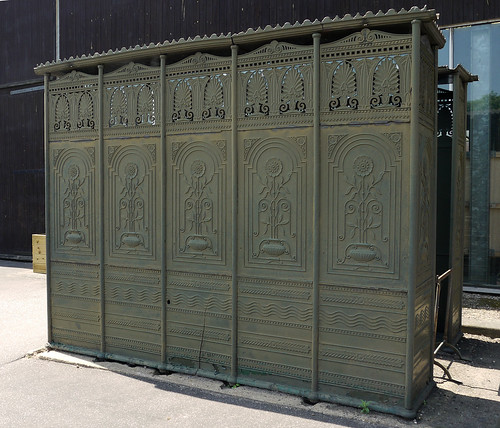
This is a very ornate cast iron urinal, dating from around the turn of the 19th/20th century. It was removed from the Woodhall Junction Station and brought to the Museum of Lincolnshire Life in 1972.
The very thin flat casting of iron is an example of the great skill of engineers of the time. Today it would not be possible to make such thin and flat designs, as the additives used in the casting process are now considered too damaging too the environment.*
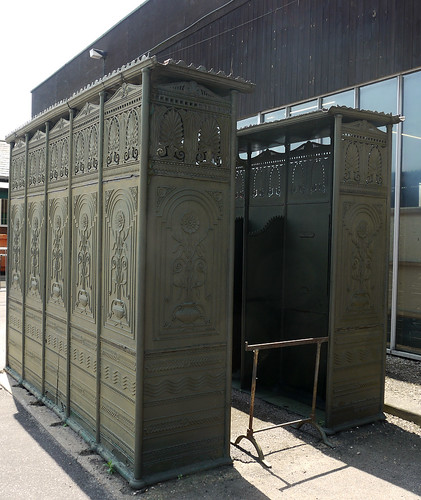
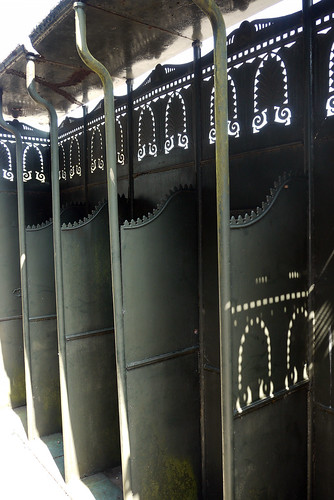
*Information taken from a signboard at The Museum of Lincolnshire Life.
16 Comments CherryPie on Jul 11th 2016
Follow peace with all men, and holiness, without which no man shall see the Lord.
Hebrews 12:14 (KJV)
10 Comments CherryPie on Jul 10th 2016
4 Comments CherryPie on Jul 10th 2016