I ascend unto My Father and your Father
Random thoughts and photos of my journey through life…
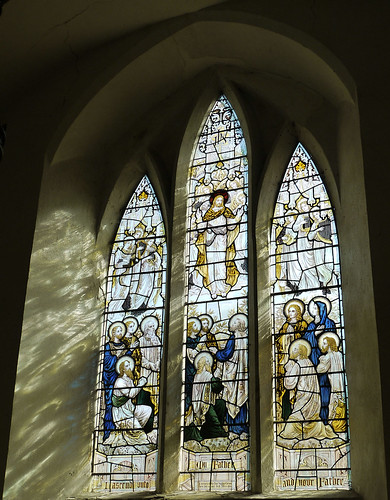
I ascend unto My Father and your Father
8 Comments CherryPie on May 14th 2015
THE GARDEN AT LINCOLN MEDIEVAL BISHOPS’ PALACE is a contemporary yet peaceful space elevated high above Lincoln city where you feel that you are soaring above the landscape along with the peregrine falcons who have nested nearby. Lincoln Medieval Bishop’s Palace is the only English Heritage property to have a vineyard, which is run with help from the local community.
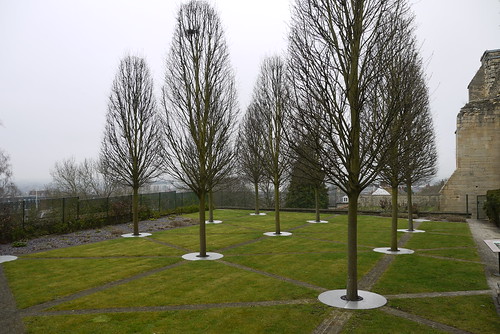
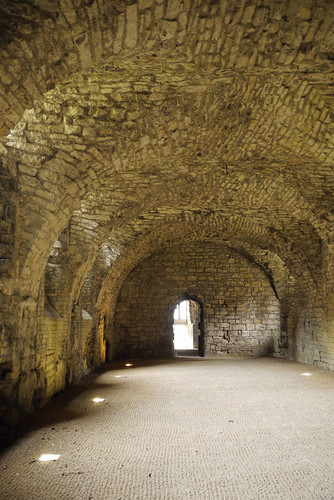
You arrive in the garden through the labyrinth of the ruined Bishops’ Palace, emerging from the darkness of a cold stone room with a vaulted ceiling, down a flight of ancient steps, and then through a gap in the thick Medieval wall into the light. Because it’s on a south-facing slope you first see the garden from above.
At the back of the terrace is a buttressed Roman wall which, in summer, is self-seeded with red Valerian ( Centranthus ruber) – highly appropriate as this tough, opportunistic plant gets its name from an ancient Roman family, the Valerii.
From the viewing platform your eye immediately picks out nine tightly clipped hornbeam ( Carpinus betulus) piercing the air like the spires of the Cathedral. Narrow weathered brick paths at precise geometric angles running between the trees echo the intricacy of the ribs supporting the Cathedral’s ceiling. Each tree is sunk into a circlet of polished stainless steel, like the architectural bosses where the ribs intersect.
If this sounds overly complicated it’s not. You’re reminded of the elegant workmanship of medieval craftsmen, such as the silversmiths who made the chalices and communion plates and the stonemasons who sent ambitiously tall towers into the air.
On descending the viewing platform onto the grass below it feels as if you are in an outdoor church. Clipped yews with recesses for benches look like the stalls of the cathedral choir. Other echoes of medieval Christianity are carefully woven into the garden.
One of the shining steel disks encircling the hornbeam has a labyrinth etched into it, a reference to one of the earliest Christian symbols of man’s search for God. Another disk has curling vine leaves upon it pointing both backwards to the earliest inhabitants of Lincoln, the Romans who brought vines from Italy, and also forwards to the vineyard planted on the lower terrace. The vines were a gift from the city’s twin town in Germany, Neustadt-an-der-Weinstrasse in 1972.
Although this garden is mainly an elegant ‘green thought in a green shade’ the restrained planting around the edge alludes to the fact that it was once a working garden. Purple lavender with its medicinal qualities, tall spires of Acanthus – a plant that recurs again and again in medieval sculpture and wood carving – and the striking blood red climbing Rosa ‘Guinee’ enliven this subtle, restful space without overpowering it.
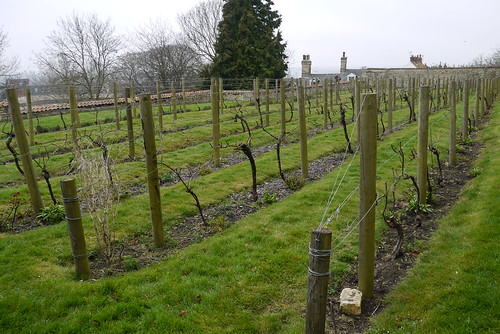
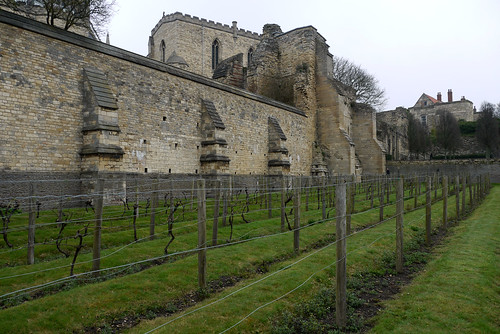
Lincoln Medieval Bishop’s Palace has the only official Vineyard within all English Heritage properties and Lincoln city. The vines were donated by Naustradt in Germany and the three varieties – Ortega, Muller Thurgau and Madelaine Sullvaina – are all white grape from the north side of the Rhine. When it was first planted in 1972 it was the most northerly vineyard in Britain, and it is now one of three.
‘The Vineyard Community Project’, put together early 2013 to help with the care of the vineyard, now involves a volunteer group from the local community, alongside a partnership with a local vineyard to help with the harvesting and the production of wine at the end of the season. The vineyard is an historical asset which has now been tamed into a functioning vineyard. This forgotten gem has become a flourishing natural environment that has not only encouraged the wildlife of the area to stop by, but also many new visitors.
18 Comments CherryPie on May 13th 2015
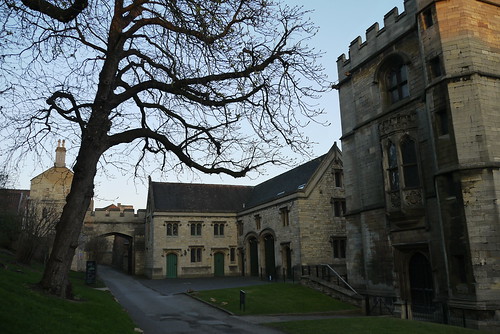
The palace of Lincoln was one of the most impressive buildings of medieval England, reflecting the power and wealth of Lincoln’s bishops. It is situated on a spectacular hillside site, in the shadow of the cathedral, providing extensive views over the city.*
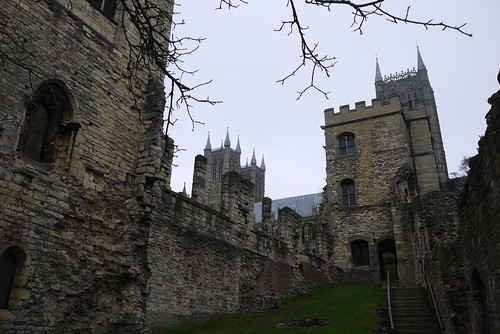
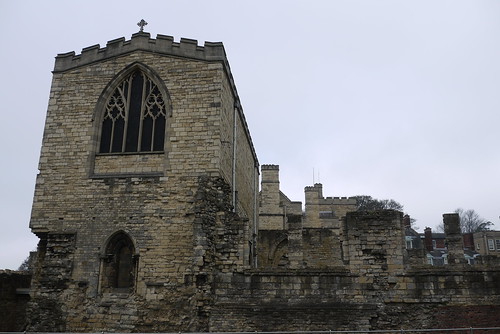
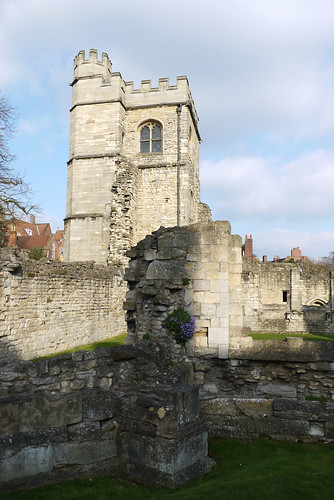
The palace lies outside the cathedral close, but was, and remains an enclosed space of 1.05 ha between the close and the east wall of the city. To the south are the Victorian Temple Gardens, and to the west is St Michael’s Church and churchyard. This position has given the site and aura of quiet and privacy, even though it lies in the heart of the city. Today it comprises the late nineteenth-century bishop’s palace and its gardens, which contain the ruins of the central buildings of the twelfth-to-seventeenth-century bishop’s palace.
Lincoln was a major Roman city, and by the early fourth century had its own bishop. St Paulinus had built a church there in 627, and in 675 the bishopric of Lindsey was established, possibly centred on the city.*
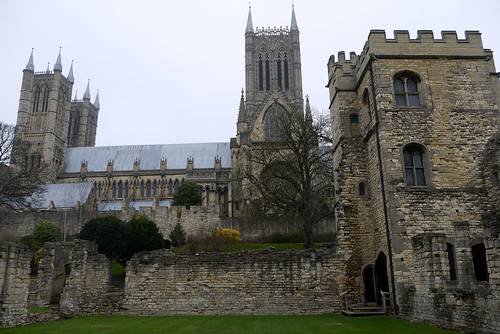
In 1607, Remi of Fecamp, the first bishop created after the Norman conquest of 1066, moved the cathedral of his diocese from Dorchester-on-Thames to Lincoln to compliment the castle that was being built within the ruins of the Roman town on top the limestone ridge. From the first, the castle and cathedral were designed as symbols of Norman power, to express authority of the crown and church on a conquered nation.
Subsequent bishops seemed to have lived outside the city, or within the royal castle, as land for a palace of their own was not granted until 1135. Even then, it was not until the mid-twelfth century that Bishop Robert de Chesney started to build a residence for himself and his household on the present site.*
*From the English Heritage guidebook to Medieval Bishops’ Palace, Lincoln
7 Comments CherryPie on May 12th 2015
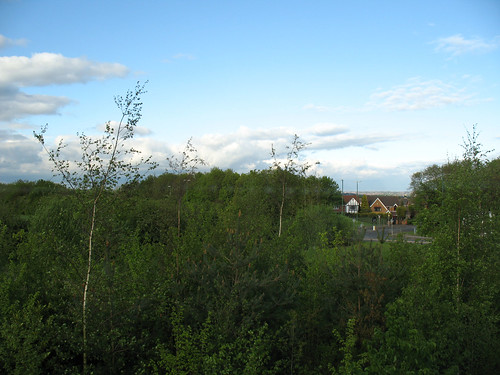
At the last minute my brother asked Mr C, Myself and my Mum to join him for his birthday celebration last Saturday. This put me in a quandary because I had a hair appointment scheduled in the afternoon which I felt was unfair on my hairdresser to rearrange at such short notice. I decided to keep the appointment and travel to Nottingham afterwards which would allow us to book into a nearby hotel and get to the meal on time.
My brother said he would text me details of the arrangements and the restaurant. By the time we were setting off to Nottingham I heard nothing so as we set off I sent him a text “we are just setting off, do you know the arrangements yet”… An hour later we received a phone call advising that three taxis had been booked and that my eldest nephew would come to meet us at the hotel in one of them. My brother said he was currently in Derby and about to set off home to Nottingham. By this stage we were past Derby and I was wondering if the would make it home in time for the Taxi pickup…
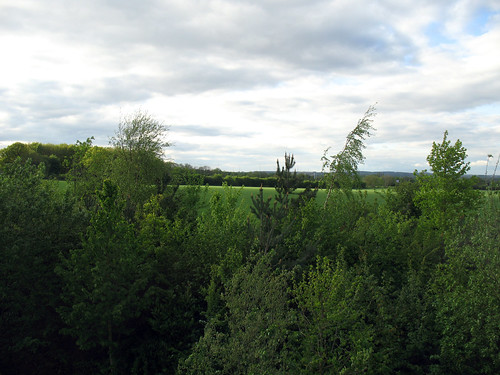
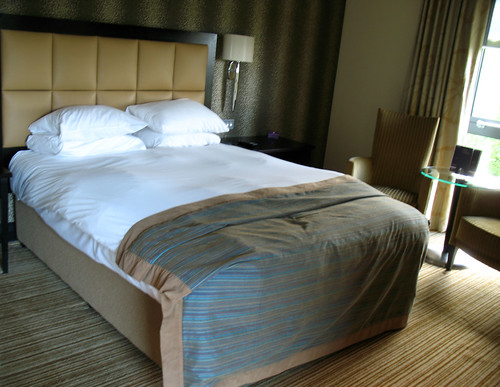
We arrived in the Hotel and checked in with half an hour to spare and made our way down to the hotel reception for that allotted time for the Taxi pick up at 7pm. No Taxi was to be seen… Twenty minutes later the Taxi arrived and my nephew came into the hotel reception area to find us. He related the tale of being home alone, having a shower then opening the curtains to see three Taxis outside his house. Shortly afterwards he received a phone call from my brother asking if there were three Taxis outside the house and if so please keep them there…
We climbed into the Taxi and went merrily on the way towards the restaurant. Along the way there was a bit of a saga! My brother (despite me asking on more than one occasion) had not said what restaurant we were going to. It transpired that he hadn’t told my nephew either and the Taxi driver had misheard the destination my brother had told him… After a slightly annoyed phone call from son to father we got to the restaurant destination in the end!!!
The company was good and the food was lovely but the service was a bit chaotic and slow and not all dishes came as ordered. In addition to this the dry white wine was served warm, always a disappointment. At the end of the meal the bill was slow to come meaning the Taxi drivers were kept waiting yet again… City life…
After the meal we retired back to the hotel for a night cap and a chat with my brother, his lady and his son. A lovely time was had by all.
I won’t go into the incident of a bottle of water shattering as it hit the the reception floor as we were making our way back to the hotel room for the night…
10 Comments CherryPie on May 11th 2015
Lord, grant that I may not so much seek to be loved as to love.
Saint Francis of Assisi
16 Comments CherryPie on May 10th 2015
…if you save me a place I will join you shortly 
8 Comments CherryPie on May 9th 2015
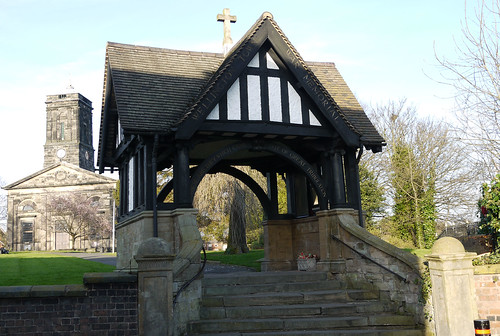
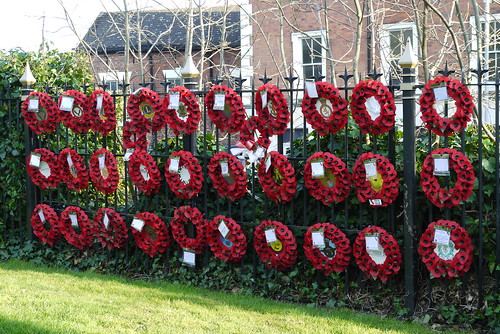
Today is the 70th anniversary of VE Day, the public holiday that was celebrated in Britain on 8th May 1945 marking the end of WWII. As a sign of respect a two minute silence was observed at my place of work.
Huge crowds gathered in London on the following day. At 3pm Churchill made a radio broadcast. In Trafalgar Square, as his voice was relayed over loudspeakers, an eye-witness noted that ‘there was an extraordinary hush over the assembled multitude’.
King George VI and the Queen appeared eight times on the balcony of Buckingham Palace, while the two Princesses – Margaret and Elizabeth (now Her Majesty the Queen) – mingled with the crowds. Churchill later gave an impromptu speech on the balcony of the Ministry of Health, telling the crowds, ‘This is your victory!‘
8 Comments CherryPie on May 8th 2015