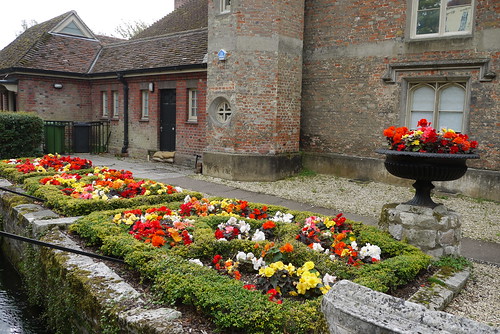
Abbey house stands on the sight of St Mary’s Abbey. It was built about 1750 and originally faced the gardens to the rear. The present castellated front was added after the widening of Broadway in 1771. Benedictine nuns, fleeing the disturbances of the French Revolution, made their homes here in the 1790s. The house now serves as the official residence of the Mayor of Winchester.*
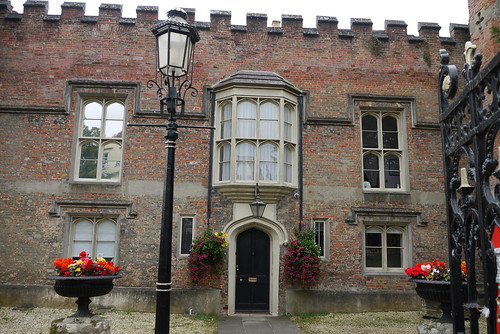
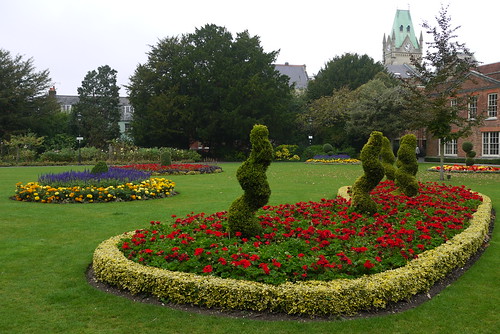
The gardens with the guildhall to the right:
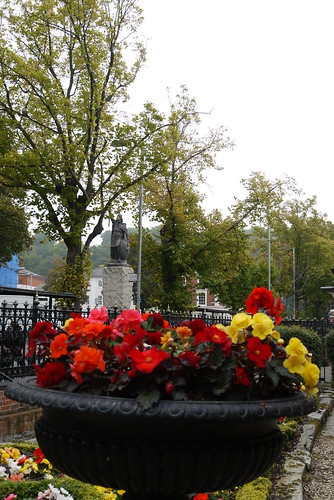
The statue of King Alfred as seen from the front of Abbey House:
*From a signboard next to the house.
Tags: Abbey House, Abbey House Garden, Alfred the Great, Gardem, King Alfred, Vacation, Winchester
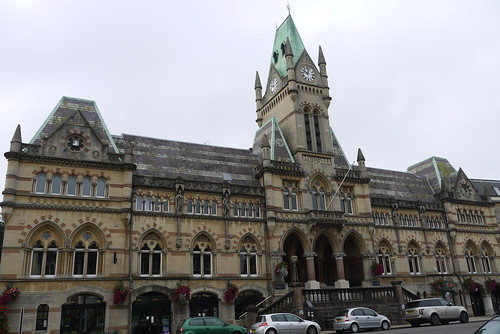
Winchester Guildhall stands on part of the site of an estate granted by Alfred the Great to his wife Ealswith probably as a coronation gift in 871 AD. After his death she retired there and founded a nunnery known as Nunnaminster. Known in the later medieval ages as St Mary’s Abbey, it was one of the foremost nunneries in England. In 1539 Henry VIII dissolved the abbey and the site passed to the crown. The land came into the City’s hands to help cover its costs for hosting the wedding of Mary Tudor and Philip of Spain in Winchester Cathedral in 1554.
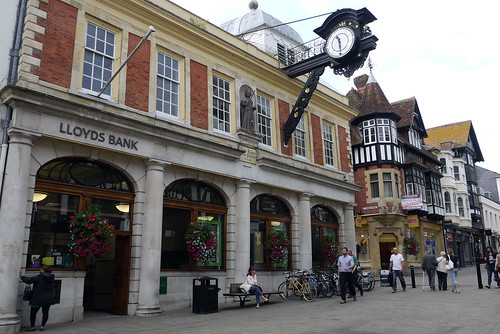
Old Guildhall
Winchester’s earliest guildhall was located next to the Butter Cross in a small chamber above the passageway leading from the High Street to the cathedral. In 1712 the guildhall occupied the upper chamber of the Old Market House on the High Street, while the ground floor served as a covered market. This remained the site of the guildhall until late Victorian period and the building is now occupied by Lloyds Bank. The expansion of civic responsibilities following the Local Reform Act of 1835 markedly changed the role of guildhalls and Winchester needed a newer and larger building.
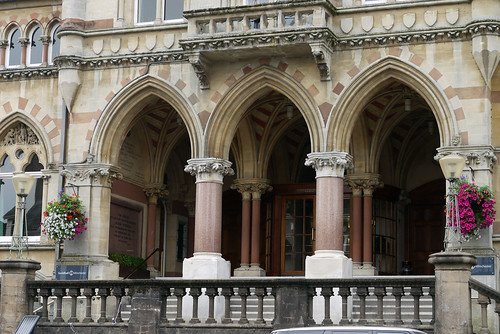
The New Guildhall
The Hastings architectural firm Jeffrey and Skiller submitted a design in the Gothic revival style and on 22nd December 1871 Viscount Eversley laid the foundation stone. Nearly a year and a half later in May 1873 the new Guildhall was opened by Lord Selborne. The Guildhall was part of a larger complex, housing the law courts, police station and fire brigade but the greater part was given over to civic roles. Events for large public audiences occurred on the Broadway where the Guildhall grand façade formed a backdrop to the podium on the staircase. These included the victory celebrations following World War I and royal visit of George VI and Queen Elizabeth on the 17th May 1946.
For a building of Gothic revival design, the Guildhall façade is relatively uncluttered. Its decoration includes four statues of kings and bishops with Winchester connections. Placed in the arches above the principle windows are sculpted panels showing events reflecting the ancient dignity of the mayor and major events in the city’s history. In pride of place is the central panel below the clock tower that shows the mythical 1st mayor of Winchester Florence de Lunne receiving the city’s charter from King Henry II.
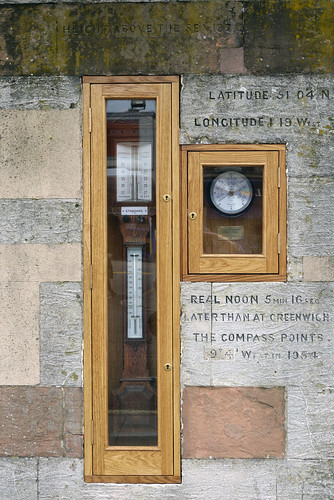
These interesting instruments are inset into the guildhall wall. So far I have been unable to find out their history…
Tags: Guildhall, Lloyds Bank, Vacation, Winchester
A person who never made a mistake never tried anything new.
Albert Einstein
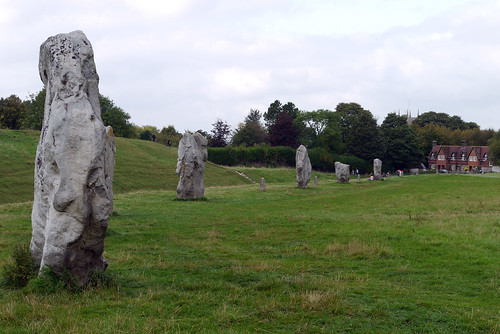
Tags: Avebury, Cherie's Place Thought, Vacation
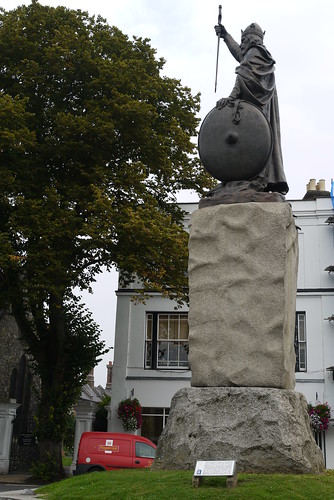
Alfred. king of the West Saxons (AD 871-889) drove the Danish invaders from Wessex. He created fortified centres, of which Winchester, the largest was his capital. During his reign, the streets in use today were first established. Alfred was the most esteemed of English kings. He encouraged the revival of learning and monastic life, and laid the foundation for a single kingdom of England. This statue by Hamo Thorneycroft, was erected in 1901.*
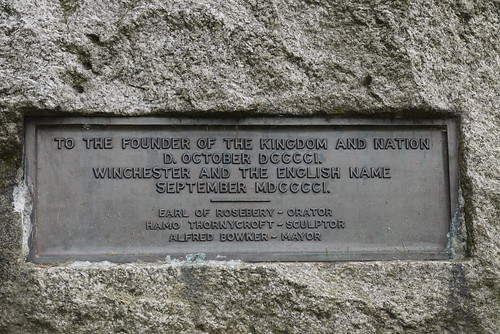
*From the signboard beneath the statue.
Tags: Alfred the Great, King Alfred, Vacation, Winchester
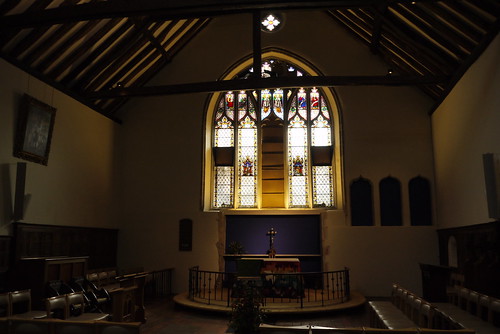
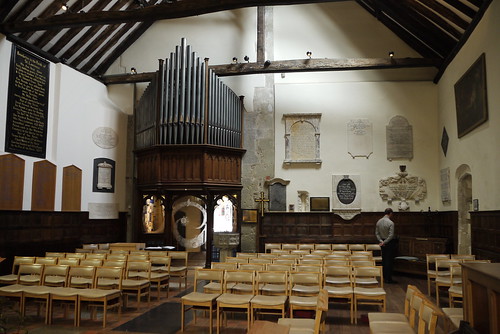
From the Three Saints website:
The medieval church of St Lawrence in the Square is of great interest, not only for its unusual square design but also for its fine 17th-century ‘king-post’ roof and its ancient site. There was a church on the site before the Norman conquest, and it was incorporated into William the Conqueror’s palace as the royal chapel.
After the palace and chapel were destroyed by fire, St Lawrence Church was rebuilt in about 1150. The church was badly damaged by fire in 1978 and after restoration re-opened in 1980, with seating for about 120 people. St Lawrence is still referred to as the Mother Church of Winchester, for it is the only surviving parish church of Norman foundation within the city walls. When a new Bishop of Winchester is on his way to his enthronement in the Cathedral, it is at St Lawrence Church that he is presented to the Mayor, clergy and citizens.
In 2012 a project to enhance the porch of the church saw the installation of a beautiful glass screen.
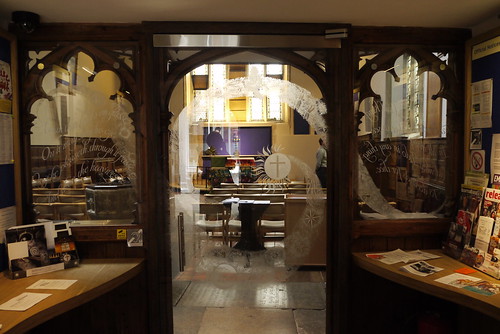
Words from The Elixir by George Herbert
Teach me, my God and King,
in all things thee to see,
and what I do in anything
to do it as for thee.
A man that looks on glass,
on it may stay his eye;
or if he pleaseth, through it pass,
and then the heaven espy.
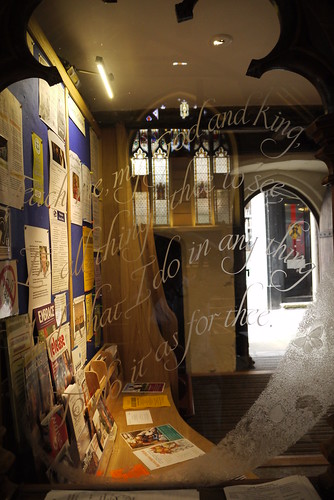
Tags: Church, Church of St Lawrence, Self Portrait, There's Always One, Vacation, Winchester
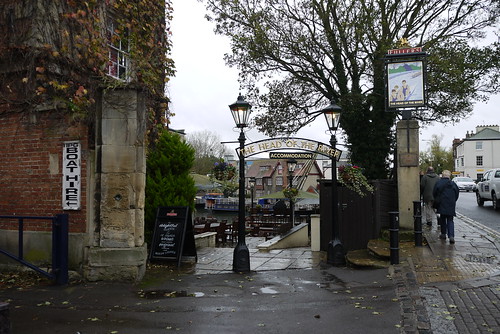
I ordered egg and bacon for breakfast which I was expecting to be a small portion without all the added extras of a full cooked breakfast. I was wrong, I was served double quantities of egg and bacon! After breakfast we packed our cases into the car and set off towards Coughton Court which was our chosen stop off point on our journey home. On arrival at Coughton Court we had a cup of tea before taking a tour of the house.
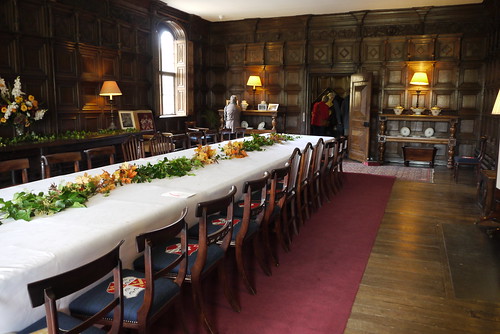
Unfortunately it was raining heavily during our visit which meant we weren’t able to visit the garden and that photo opportunities were limited. However we did drop lucky when we visited the Anglican Church just as a historian started to give a very interesting and informative talk on the history of Coughton Court and the Throckmortons. After the talk it was time for lunch before continuing on our journey home. After such a large breakfast all I needed was a small cake to tide me over until our evening meal.
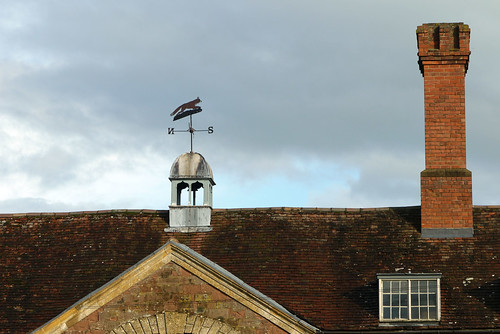
Tags: Coughton Court, Oxford, The Head of the River, Weekend away
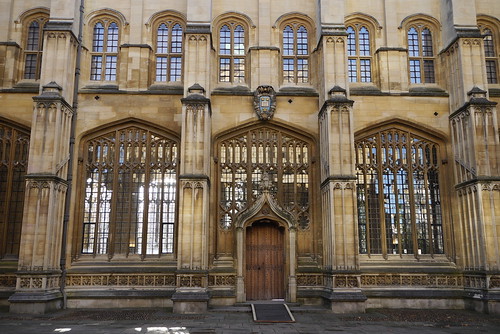
After breakfast, where the correct amount of toast for three people was served, we set off for the Bodleian Library. On our way there we stopped off at the “Oxford University Press” bookshop. I am a fan of their “Very Short Introductions – To Almost Everything” and I was in my element seeing the full collection lined up in one place. We decided to return later to make some purchases.
On arrival at the Bodleian Library we purchased tickets for the tour then sat in the library hall waiting for the tour guide. Mum rushed out at the very last minute saying she didn’t like the thought of the steps in the library… As it turned out her departure was unnecessary, the steps were only a small (easily missed) part of the extremely interesting tour of the building. When we located her after the tour it transpired that she had gone off shopping!! After the tour I purchased a book in the Bodleian Library shop before returning to the Oxford University Press bookshop to purchase three of their short guides for the price of two.
At this point it was time for Mr C to move his car from the hotel car park as we did not have an allocated space for that evening. Mr C deposited mum and I in M&S, the place that mum was aiming for and failed to find on her errant shopping expedition. I am not really a good person to go shopping with because I dislike shopping. I did however spot a lovely glass necklace and bracelet and treated myself for my birthday 
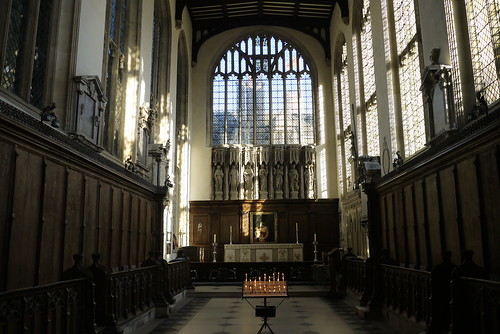
When Mr C returned from moving his car we headed off for a creperie that Mr C had seen an advert for. When we arrived it turned out to be a mobile road side booth. We eventually found somewhere more suitable and sat outside enjoying our lunch in the unseasonably warm weather. After lunch we made our way to the University Church of St Mary which we found very interesting.
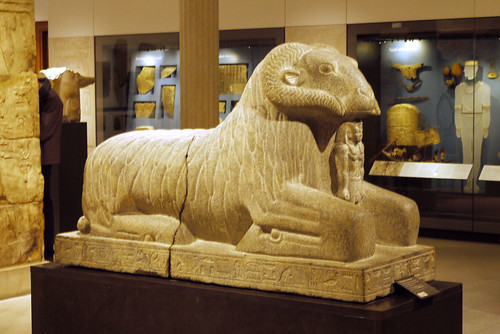
We then made our way to the Ashmolean museum, taking in Blackwell Bookshop along the way. On arrival at the Ashmolean it was time for a cup of tea before exploring the Ancient Egyptian and Syrian halls, after which it was time to return to the hotel and rest our weary feet and freshen up before our evening meal.
We struggled to find a place to get booked in to. We ended up finding a table available at the Brasserie Blanc. We traveled by cab to save our weary feet. The brasserie had a nice ambiance and the food was delicious. After the meal we returned to The Head of the River for a nightcap and to pack our cases for the journey home…
Tags: Ashmolean Museum, Bodleian Library, Oxford, University Church of St Mary, Weekend away