Random thoughts and photos of my journey through life…
8 Comments CherryPie on Jan 8th 2014
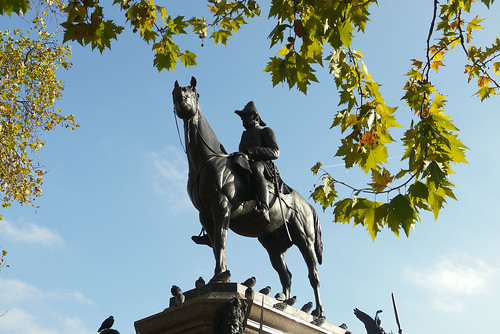
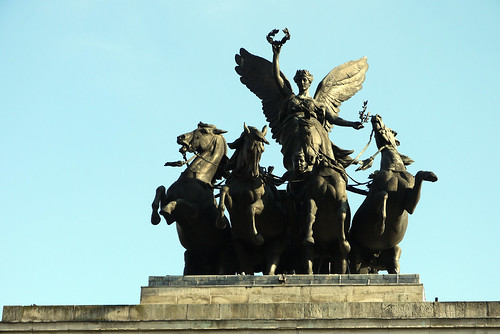
Before the Wellington Arch was moved to it’s present location it was topped by a controversial statue of The Duke of Wellington. When the arch was dismantled and relocated the statue was taken down and replaced by the Quadriga that now tops the arch. This left the question of what to do with the statue of Wellington.
In 1883 the arch was dismantled and reconstructed on its present site. The Wellington statue was taken down in the process, and the question of what to do with it arose again.
No one seems to have wanted it back on the arch, and a strongly worded memorandum from the president and academicans of the Royal Academy urged the government to relieve London of ‘a blot which has long been a source of annoyance to Englishmen and of derision to foreigners’.
A committee chaired by the Prince of Wales was formed to consider the beautification of the newly formed place. It cast around for another site for the giant statue, but not finding one that met with approval proposed to melt it down. At this point the army spoke up; much of the money subscribed for the statue had come from officers, and they wanted it if no one else did. So, in 1885, the statue was unveiled on a new site near the garrison church at Aldershot by the Prince of Wales, where it remains.
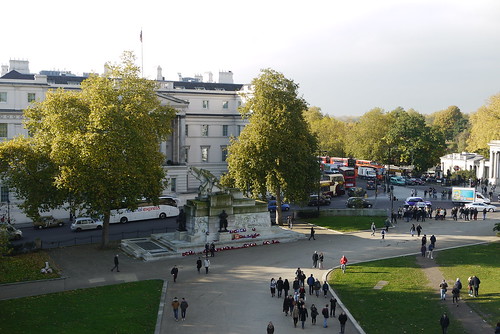
The committee commissioned Sir Joseph Boehm to make a new equestrian stature of the Duke of Wellington, and in 1888 the very fine monument which stands opposite Apsley House was unveiled.*
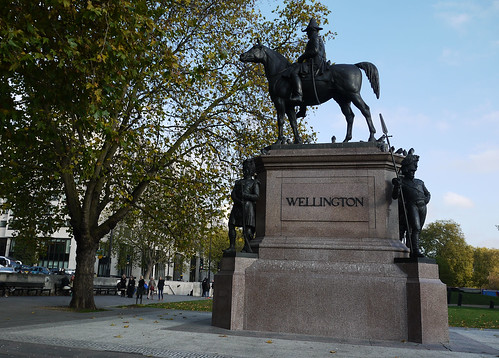
* From the English Heritage guide book to The Wellington Arch and the Marble Arch.
6 Comments CherryPie on Jan 6th 2014

Filed under Faith Foundations, Gardens, Holidays, Newcastle & Crookham 2013
If you want to understand the invisible look carefully at the visible.
The Talmud

18 Comments CherryPie on Jan 5th 2014
8 Comments CherryPie on Jan 4th 2014
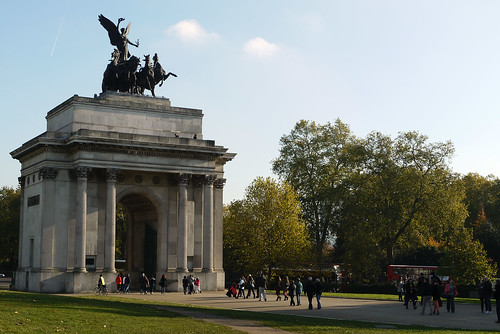
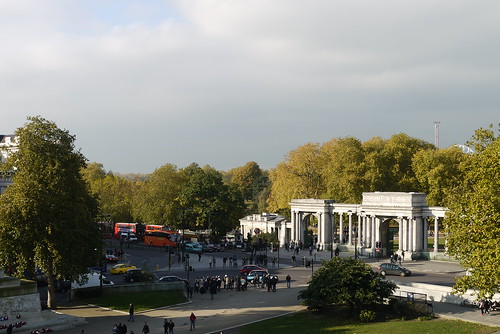
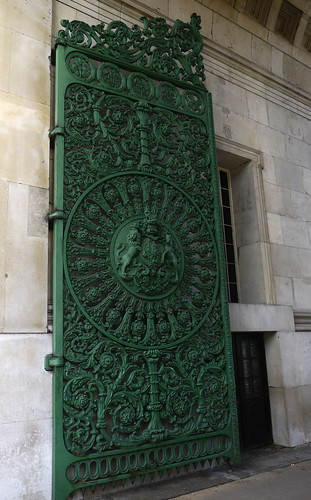
The Wellington Arch and its companion Marble Arch have interesting histories. The English Heritage guidebook introduction gives a brief overview:
Usually built to commemorate a great victory, the triumphal arch was a familiar feature of the Roman world. In the 1820s, this classical model was adapted by two of the finest architects on the day: Decimus Burton used it for the Wellington Arch, and John Nash copied the Arch of Constantine in Rome as the basis for the Marble Arch. This was no mere accident, since both arches were indeed mean to serve as victory monuments. After much public lobbying, Britain was at last to have appropriate memorials marking its military and naval triumphs over Napoleonic France.
The patron behind these works was King George IV, who had long been greatly interested in architecture. His vision was that of a grand ceremonial route into his newly planned metropolitan residence, Buckingham Palace. The Wellington Arch would serve as the outer entrance at the top of Constitution Hill, and the Marble Arch would open gloriously into the courtyard of the palace itself.
The guidebook goes onto explain the context for design and construction of each arch and also their turbulent later histories, including their complete removal to fresh sites in the Victorian era, through to the present day.
4 Comments CherryPie on Jan 3rd 2014
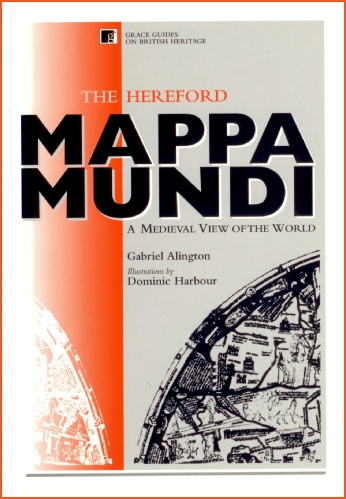 …a medieval view of the world
Synopsis (from book cover):
How was it possible for such a large and fragile artifact to have survived intact from the Middle Ages to the present day? The Hereford Mappa Mundi, moved in April 1996 from the Cathedral Crypt to a purpose built museum, is an unique document. It provides us with a window into time past when there were no aeroplanes or cars, no radio or television, no telephones or newspapers and when travel beyond the immediate confines of ones’s home was an arduous and considerable undertaking. All the more remarkable therefore that such a map of the world is able to show relative positions for cities and whole continents, although the people and animals depicted are often bizarre and fantastical. The Mappa Mundi gives us today an incomparable insight into the mind of Medieval Christendom, depicting not only the geographical world but also the spirituality, philosophy of life and the political and economic structures of its people. The creation of such a map was not only a considerable achievement, but a symbol of power and status in a world still in a feudal stat. This volume takes the reader on a tour of that world as well as of the maps; a journey as fascinating as the Mappa itself.
Book Review:
When I visited Hereford Cathedral in November I particularly wanted to revisit the Mappa Mundi. I picked up this book whilst I was there.
The book gives added incite to the Mappa Mundi which is housed in a specially built display wing of the Cathedral. It is uncertain whether the Mappa was created in Hereford or elsewhere. This book takes the view that the map was created elsewhere and one of the topics is the map’s origins and journey to Hereford. Other topics include the medieval view of the world, the geography of the map and the creatures (both real and mythical) that feature on the map.
The book is illustrated throughout by Dominic Harbour, it also contains a full colour copy of the Mappa Mundi.
I recommend the book to anyone who wants to find out more about the Hereford Mappa Mundi.
11 Comments CherryPie on Jan 2nd 2014