After my Trade Union business on Thursday I decided to stay in the city for an evening meal to save the bother of cooking when I got home. I ended up in The Old Joint Stock, a Fuller’s Ale and Pie House.
The grade two listed building, built in 1864 was originally a library before it became the Birmingham Joint Stock Bank, Lloyd’s Bank then took the building over in 1889 the very same year that Birmingham received City status.
Designed by local architect Julius Alfred Chatwin, best known as the builder of many Victorian Gothic churches including part of St Philip’s Cathedral situated right opposite The Old Joint Stock.
The glass domed ceiling is magnificent, but there was no point trying to take a photo without a tripod, which even I couldn’t rustle up from my handbag. The pub has an island bar and even it’s own 80 seat theatre, which is located on the second floor. The menu was extensive and although I was extremely tempted by the pies and the fish and chips , I remembered my diet so I opted for lemon and ginger cod on mashed potato with peas but I did allow myself a glass of wine 
Although I wasn’t able to get photographs inside the pub, I did manage to capture this photo of St Philip’s Cathedral.

Tags: Architecture, Birmingham, Cathedral, Meal Out, St Philip's Cathedral, The Old Joint Stock

Maybe it is stretching the point, but I can see lots of balance in this photograph. It was taken yesterday after my regional (trade union) committee meeting. I had hoped to take quite a few photographs in the city, but as you can see from this photo the light was failing and it was only 15.15.
The meeting was long and we didn’t manage to get through the agenda items in the time alloted, but it was however very productive and informative. We discussed many issues, two key ones were the Civil Service Compensation Scheme (CSCS) talks and the Make Your Vote Count Campaign (MYVC).
Recently the Civil Service management announced unilateral changes to the CSCS and at the meeting we received an update on how the negotiations had progressed so far and what the next step would be.
The MYVC aims to put pressure on candidates in the forthcoming elections by canvasing their opinion and seeking commitment on key issues for the public sector. This campaign has been building for 4 years and been tested during the local and European elections, with lessons learned we are ready for the challenge.
After all that hard work and the photo challenges the only thing to do was stay for dinner in the city, but that is for another post

For more of this weeks PhotoHunt pictures check out tnchick.
Tags: Birmingham, CSCS, MYVC, PCS, PhotoHunt, The Birmingham Eye, Trade Union
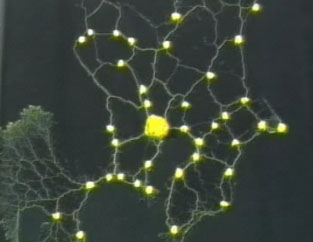 One of the interesting creatures that I learned about when I attended Christopher Lloyd’s lecture at the Royal Institution was the slime mould. He explained how individual pieces joined together to find the quickest, most efficient way through a maze to reach food that had been placed at the entrances. Over at the BBC I found another fascinating article about slime moulds. Scientists have come to the conclusion that the way that slime moulds grow could help engineers design wireless communication networks.
Scientists drew this conclusion after observing a slime mould as it grew into a network that was almost identical to the Tokyo rail system.
The scientists describe their ideas for “biologically inspired networks” in the journal Science.
They have incorporated the slime mould’s efficient strategy into a mathematical formula.
This “slime formula” could help engineers develop better, more efficient designs.
The single amoeboid cells of slime moulds fuse and spread into a network as they feed and grow.
“These biological networks have been honed by many cycles of evolutionary selection pressure,” wrote the researchers in their article.
The research team, led by Dr Atsushi Tero from Hokkaido University, Japan, wanted to capture this evolved efficiency, which they say could be used to inform human engineering decisions.
The scientists put the slime to the test by allowing it to grow on a wet surface on which they placed oat flakes in locations that corresponded to the cities surrounding Tokyo.
They placed the slime mould, Physarum polycephalum, in the centre.
As it grew outwards, it organised itself into a network around the food that closely resembled the train network connecting Tokyo to its surrounding cities.
The researchers then converted this growth “strategy” into a mathematical formula.
The researchers say that this model could provide a starting point for improving the efficiency and even decreasing the cost of “self-organised networks”, such as computer and mobile communication networks that are not centrally controlled.
The idea for using slime moulds in this ways inspired by Toshiyuki Nakagaki, who was responsible for showing that the slime could find the most efficient way through a maze.
Tags: Science, Slime Mould, Technology
I saw this whilst I was out and about today, it gave me a chuckle which I was in need of. But where did I see it?
I wonder how many take advantage of the service?

Originally Darwin tried to rear tropical plants within a plant case that he had bought for the drawing room. Unfortunately the plant case was too small and some of the more exotic blooms failed, so he erected a hothouse.
In the early 1860s, he erected a hothouse alongside the green house in the kitchen garden to provide him with the specialized growing environment he needed for experimentation. The compartments adjoined one another; with interconnecting doors and wooden benches on either side running the length of them. Sloping glass roofs captured the sun’s rays and a boiler system kept the environment warm and well suited to delicate species. Darwin quickly filled his new hothouse laboratory with specimens from his friend Joseph Hooker at Kew, and was soon in the thrall of his new occupation. *
Today the greenhouses are still stocked with the same type of plant specimens that Darwin cultivated for his botanical research. The species include; Orchids, Carnivorous plants, Comet orchids, Climbing plants and Common Toadflax.
If you look closely at the first photograph you will see that one of the zombies I mentioned in my post yesterday has strayed from it’s horde. Perhaps it should keep well clear of those carnivorous plants!


*From the English Heritage guide book.
Tags: Down House, English Heritage, Weekend away
On the way back from my trip to Kent last October I met up with friends at Down House, the home of Charles Darwin from 1842 until his death in 1882.
The experience was not as enjoyable as the other places I had been visiting and at first I couldn’t quite put my finger on what the problem was. But then it dawned on me, English Heritage do those audio tour guides rather than having real people in the rooms to talk too. The audio guides are very informative but you can get a bit of information overload. Worst of all it means there are groups of zombie-like people all standing staring at the same thing for several minutes, it rather detracts from the experience.
You can probably tell from the photos that the sky was rather overcast although the rain did hold back until after we had finished our visit.


Tags: Down House, English Heritage, Weekend away
Knole is the home of the Sackville family and was the childhood home of Vita Sackville-West and she loved it with a passion. The house passed down through the male line of the family so due to a technicality Vita was unable to inherit the house:
‘Sissinghurst and and St Loup are my spiritual homes,’ she later wrote. ‘and of course Knole, which is denied me for ever, through “a technical fault over which we have no control”, as they say on the radio.’
Although the house is in the care of the National Trust a large part of it is still lived in by the Sackville-Wests:
Today, the house is in the care of the National Trust; however, the Trust only owns the house and about 43 acres of the park. Considerably more than half the house is still home to the Sackville-Wests. Lord Sackville and his family still own the gardens and the rest of the surrounding estate. Knole’s garden is probably the largest private walled garden in Britain at 26 acres (30 including the ‘footprint’ of the house), and indeed is large enough to have the very unusual (essentially mediaeval) feature of a smaller walled garden inside itself. Knole Park is a Site of Special Scientific Interest (SSSI) and the park hosts the annual Knole Run, a prestigious schools cross-country race.
Unfortunately on the day I visited I wasn’t able to explore the grounds because it started to pour down with rain which was a shame. I suppose that gives me a good excuse to go back though.


Tags: Heritage, Knole, National Trust, Weekend away