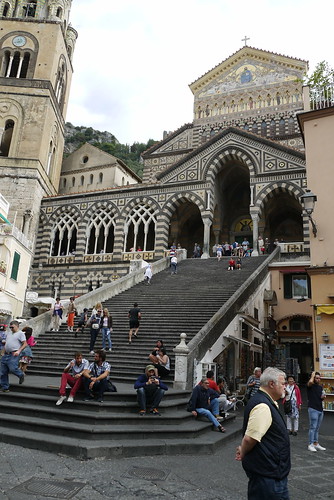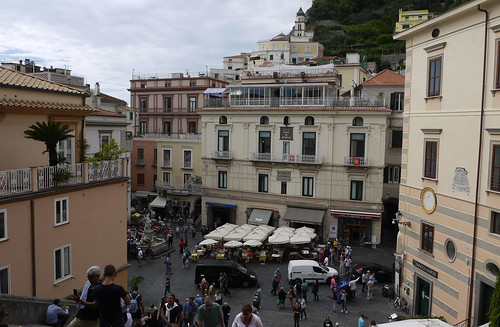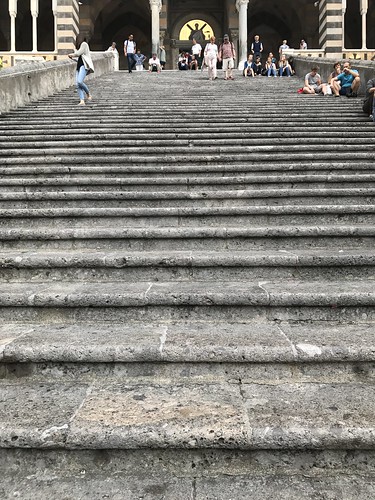
The Duomo of Amalfi, situated at the top of a long flight of steps, dominates the city’s main square. During the Middle Ages Amalfi was one of four powerful Maritime Republics of Italy. It traded prolifically with other countries, in particular the Orient and the Maghreb. The monument complex of the Cathedral (Duomo) is a testament to that past. Ascending the steep flight of steps gives the tangible impression of reaching up towards God. At the top of the steps are two bronze doors with a fresco of St. Andrew above that were cast in Constantinople in 1057.
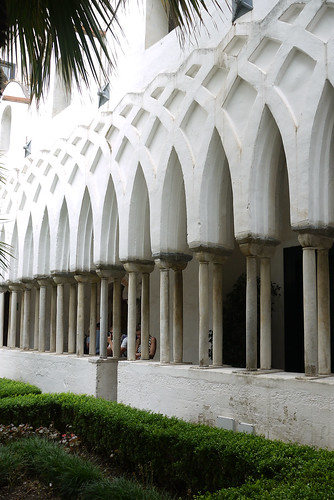
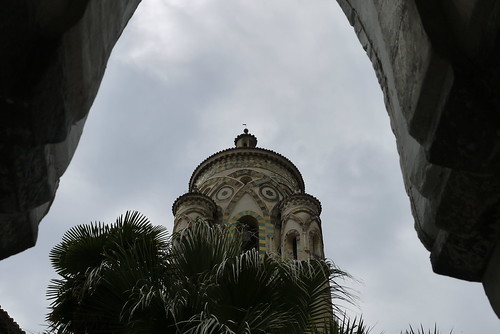
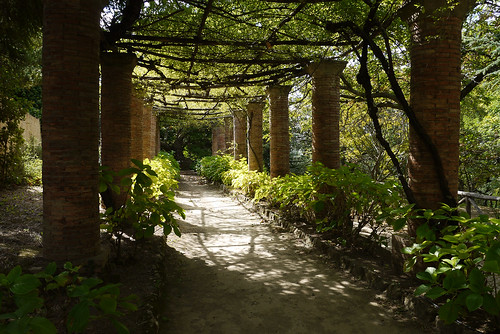
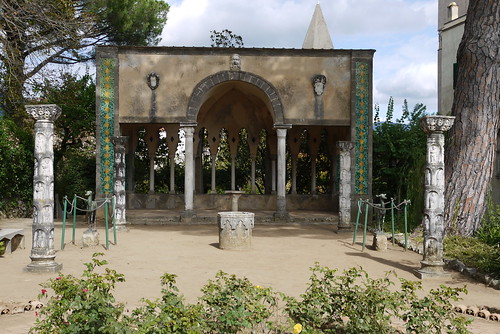
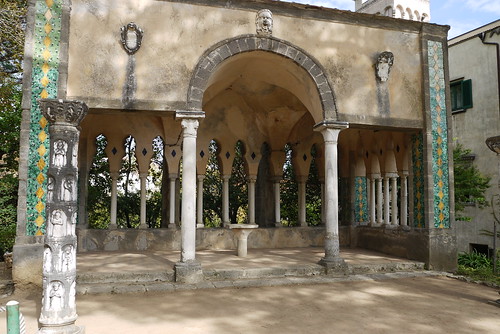
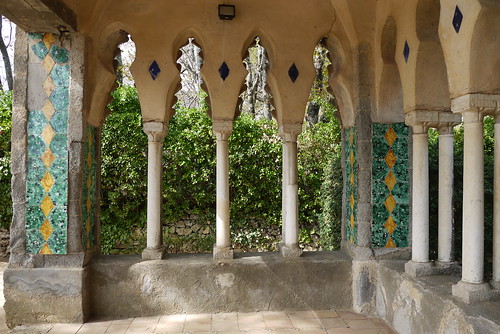
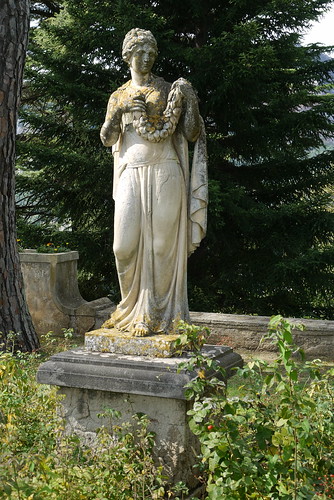
The bronze doors are the main entrance to the Cathedral; however visitors today gain access to the Cathedral complex via a side door leading to the Paradise Cloister. Stepping into the cloister I noticed how peaceful and quiet it was in stark contrast to the hustle and bustle of Amalfi itself. The cloister, Oriental in style, is the ancient cemetery of the nobility of Amalfi. A small Mediterranean garden is situated in the middle of the cloister courtyard and round the edges of it are sarcophagi, marble fragments with decorated mosaics and small funerary chapels. The Cathedral bell tower which is Moorish in style can be seen through the cloister arches.
To one side of the cloister is a door which takes you into the small Corsano family chapel with its fourteenth century frescoes depicting the Death of the Virgin and also Saints and Prophets. The chapel leads to the Basilica of the Crucifix. The Basilica, recently restored back to a single nave, was once dedicated to Our Lady of the Assumption and subsequently to the Saints Cosmas and Damian.
The oldest part of the nave was the first Cathedral of Amalfi, dating to the sixth century AD. The church was extended during the tenth century and when the new cathedral was built adjacent to the original church, the two were connected by a long colonnade, remnants of which can be seen in the southern wall. The styling gives the nave the appearance of a Christian mosque. The nave was altered in the fifteenth century to make way for the Paradise Cloister and construction of small family chapels for wealthy families, a few of which have survived with fourteenth and fifteenth century frescoes.
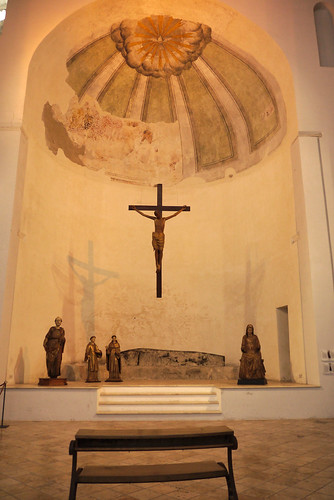
Since 1996 the Basilica has been home to the Diocesan Museum which displays sacred objects from the treasures of the Cathedral of Amalfi. The collection displays many objects of interest including relics in caskets, silver skull reliquaries, a wooden fragment of Christ’s Cross, a casket containing a Holy Thorn, monstrances, vestments, sculptures, paintings and liturgical items. In the apse of the Basilica hangs a stunning fourteenth century Crucifix.
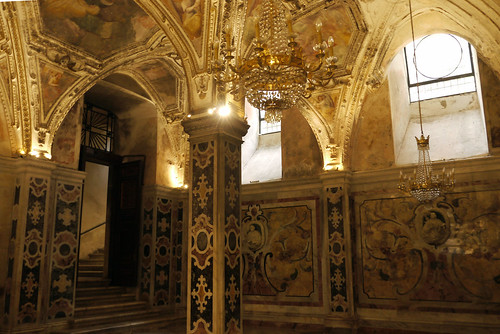
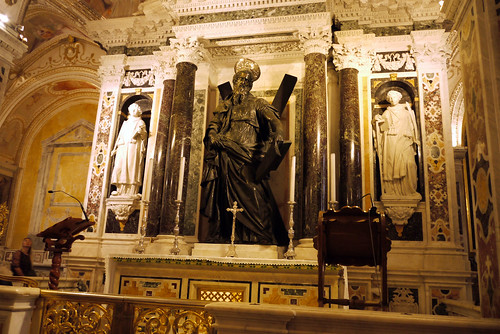
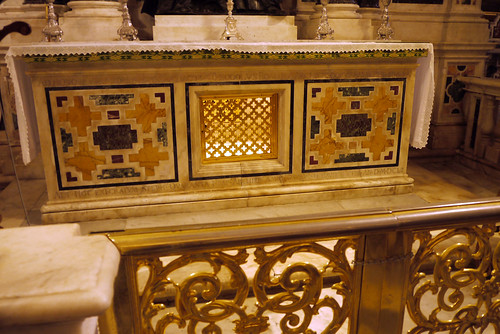
Steps from the Basilica lead down to the crypt where relics of the body of St. Andrew are kept. St. Andrew was crucified in the Greek city of Patras and his body was taken to Constantinople. Later, during the Fourth Crusade, it was moved to Amalfi by the papal legate Cardinal Pietro Capuano. The relics were placed in the crypt in May 1208.
The current style of the crypt dates to the seventeenth century. Beneath the main altar lies a crystal ampule from which on the vigil of St. Andrew’s Feast Day (and occasionally at other times) a substance called ‘Manna’ is collected. This is a dense liquid which sweats out of the tomb of the Apostle. The event first happened in Patras then in Constantinople and now in Amalfi. Above the altar is a bronze statue of St. Andrew the Apostle which is flanked by a pair of marble statues of St. Stephen and St. Lawrence representing the Western and Eastern churches. Behind the altar are large images of St. John the Baptist and St. Andrew.
The back of St. Andrew’s skull is currently in the Reconciliation Chapel of the Cathedral so that it can be venerated by the faithful.
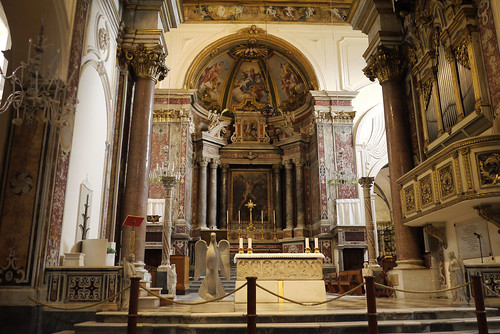
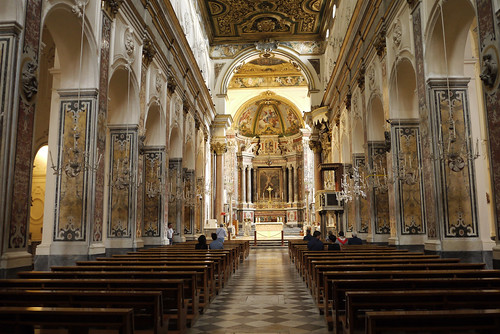
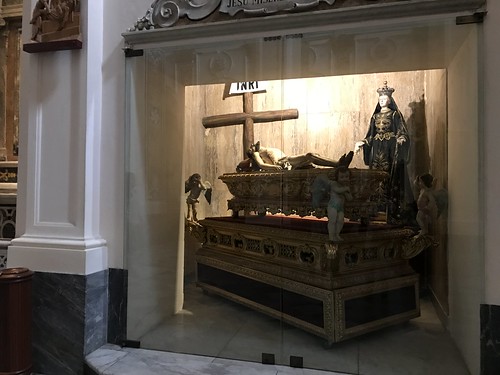
Steps from the crypt lead up to the cathedral which I found to be rather dark and slightly oppressive. However the guidebook describes it as a wonderful, inspiring spectacle. The current baroque style has obscured most of the original Romanesque structure. The panelled ceiling and canvases adorning the walls depict scenes from St. Andrew’s life. Both the left and right aisles have chapels containing interesting artefacts including a catafalque bearing a sculpture of the dead Christ, which, on Good Friday, is used in a procession along the streets of Amalfi.
NB:
- I have used the guidebook of the The Diocesan Museum of Amalfi as a source of information.
- Other relics of St. Andrew of the Apostle are claimed to be held in St Andrew’s Cathedral, Patras, Greece, St. Mary’s Cathedral in Scotland and perhaps in other locations.