…Reconstructing the Final Days of Jesus
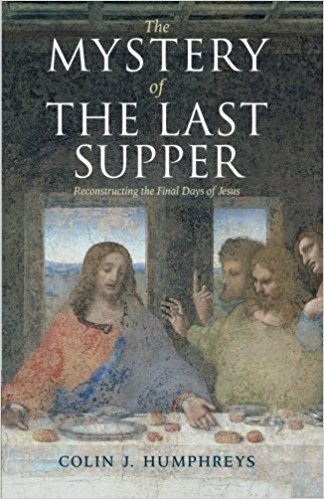 Synopsis (from the book cover):
Apparent inconsistencies in the gospel accounts of Jesus’ final week have puzzled Bible scholars for centuries. Matthew, Mark and Luke clearly state that the last supper was a Passover meal, whereas John asserts that it occured before the festival. The gospel narratives also do not seem to allow enough time for all the events recorded between the last supper and the crucifixion, whilst indicating that Wednesday was a ‘missing day’ on which Jesus did nothing. Colin Humphreys presents a compelling, fresh account of how these inconsistencies can be explained, drawing on the evidence from the Dead Sea Scrolls and Egyption texts and using astronomy to reconstruct ancient calendars. In doing so, Humphreys proposes a new theory – that the last supper took place on a Wednesday, rather than a Thursday as traditionally believed – and successfully unifies the supposedly contradictory gospel stories.
Review:
Colin’s writing style is easy and compelling and his book is fascinating, providing credible evidence to pinpoint an exact dating of Christ’s Crucifixion. He presents astronomical information and different calendars that were in use at that time, proposing that the discrepancies in the gospel accounts and timings were due to the writers using different calendars in their accounts of the event. The evidence he provides reconciles the differences.
I recommend this book to anyone who is interested in the subject.
Tags: Book Review, Books, Colin J. Humphreys, Jesus, The Mystery of The Last Supper
On that day you will realize that I am in my Father, and you are in me, and I am in you.
John 14:20 (NIV)
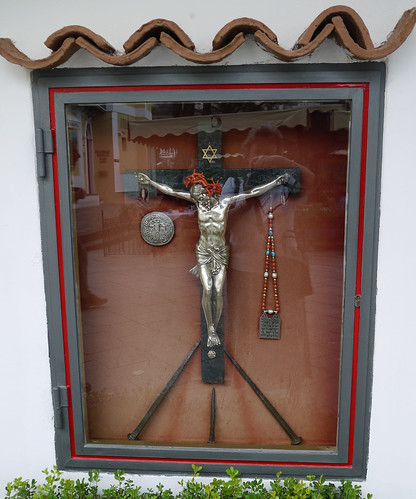
The long tradition of coral carving on the Amalfi Coast is put in the spotlight at the Coral Museum in Ravello. Tucked away in an unassuming shop fronted by flower pots, the museum is housed in the Camo workshop, one of the area’s most prestigious names for coral and cameo jewelry. The Ravello area has been a center of marine jewelry craftsmen for centuries, where coral has been plucked from the waters of the Gulf of Salerno and Napoli and carefully carved into jewelry and fashioned into figurines. The museum documents the various manufacturing techniques, showing the ancient tools used in turning the raw materials into pieces of art. Hundreds of pieces are on display, including a stunning coral crucifix and a magnificent Madonna, along with beads, cameos and jewelry, a section of Ebraica, and even a nativity scene – everything handmade from coral, pearls or shells, ranging from Roman times to the 20th century.
Unfortunately we ran out of time and didn’t get the opportunity to see the museum. Maybe next time 
Tags: Christ, Coral Museum, Cross, Crucifix, Crucifixion, Jesus, Love, Portrait, Ravello, Self Portrait, Vacation

The church, dedicated to St. John the Baptist stands of the site of an earlier building.
The church, preceded by a covered atrium , is annexed to the Franciscan convent. Originally a Latin cross , with three naves and eight chapels , following the eighteenth-century restorations, it is today presented as a single -barreled vaulted hall (until the 1980 earthquake decorated with frescoes ) and a short transept with a scarsella [1] . Under the high altar lie the remains of the blessed Bonaventura da Potenza , who died in Ravello in 1711, four miracles of which are depicted on the tables that adorn the walls of the apse.. Leaning against the walls of the nave are four altars, two on each side, decorated with paintings. The first altar on the right has a canvas depicting the three Franciscan saints Santa Chiara , San Bonaventura and San Ludovico d’Angiò ; the following altar is adorned with the Coronation of St. Joseph . On the first altar on the left is a Deposition of Christ , while on the following altar stands Our Lady of the Rosary with Saints Dominic and Catherine . The altars of the transept are dedicated, respectively, to the Immacolata (right altar) and to Sant’Antonio (left altar) [4]. In the choir located on the counter-façade there is a 1909 pipe organ, which reuses part of a previous instrument of 1736, restored in 2012 [5] .

Under the main altar is the urn containing the body of Blessed Bonaventura da Potenza, who died in Ravello in 1711 and was declared Blessed in 1775 by Pope Pius VI. Also in the same church are the remains of the Servant of God Father Donato Antonio del Quercio di Caposele, who died in great fame of holiness (+ 1774) and of the worthy brothers between Antonio and Padre Bonaventura Mansi, of the Friars Minor Conventual.


Tags: Church, Church of San Francesco, Italy, John the Baptist, Ravello, St Francis, Vacation

At the end of the path you can see the remains of the Holy Trinity Benedictine Monastery built in the 9th century to house young women from the noble families of Ravello.
Suppressed in 1811, by Royal Decree. Demolished in 1812.


Sadly the archaeological site and the viewpoint were inaccessible due to building works!

We were however able to enjoy views of Villa Maria’s vegetable garden.


Tags: Benedictine, Cats, Convent, Holy Trinity Convent, Monastery, Ravello, There's Always One, Vacation, Vegetable garden, Villa Maria
In him was life; and the life was the light of men.
John 1:4 (KJV)

Tags: Cherie's Place Thought, Croatia, Piran, Vacation, Yugoslavia

The Duomo (Cathedral), renovated in 1786, was originally built in the 11th century at the request of Nicola Rufolo, owner of the adjacent Villa Rufolo. The Cathedral is dedicated to St. Pantaleone, the patron saint of the city.

The bronze embossed entrance door dates from 1179 and has 54 panels depicting scenes of the major mysteries of Christ’s life, death and resurrection, along with religious iconography such as arches, lions, griffins and symbolic figures that narrate biblical tales. Within Italy, there remain approximately 20 of this type of door, most of which can be found in southern Italy. Other similar doors have been lost over the years for various reasons.

Within the Cathedral to the left of the altar is a small chapel dedicated to St. Pantaleone and at the back of which is a small passageway that leads to the Holy Relic of St. Pantaleone; a vial of his blood that becomes translucent every 27th July, the day of his martyrdom. The vial is placed behind glass and a metal grille.


The Cathedral contains two ornate pulpits (ambos). One, the Ambo of the Epistles, was built on the order of Constantino Rogadeo, second Bishop of Ravello and its mosaic scenes depict Jonah being swallowed by the whale. There is a similar ambos in the Cathedral of Salerno.


The second ambos is for the reading of the Gospels. It was donated by Nicola Rufolo and dates from 1272. This ambos is topped by an eagle whose claws rest on the book of John the Evangelist; ‘IN PRINCIPIO ERAT VERBUM’.

Beneath the Cathedral is the crypt which houses a museum that contains items from the Roman era, holy relics and other interesting items.
Tags: Cathedral, Duomo, Italy, Ravello, Vacation