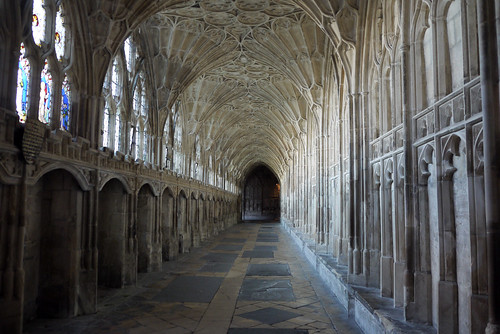
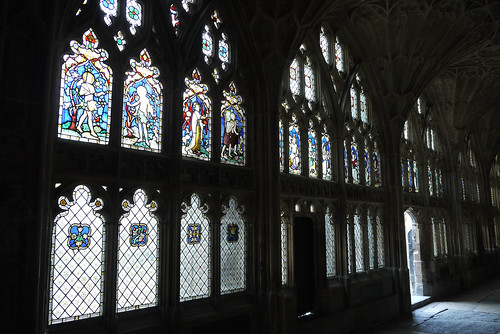
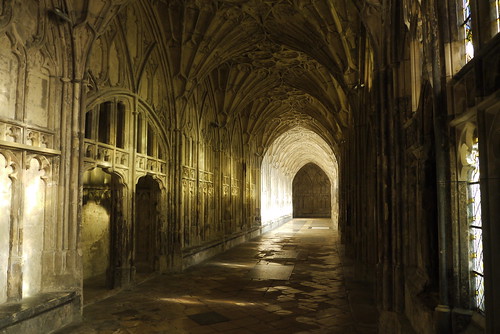
Gloucester’s great Cloister is famous for its magnificent fan vaulting, which is believed to be the earliest example in England.
Originally built to house the monks, it provided space for them to live, work and meditate. In many abbeys, the cloisters were traditionally built on the south side, but at Gloucester, it unusually lies on the north.
Using the normal Benedictine layout, all of the domestic buildings would have originally branched off three of the cloister walks.
Begun in the late 14th century and finished by Abbot Froucester before 1412, it replaced an earlier Norman cloister.
The design itself incorporates a row of twenty carrels (niche like spaces), which would have originally houses desks for the monks to study. The Cloister also includes a lavatorium, (washing place) which would have made use of a local stream.
19 Comments CherryPie on Mar 4th 2016

Filed under Colwall 2016, Faith Foundations, Heritage, Holidays
Gloucester Cathedral – The West Window
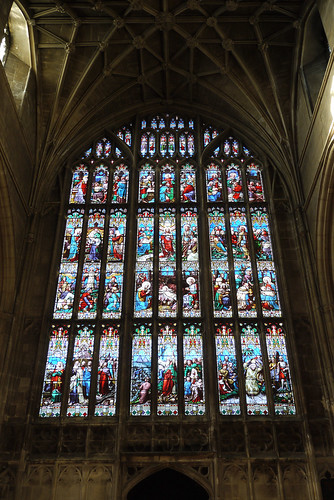
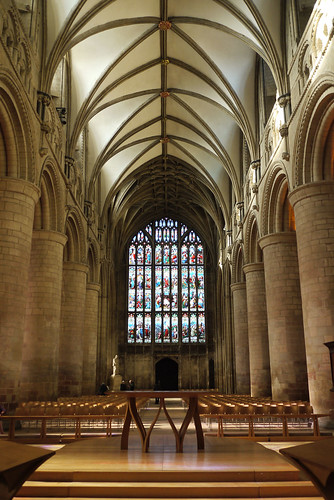
At the entrance to Gloucester Cathedral, the West Window is a prominent feature. Although my photographs don’t capture the details well, the window depicts Biblical scenes.
The glass we see today was installed in 1859 as a memorial to Dr J. H. Monk, Bishop of Gloucester from 1830 to 1856. It was made by the large Newcastle firm of William Wailes, and is signed and dated in the red strip in the bottom left-hand corner of the window.
The themes of the window are the Birth of Jesus and the Doctrine of Baptism. These are highly appropriate for the window’s location, as fonts are usually placed near the main, often west, entrance to churches.
In the central section, between the upper and lower transoms (the main horizontal stonework across the window), you will see the nativity, with shepherds and kings visible through the windows hurrying towards the stable. To the left of this, angels announce the birth of Jesus to the shepherds, while on the right the three kings worship the infant.
Above these nativity scenes, from left to right, are the Presentation of Christ by his parents in the temple, the Baptism of Jesus by John the Baptist, and John the Baptist preaching by the River Jordan. Three Christian baptisms from the Acts of the Apostles are depicted above the upper transom: those of Paul, of Cornelius, and of the jailer of Philippi.
Across the bottom of the window are three ‘watery’ incidents from the Old Testament. The first of these shows Noah with his family, animals, and birds leaving the ark after the flood. Next are the Israelites after passing safely across the Red Sea. The horror of the Egyptians as they face drowning is vividly captured, as are the treasures at Moses’ feet. Finally Naaman can be seen washing in the Jordan to rid himself of leprosy. Note his feet are showing through the water.*
*From Gloucester Cathedral Stained Glass – Gloucester Cathedral 2004
4 Comments CherryPie on Mar 3rd 2016
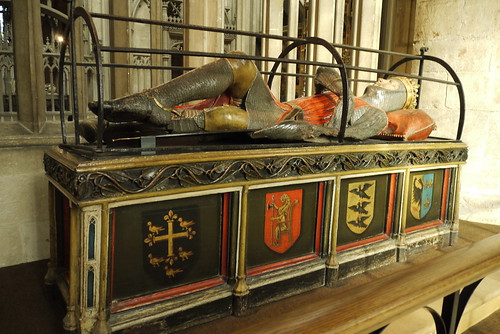
Eldest son of William the Conqueror, and benefactor of Gloucester Abbey. He died in 1134 at Cardiff Castle, a prisoner of his youngest brother, King Henry I.
6 Comments CherryPie on Mar 2nd 2016
Filed under Colwall 2016, Faith Foundations, Holidays
Gloucester Cathedral – The Chapel of St Thomas
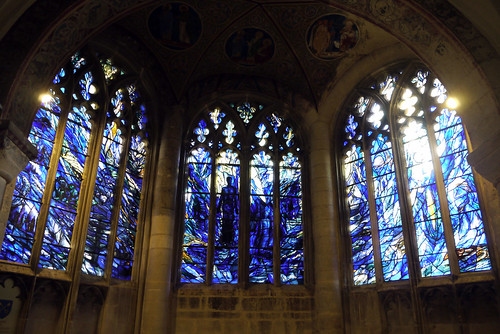
The vivid glass, by Tom Denny, was commissioned in 1990 and installed in 1992 to celebrate the 900th anniversary of the beginning of Abbot Serlo’s building of the new abbey in 1089. The theme of the windows is that of ‘praise’. Tom’s inspiration being Psalm 148: ‘Praise the Lord from the heavens, praise him in the heights’.
Initially the design appears to be abstract, but look carefully. The window on the left evokes the praise offered by creation, and here you will find (in the words of the Psalmist) ‘fruitful trees and all cedars; beasts and all cattle; kings of the earth and all people’. The right-hand window reflects the praise offered by the elements, and here you can see sun and moon, fire and hail, wind and storm. Notice how the leading gives a feeling of movement.
The central window records the moment when St Thomas realises that he is facing the risen Christ. He kneels, praising, in front of Christ, behind whom can be seen two watching apostles.*
*From Gloucester Cathedral Stained Glass – Gloucester Cathedral 2004
6 Comments CherryPie on Mar 1st 2016
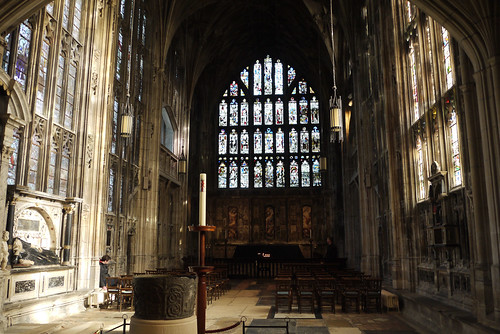
An intimate space for worship and contemplation, Gloucester Cathedral’s magnificent Lady Chapel was the last part of the church to be built during the Medieval period in the 15th century.
Dedicated to ‘Our Lady’, the Blessed Virgin Mary, the mother of Jesus, the Lady Chapel is unique in its design and decoration.
It has a vaulted roof on a series of stone arches filled with stained-glass windows; these were made by the famous Arts and Crafts designer Christopher Whall in the early 1900s.
In front of the altar are the wooden rails made in 1617 on the orders of William Laud (Dean of Gloucester until 1621). Behind the high altar, the Chapel’s reredos bears the scars of the Reformation and the Civil War – a poignant reminder to all.
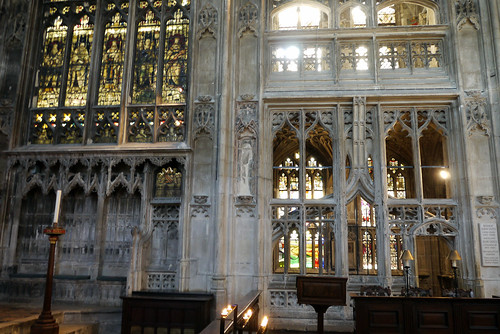
Devotion to the Virgin Mary in England was demonstrated not only by the building of Lady Chapels but also through the development of a particular type of musical anthem. Whereas the monks of the medieval abbeys sand Gregorian plainsong, the songs in praise of the Virgin – Marian antiphons’, as they are known – required a full range of voices; treble, alto, tenor and bass. This led to boys being brought in to sing in the lady chapel. By the middle of the fifteenth century adult male singers who were not monks would be employed. At Gloucester two singing galleries were constructed, one n the north and one on the south, from which two choirs could sing, calling and responding to each other – ‘antiphonally’ – across the chapel.
Dazzling to the eye heavy with incense and filled with glorious music for the Virgin, the Lady Chapel was intended to overwhelm the worshipper with devotional intensity.*
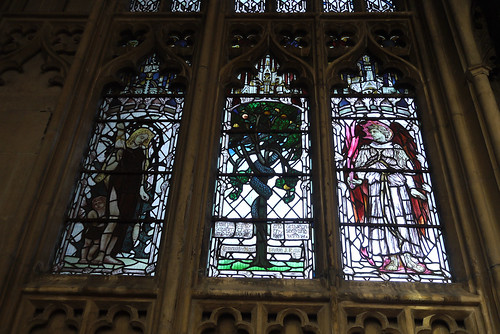
*From Gloucester Cathedral FAITH, ART AND ARCHITECTURE: 1000 YEARS by Chapter of Gloucester Cathedral 2011
8 Comments CherryPie on Feb 29th 2016
A friend is “trust”, a friend is “warmth”,
A friend is “always there”
To add to every happiness,
To lessen every care.
Anon
7 Comments CherryPie on Feb 28th 2016