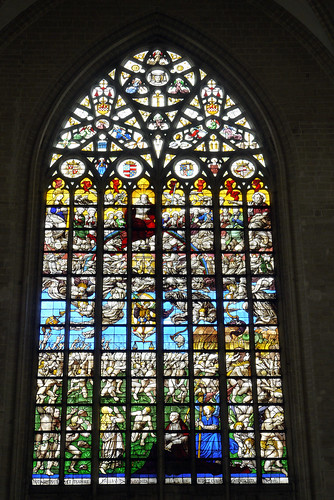
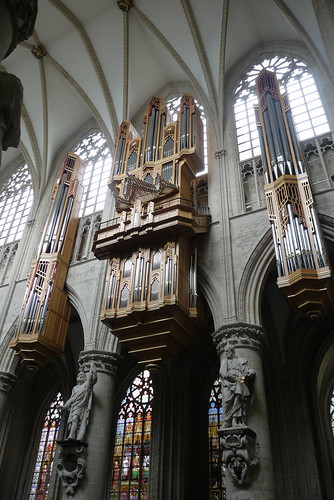
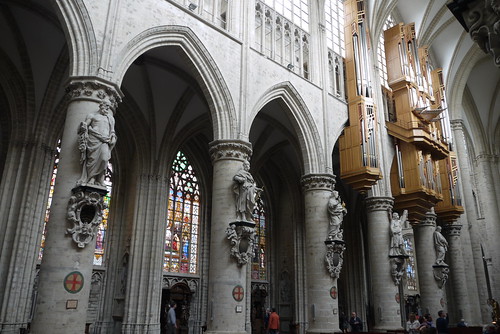
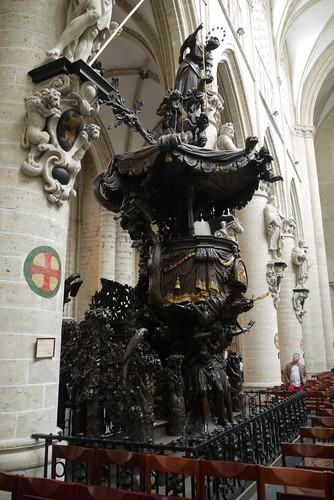
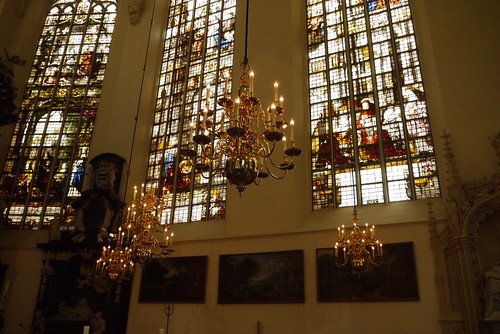
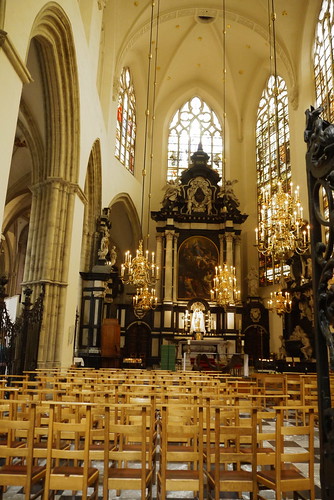
Owing to the ransackings by Protestant iconoclasts in 1579 and thefts by French Revolutionists in 1793, the interior of the cathedral is far less rich than it was in medieval times. It nonetheless contains some fine stained glass, such as the Last Judgement Window, dating from 1528, on the west front of the cathedral, facing the altar.*
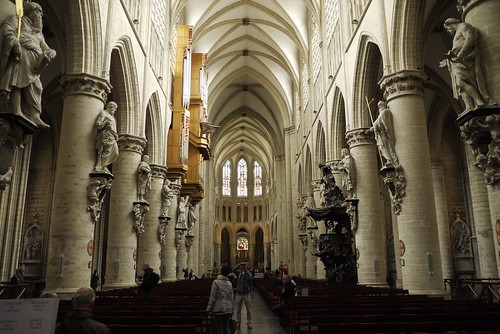
Also of particular interest is the beautiful and original Grenzing organ.*
The flamboyantly carved Baroque Pulpit in the central aisle depicts Adam and Eve’s expulsion from Paradise. This pulpit, by the Antwerp-born sculptor Hendrik Verbruggen, was built in 1699, although it was not installed till 1776.*
*From The Belgium & Luxembourg Eyewitness Travel Guide.
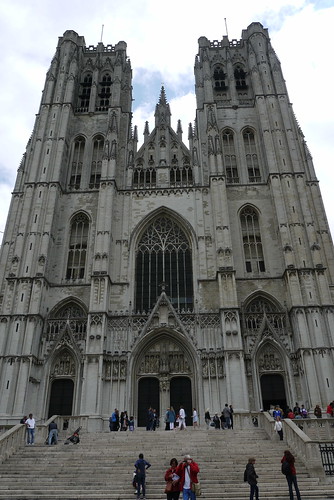
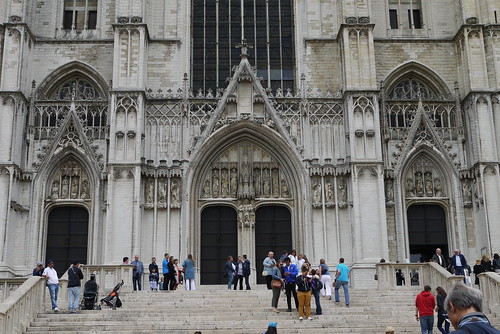
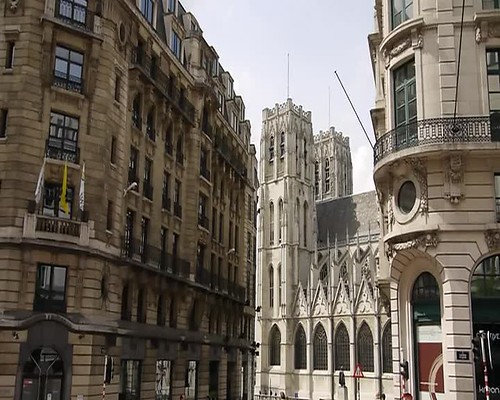
Although it is the national church of Belgium. Cathedrale Sts-Michel-et-Gudule was granted cathedral status only in 1962. It was built with a sandy limestone brought from the local quarries and is one of the finest surviving examples of Brabant Gothic Gothic architecture
There has been a church on the site of the cathedral since at least the 11th century. Work began on the Gothic cathedral in 1226 under Henry I, Duke of Brabant, and was finally completed 300 years later at the begining of the 16th century, under the reign of Charles V. It was dedicated to the city’s patron saints, archangel Michael and a local 8th-century pious woman, St Gudule.*
The pillars of the nave are decorated with statues of the 12 apostles.
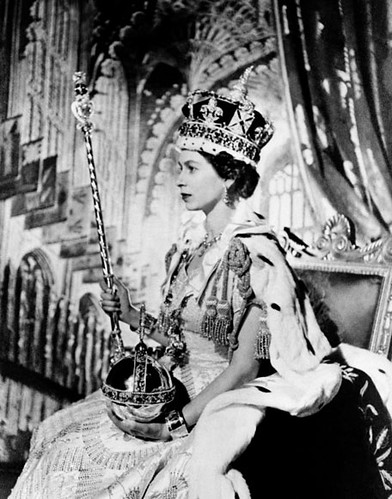
The coronation was delayed for more than a year because of the tradition that such a festival was inappropriate during the period of mourning that followed the death of the preceding sovereign. In the ceremony itself, Elizabeth swore an oath to uphold the laws of her nations and to govern the Church of England. Celebrations took place and a commemorative medal was issued throughout the Commonwealth realms.
The Coronation ceremony of Elizabeth II followed a similar pattern to the coronations of the kings and queens before her, being held in Westminster Abbey, and involving the peerage and clergy. However, for the new Queen, several parts of the ceremony were markedly different. The coronation of the Queen was the first ever to be televised (although the BBC Television Service had covered part of the procession from Westminster Abbey after her father’s coronation in 1937[10]), and was also the world’s first major international event to be broadcast on television. There had been considerable debate within the British Cabinet on the subject, with Prime MinisterWinston Churchill against the idea; but, Elizabeth refused her British prime minister’s advice on this matter and insisted the event take place before television cameras,[11] as well as those filming with experimental 3D technology.[n 1][12] The event was also filmed in colour, separately from the BBC’s black and white television broadcast.[13] Millions across Britain watched the coronation live, while, to make sure Canadians could see it on the same day, RAF Canberras flew film of the ceremony across the Atlantic Ocean to be broadcast by the Canadian Broadcasting Corporation,[14] the first non-stop flights between the United Kingdom and the Canadian mainland. In Goose Bay, Labrador, the film was transferred to a Royal Canadian Air ForceCF-100 jet fighter for the further trip to Montreal. In all, three such voyages were made as the coronation proceeded.[15]
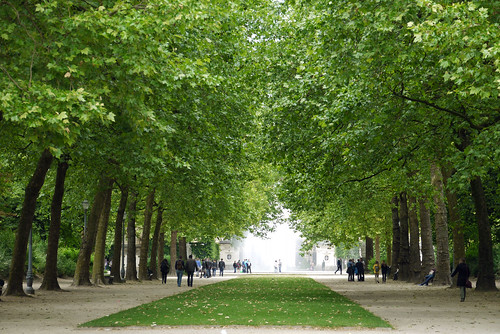
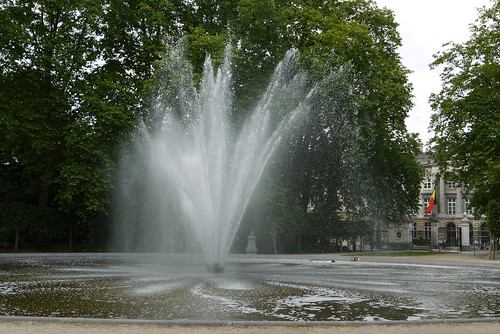
Palace of the Nation houses the parliament today. This forms an harmonious part of the perspective of Parc de Bruxelles. A symbolic site of the Belgian revolution of 1830, it was occupied by the people of Brussels during the attack against the Dutch.*
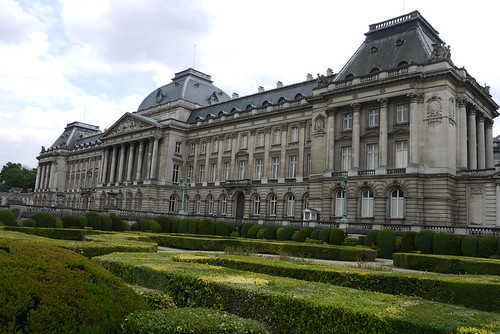
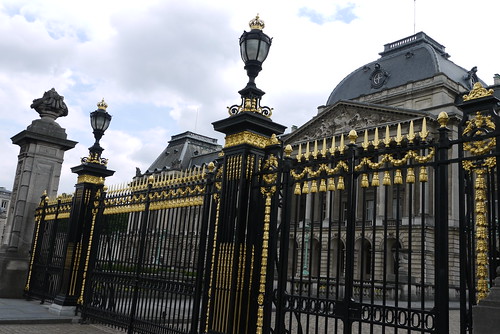
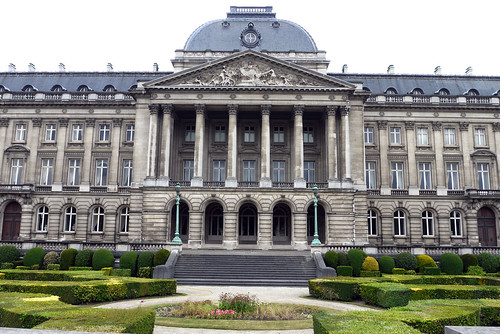
Consisting of two 18th-century mansions joined together by King William I of Holland. It was Leopold II who extended it into a royal palace by designing a new facade combining the side pavilions by two symmetrical wings and a portico surmounted by a sculpted pediment. It houses the offices of the royal family and is open to the public in summer. When the national flag is flying on top of the palace it means the King is in Belgium.*