The Crucified of Piran

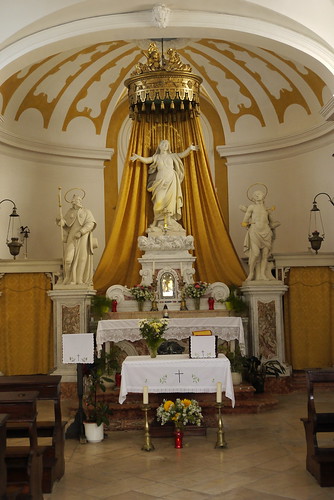
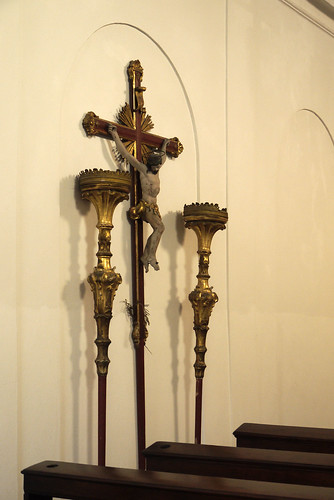
The Crucified from Piran is located with in the Church of St George.

In 2009 a glass case was installed above the choir banks on the right-hand side of the presbytery to keep the Crucified from Piran, one of the key monuments of the Mediaeval sculpture art in Slovenia. The Gothic art especially intensifies the martyrdom of Christ on the cross. The original location of the sculpture is not known. It might have originally hung in the church at Bernardin. For a long period of time it hung in the baptistery of the St. George church in Piran.

The Crucified from Piran is a monumental wooden sculpture on the Y-shaped cross symbolizing the tree of life. The experts (Emilijan Cevc, PhD) consider it to be the work of a travelling Venetian carver or workshop. Originally it was considered to have been made between 1370 and 1380, however the conservation and renovation works later showed that it was probably made in the beginning of the 14th century.*

The Crucified of Piran

Photograph from a leaflet by The St. George Treasures Association

*From a leaflet by The St. George Treasures Association

2 Comments CherryPie on Dec 5th 2015

Untitled

Above the compact town centre reigns St. George’s Cathedral, which gives the city its special character. It was probably built in the 12th century, but no exact data in this regard exists.

In the 14th century, it was built to its present size. In the year 1344, on the Day of St. George, the cathedral was consecrated by nine bishops from near and far. It acquired its present appearance after Baroque renovation in the year 1637. The Bell Tower was completed in 1608, and the Baptistery in the year 1650. During these years, reinforcements were made to the hill on which the cathedral rests.

The supporting walls were built in the year 1641, and on the sea side, the hill was fortified with stone arches. The construction of the stone arches began in the year 1663 and lasted until 1804. They were seriously dilapidated due to the effects of erosion, and thus had to be reconstructed and restored in 1998.

Untitled

Untitled

Among the important pieces of the cathedral’s property is the church organ, made by Petar Nakić, a Franciscan monk from Dalmatia. After his theology studies in Venice, he was trained in organ making and in the year 1729 completely dedicated himself to this craft. His organ in Piran was installed in the year 1746 and had 16 ranks. Unfortunately, it was damaged and had to go through a series of restorations.

During World War I, it was severely damaged. All the larger pipes were removed to be melted into weapons. Almost 100 years before that, its keyboard in the manual was changed by A.V. Rossi from Trieste. In the year 1936, it was reconstructed by G. Bencz, but he did not restore the original disposition. In the year 1956, several adjustments were made by V. Rebolj, and so the set up of the organ today considerably varies from the original.

Untitled

6 Comments CherryPie on Dec 4th 2015

Church of St George

The bell tower predominates over the town of Piran.

The Bell Tower from the Harbour

This [the bell tower] was completed in 1608 and is a small-scale copy of the campanile of San Marco in Venice, which confirms that it was built in the period of the Venetian influence on Piran. Among other newer bells, there is also a bell from the 15th century.*

Archangel Michael from the Town Walls

Archangel Michael

On top of the bell tower is a fabulous statue of the Archangel Michael, which I noticed immediately on my arrival in Piran. On that day he had his back to the square but when I walked round to the sea front to photograph his front profile I noticed he still had his back towards me…

When I arrived in Piran, I noticed he had his back to the square and was facing towards the sea. Today however he had his back to the sea and I began to doubt myself…

Whilst pondering the possibility that I might have made a mistake he appeared to move slightly. As I stared at him he moved 40o to face more towards my direction! We began to suspect that Archangel Michael was more than he seemed.

Closer inspection revealed that Michael has a hidden secret, he is in fact a gigantic weathervane.

Church of St George

*From the Piran Tourist Guidebook

4 Comments CherryPie on Dec 3rd 2015

Cerkev SV. Roka

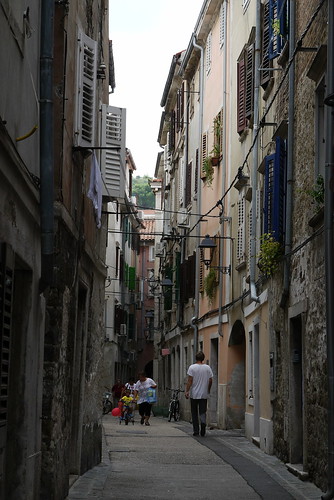
The end of the alleyway in my previous post opens up into a small square when one of many small hidden churches can be found. The Square of Fraternity is also know as the Rok market. The church was built at the end of the sixteenth century and is dedicated to St. Roch.

He went on pilgrimage to Rome and devoted himself to caring for the victims of a plague that was ravaging Italy. He became a victim himself at Piacenza but recovered and was reputed to have performed many miracles of healing.

Cerkev SV. Roka

Cerkev SV. Roka

4 Comments CherryPie on Dec 2nd 2015

…leads to hidden wonders.

The Road Less Traveled

A Hidden Wonder

6 Comments CherryPie on Dec 1st 2015

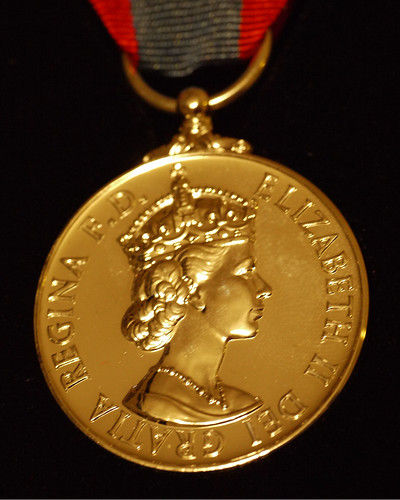
Imperial Service Medal

Earlier this year I was informed that I had been awarded the Imperial Service Medal. My name along with a number of my colleagues names was published in the London Gazette 2nd June 2015.

Madam,

I am commanded to forward the Imperial Service Medal which Her Majesty The Queen has been graciously pleased to award to you in recognition of the meritorious services which you have rendered.

I have the honour to be, Madam,

Your obedient servant,

J M Vernon

Registrar of the Imperial Service Order
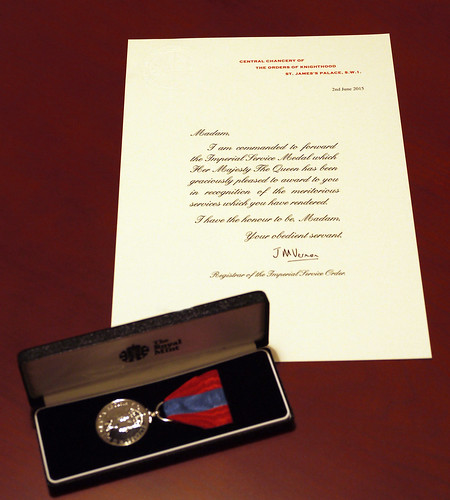
Imperial Service Medal

On Friday 27th November 2015 a of few of those colleagues awarded with the medal, accompanied by family members gathered together for a formal award ceremony where we were presented with our medals. After the formal proceedings and presentation of medals there was a buffet which allowed us to socialise and enjoy the occasion.

The Imperial Service Medal Citation

Throughout history Monarchs and governments have realised the value and indeed the necessity, of giving some kind of reward as a token of their appreciation of loyal and devoted service or gallantry in battle.

In earlier times this might have taken a tangible form such as gifts of land and money; honours were often given in the form of gold chains, badges or medallions, and awards for gallantry in the form of accoutrements and weapons.

Since the middle ages these have gradually been replaced by peerages, knighthoods and the Insignia of Orders of Chivalry.

The Imperial Service Medal is an award within the Imperial Service Order which was created and instituted on 8th August 1902 by King Edward VII who wished to recognise more fully the faithful and meritorious services rendered to him by members of “The Civil Service of various parts of the Empire’”.

The Imperial Service Medal is governed by statute and is awarded to those employees in industrial and certain non-industrial grades who, on retirement from the Civil Service, have completed not less than 25 years faithful and meritorious service.

The obverse of the medal bears the effigy of the Sovereign and the reverse the words “For Faithful Service” and a design symbolising:

“The enjoyment of well-earned retirements” from the Civil Service.

24 Comments CherryPie on Nov 30th 2015

We need time to dream, time to remember, and time to reach the infinite. Time to be.

Gladys Taber

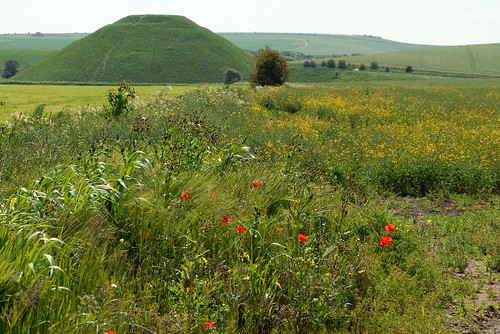
Silbury Hill

16 Comments CherryPie on Nov 29th 2015

« Newer Posts - Older Posts »