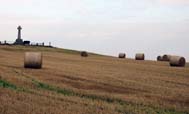
Hexham Abbey

The FONT, the place of baptism, or christening, stands on a plinth at the west end of the nave. It is a composite creation which tellingly symbolises the long history of Wirlfrid’s church. The large circular bowl is believed to be Roman, possibly an inverted pillar-base; it is set on a medieval carved stone base decorated with typically 13th-century dog-tooth decoration; the fine wooden cover is 17th century; while the great canopy above it, more than six metres tall, was made in 1916 by a Belgian refugee, re-using 15th-century woodwork.*

Behind the canopy a stained glass window has two tiers showing the Northumbrian saints and below them a tier showing episodes from the saints’ histories.

*From the Hexham Abbey guidebook

11 Comments CherryPie on Nov 21st 2015

Frith Stool

The Frith Stool stands in the middle of the Choir at Hexham Abbey, a solid block of sandstone that was broken in two during the 19th century and cemented together again; the stone has been worn smooth by human hands over many centuries. It was made into a seat in the earliest days of the church, probably in the 7th century, and it has played a part in its story ever since.

When Wilfrid founded the first church at Hexham he was Bishop of the Northumbrians with his seat at York; but later he became abbot and bishop here at what was then known as the Hagustaldian Church, so almost certainly he sat on this as his throne; with, it is to be hoped, a cushion. Hexham was a cathedral, at the centre of a diocese, from about 678 to about 821, and this throne was perhaps made the bishop’s official cathedra.

Wilfrid used stones brought from the Roman ruins at Corbridge for his church, and this large block of stone too may have been quarried originally by Roman workmen. Probably Wilfrid’s own Anglo-Saxon Northumbrians scooped out the seat and carved the simple patterns on the arms and front. There parallel straight lines to emphasise the outline of the seat, and an interlace design on the upper side of the arms ending in a triquetra. The same pattern appears in a manuscript illumination of St Matthew seated in a wooden chair that was painted at Canterbury perhaps about 750; but the design is so simple that it could have been carved at almost any time. The seat seems to have been set against a wall, in the middle of stone benches for other clergy; and perhaps it was once on stone supports carved in animal form, rather like larger versions of the beasts now in the niches of the nave.

Prior Richard, who led the new community in its early days and was the first historian of Hexham, wrote of it with pride, calling it the FRITH STOOL The Frith Stool was ‘the Chair of Peace’. Frith, though now obsolete, was common enough in Prior Richard’s time and long before, in Anglo-Saxon English and Old German, meaning peace, security and freedom from molestation. Different forms of the word are found in the name ‘Frederick’ (peace-ruler) and the modem German words for peace, Friede, and churchyard, Friedhof. Many of the greater churches had such frith stools placed, as was this one, close by the high altar. Refugees in time of trouble and civil war, or wrongdoers in flight from authority and justice could claim the protection of the Church until they were assured of a full and fair trial. Anyone breaking the right to sanctuary by taking or killing a refugee within the church was liable to a fine of £96; but, writes Prior Richard, if the victim reached ‘the stone cathedra next to the altar, which the English call the fridstol’, that breach of sanctuary was beyond pardon, and the culprit faced excommunication or death.

The Frith Stool remained close by the high altar throughout the Middle Ages, and it was certainly used in the troubled times of the Border Wars, though we cannot be sure just how much safety it guaranteed. Deserters and petty thieves found their way to the protection of the Priory Church and became ‘grithmen’. In Edward Ill’s reign, the king authorised the recruitment of such wrongdoers into the army. In Tudor times the right of sanctuary was strictly limited, for Henry VIII would allow no one to defy the royal law; and it was completely abolished soon after.

2 Comments CherryPie on Nov 20th 2015

Hexham Abbey

HEXHAM ABBEY, dedicated to St Andrew, is one of the earliest surviving Christian foundations in Britain and for much of its history has reflected two very different Christian lifestyles: the enclosed community of men living by a monastic rule and the open community of the faithful who come together regularly to share in acts of worship. Built in 674-8 as a Benedictine monastery, a centre for the spread of the Christian faith and place of pilgrimage, by the formidable Wilfrid, bishop of York, it almost immediately became a cathedral church when the huge see of York was divided into four in 681 – much to Wilfrid’s disapproval – and Hexham became a bishopric. Wilfrid’s monastery was damaged by Viking raids in the 9th centruy, when the church was handsomely rebuilt as both a monastic and a parish church. Serving solely as a parish church after the Dissolution of the Monasteries, it was again substantially restored and rebuilt in the 19th and early 20th centuries to create the impressive and dignified building we see today.*

Hexham Abbey

Built on a spur of land looking east across the Tyne valley just below the point where the North and South Tyne rivers combine, the church was one of the first to be built of stone, on a magnificent scale and possibly to a Roman-style basilica plan which was unique in Britain at the time and could well have been inspired by Wilfrid’s travels. Wilfrid’s follower and biographer Eddius Stephanus described its ‘crypts of beautifully dressed stone, the vast structure supported by columns of various styles and numerous side-aisles, the walls of remarkable height and length… we have never heard of its like this side of the Alps.’*

Hexham Abbey

Hexham Abbey

Hexham Abbey - The Night Stair

*From the Hexham Abbey guidebook

16 Comments CherryPie on Nov 19th 2015

The Tyne Bridge from the Hotel Vermont

Over the years I have stayed in many hotels in Newcastle. I first encountered the Hotel Vermont in 2013 and, although on that occasion I only stayed there for one night I immediately fell in love with it. Now it is my choice of accommodation when I stay in Newcastle.

From the hotel website:

The Vermont Hotel offers a host of facilities and services designed to make your stay in Newcastle as enjoyable as possible.

If you are looking for a Newcastle Hotel then few hotels can boast a more enviable city centre postcode than the Vermont Hotel, for this imposing structure is located in the heart of the City of Newcastle-upon-Tyne, not only next to the Castle Keep and opposite the historic Moot Hall, but also just two minutes from Newcastle’s Central Station.

Combining old character in the form of 1930s grandeur with contemporary elegance and four-star luxury, the landmark building is your base from which to discover the many bars, shops and attractions of the town centre and wider area.

If you searched for hotel Newcastle and found us you will be pleased you did. Look outside your window and you will see such sights as the River Tyne, Millennium Bridge or stunning cathedral.

The Hotel Vermont from the Black Gate

The Hotel Vermont & The Castle Keep

Room to Relax

4 Comments CherryPie on Nov 18th 2015

Shining Through

Light Reflections

Through the Half Open Door

The Percy Chantry

Tynemouth Priory

8 Comments CherryPie on Nov 17th 2015

Scarab Beetle

We booked a taxi to take us to the coach in good time for our annual trip to London. Normally, we drive and leave the car outside the local supermarket but on this occasion the trip coincided with an annual bonfire event and the place would be teeming with people. The journey to London ran smoothly; we didn’t even get caught up in traffic for the Lord Mayor’s Show which was taking place that day.

Once in London, we headed towards the British Museum to visit the Egyptian Sculpture Gallery. I noticed a few things that I don’t remember seeing before, including an enormous scarab beetle:

This is one of the largest representations of scarab beetles to survive. It also ranks among the last great statues of any pharaonic deity. The scarab represented Khephri, the form assumed by the sun-god at dawn. The Egyptians noticed that scarabs hatch from buried dung balls as if by self-creation. The sun-god was also believed to be self-creating, renewing his powers each night before his rebirth at daybreak. Each sunrise was a repetition of the god’s first appearance at the dawn of time as the creator at Atum.

The statue is made of quartz diorite, a stone not normally used in Egyptian sculpture. Three ancient quarries have been identified, deep in the Eastern Desert. Their exploitation is archaeologically confirmed for the Roman Period, but the subject and workmanship of this piece suggest that it was made a bit earlier under the Ptolemies.*

London Transport

After our brief visit to the museum we made our way to the nearby Spaghetti House for lunch before going on our way to the Churchill Cabinet War Rooms for the afternoon. By this time, the weather had turned rather inclement so we were glad to get inside. The Cabinet War Rooms, hidden in an underground bunker beneath the streets of Westminster, protected the staff and secrets at the heart of Britain’s government during the Second World War as Churchill and his inner circle plotted the defeat of Germany. I have been before and it was just as good as I remembered although on this occasion it was a lot busier than on my previous visit.
We had time to spare before it was time to return to board the coach so we spent some time in Foyles bookshop. I found the floor listings quite confusing and one of the sections I was interested in didn’t even have a number next to it. I think they are still organizing the shelves after the relocation from the next door building. After we had browsed around in the bookshop we made our way back to the coach pick up location in Park Lane. The coach arrived on time and we ate sandwiches that we had purchased earlier in the day as we settled down for the journey home.

The journey was good until we reached Birmingham where we encountered severe cross winds. The bus swayed from side to side quite alarmingly. I was muttering quietly that the driver should slow down as I feared the bus was likely to tip over due to the violence of the swaying. At this point one of the ladies thought it would be a good idea to stand up in the aisle and show mobile phone photographs to the people in the seat behind!! The bus did slow down for a while only to speed up again causing the bus to sway from side to side again though not quite so alarmingly as it had done previously. Shortly afterwards there was a loud bang, not unlike the sound of gunshot followed by a ricocheting noise then silence. The tyre had blown which led to the driver slowing right down and crawling all the way to the M54 coming off at junction 1 to park in a safe place so that the damage could be assessed.

It would be two hours before a tyre company could come and replace the tyre but luckily the coach company was able to find a driver that could bring a relief coach to rescue us. At least we weren’t stuck on the coach for four hours as we had been on a previous trip. The new coach arrived and we arrived at our destination an hour later than scheduled which caused a problem booking a taxi due to it being peak time but it all worked out in the end.

As we had got on the coach that morning we were told that this would possibly be the last trip (after 35 years). If this proves to be the case we certainly went out with a bang!!!

*From an information board next to the scarab beetle.

6 Comments CherryPie on Nov 16th 2015

Roll on, thou deep and dark blue ocean, roll!
Ten thousand fleets sweep over thee in vain;
Man marks the earth with ruin – his control
Stops with the shore.

Lord Byron

Shoreline

15 Comments CherryPie on Nov 15th 2015

« Newer Posts - Older Posts »