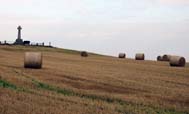
Tynemouth

From Wiki:

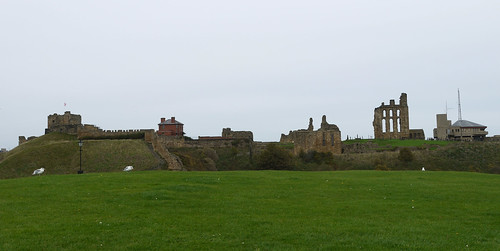
The headland towering over the mouth of the Tyne has been settled since the Iron Age. The Romans occupied it. In the 7th century a monastery was built there and later fortified. The headland was known as PEN BAL CRAG

The place where now stands the Monastery of Tynemouth was anciently called by the Saxons Benebalcrag

— Leland at the time of Henry VIII

The monastery was sacked by the Danes in 800, rebuilt, destroyed again in 875 but by 1083 was again operational.[3]

Three kings are reputed to have been buried within the monastery – Oswin – King of Deira (651); Osred II – King of Northumbria (792) and Malcolm III- King of Scotland (1093). Three crowns still adorn the North Tyneside coat of arms. (North Tyneside Council 1990).

The queens of Edward I and Edward II stayed in the Priory and Castle while their husbands were campaigning in Scotland. King Edward III considered it to be one of the strongest castles in the Northern Marches. After Bannockburn in 1314, Edward II fled from Tynemouth by ship.

A village had long been established in the shelter of the fortified Priory and around 1325 the then Prior built a port for fishing and trading. This led to a dispute between Tynemouth and the more powerful Newcastle over shipping rights on the Tyne which continued for centuries.

Tynemouth Priory & Castle

Lord Collingwood Memorial - Tynemouth

Tynemouth

12 Comments CherryPie on Nov 12th 2015

…and in the morning, we will remember them.

Lights Out - 4th August 2014

During 2014-2018 a series of nationwide and international events are taking place to commemorate the centenary of World War One. The series of events is being led by the Imperial War Museum, which has a dedicated website entitled 1914.org.

The events will serve to remind us of those who sacrificed their lives so that we can enjoy the freedoms we have today as well as reminding us to be grateful for their sacrifice.

Poppies in the Moat

One of those events was the planting of 888,246 poppies in the moat around The Tower of London, one poppy for each fallen British and Commonwealth servicemen. As Remembrance day 2014 approached, a sea of poppies filled the moat as a visual reminder of the number of those who sacrificed their lives and the blood lost…

Following Remembrance day in 2014 most of the poppies were sold to members of the public in support of six service charities; Cobeso, Combat Stress, Coming Home, Help for Heroes, The Royal British Legion and SSAFA.  Poppies that were part the ‘Wave’ and the ‘Weeping Window’ were held back so they could ‘Go on Tour‘ and be displayed at different venues around the country to allow more people to have the chance to see them and reflect. When the country tour concludes in 2018 the touring poppies will be permanently housed at the Imperial War Museums in London and Manchester.

The poppy fields as described by the ‘War Poets’ are a poignant reminder to me of the lives that were lost in both World War One and World War Two and also the lives lost in more recent wars.

Poppies to me are a simile of the lives that were lost. They are vibrant, standing strong and bold yet fragile and defeated by a heavy downfall or a spring breeze. They remind me of the fragility of peace and freedom and how easily our freedom can be lost.

Reflection on World War One (and the more recent World War Two) serve as a reminder of what might have been if the outcome of those wars had been different…

In Flanders Fields

In Flanders Fields the poppies blow
Between the crosses row on row,
That mark our place; and in the sky
The larks, still bravely singing, fly
Scarce heard amid the guns below.

We are the Dead. Short days ago
We lived, felt dawn, saw sunset glow,
Loved and were loved, and now we lie
In Flanders fields.

Take up our quarrel with the foe:
To you from failing hands we throw
The torch; be yours to hold it high.
If ye break faith with us who die
We shall not sleep, though poppies grow
In Flanders fields.

Lieutenant Colonel John McCrae
1915

13 Comments CherryPie on Nov 11th 2015

For some reason my computer has decided to play up this evening. One of the programes has decided to hog all the CPU resources meaning that nothing else will work. So I am resigned to working on my laptop with limited resources and it is sooo slow… Hopefully normal service will be resumed ASAP.

I am leaving my computer to run for now but if it doesn’t settle down I will have to kill the process and re-install. But I really could do without the hassle…

On a lighter note I will leave you with a few photographs from Cragside Formal Garden :-)

Cragside Formal Garden

Cragside Formal Garden

Cragside Formal Garden

Cragside Formal Garden

11 Comments CherryPie on Nov 10th 2015

The Iron Bridge

Nelly's Moss Lake

Nelly's Moss Lake

Nelly's Moss Lake

4 Comments CherryPie on Nov 9th 2015

Just as a fire is covered by smoke and a mirror is obscured by dust, just as the embryo rests deep within the womb, wisdom is hidden by selfish desire.

Bhagavad Gita

Sunset

20 Comments CherryPie on Nov 8th 2015

St Mary's Cathedral

The church was built in the 1840s to a neo-Gothic design by architect August Welby Pugin, famous for his work on the Houses of Parliament in Westminster. It was paid for by halfpenny donations from the poorest community of immigrants on Tyneside, and was enhanced in the following decades by bequests from the Dunn family (especially by the addition of a steeple): the Dunns are remembered in several windows. Very recently it has been further beautified by bequests from various benefactors, most notably from Martin Ballinger (d.2007), who paid for the new floor and organ (installed in 2012-13).

St Mary's Cathedral

A statue of Cardinal Basil Hume (a much loved Archbishop of Westminster) is situated in a memorial garden on the south side of the Cathedral. The garden recalls the Northern Saints and Holy Island (Lindisfarne). The sculpture is the work of  Nigel Boonham, a British portrait artist.

St Mary's Cathedral & Memorial Garden

The Cardinal Basil Hume Sculpture and Memorial Garden was unveiled by the Queen on 7th May 2002, in the year of Her Majesty’s Golden Jubilee. They were commissioned by the Cardinal Hume Memorial Trust in April 2000 to celebrate Cardinal Hume’s life and work and are situated at the southern end of St. Mary’s Catholic Cathedral, Newcastle upon Tyne, opposite Central Station.

The three-metre bronze sculptures shows Cardinal Hume in his Benedictine monk’s habit, wearing a cardinal’s skullcap and the cross of St. Cuthbert. The statue is set in a garden that reflects his love of the holy landscape of Northumbria and of the Northern Saints and stands on a sandstone platform in the shape of Holy Island (Lindisfarne). Hume welcomes people into the garden, indicating with his left hand the way to Lindisfarne. Nearby is the shape of Inner Farne, the remote island where the first monk-bishops of Lindisfarne, St. Cuthbert and St. Aidan, lived as hermits.

The garden features a small boulder taken from Inner Farne and a three-ton boulder taken from below Lindisfarne Castle inscribed with a facsimile of the Moore Manuscript of the 7th century Cædmon’s Hymn – the earliest Christian poem in Old English. Below the bronze plaque is a stone that was once part of the monks quarters at Ampleforth Abbey, Basil Hume’s monastic home.

The Hymn provides a link to two other Northern Saints admired by Hume: St. Hilda, who encouraged the illiterate herdsman Cædmon to become a monk at Whitby and St. Bede who told his story. The translation contains references to a landscape made by God and is the inspirational key to the design of the garden.

The memorial garden is a space for peaceful contemplation with levels of spiritual symbolism that reflect Basil Hume’s life and work. Each level is progressively higher and smaller in area, representing the proportion of men, physically and spiritually, in each state. Hume admired the hermits but his symbolic place in on Lindisfarne as a man of the church acting as a spiritual beacon, indicating the path to the land God made for man.*

Cardinal Basil Hume

Cædmon’s Hymn

Northumbrian Dialect
Nu scilun herga/hefenricæs uard,
metudæs mehti/and his modgithanc,
uerc uuldurfadur/sue he uundra gihuæs,
eci dryctin,/or astelidæ;
he ærist scop/ældu barnum
hefen til hrofe,/halig scepen,
tha middingærd/moncynnæs uard;
eci dryctin/æfter tiadæ
firum foldu, frea allmehtig.

English Translation
It is meet that we worship/the Warden of heaven,
The might of the Maker,/His purpose of mind,
The Glory-Father’s work/when of all His wonders
Eternal God/ made a beginning.
He earliest established/for earth’s children
Heaven for a roof,/the Holy Shaper;
Then mankind’s Warden/created the world,
Eternal Monarch,/making for men
Land to live on,/Almighty Lord!

*From a leaflet about the garden, the statue and the sculptor.

10 Comments CherryPie on Nov 7th 2015

Sunset Over the River Tyne

Comments Off CherryPie on Nov 6th 2015

« Newer Posts - Older Posts »