Then, I am still and wait here in the silence,
Until you come and sit awhile with me.You raise me up, so I can stand on mountains
You raise me up, to walk on stormy seas
I am strong, when I am on your shoulders
You raise me up… to more than I can be.
6 Comments CherryPie on Mar 14th 2015
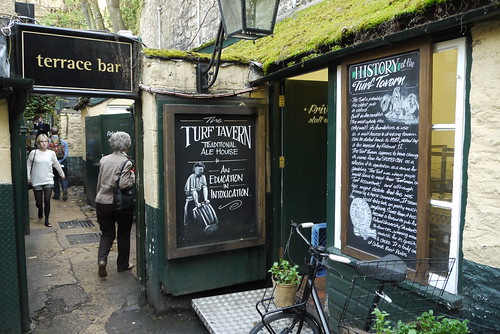
Whilst walking in Oxford, my companions thought I had lost my senses when I suddenly veered off down a narrow alleyway. I had been paying attention the words of a nearby tour guide who was speaking to his group. One of the things he mentioned was this hidden gem. Unfortunately there was not enough time to stop and sample the wares.
Everyone needs a little help to find this famous pub on their first visit. Walk underneath the Bridge of Sighs, down New College Lane and on your left you’ll see a narrow alley called St Helen’s Passage. It doesn’t look as if it leads anywhere but follow it as it winds to the long, low Turf Tavern, named for earlier associations with horse racing. The pub originally a malthouse, lies alongside the old city wall walls and has medieval origins, although most of what you see now is 16th century. The rambling rooms are low-ceilinged and there’s a beer garden with braziers to keep you warm at night.*
*From the Pitkin City Guide to Oxford
23 Comments CherryPie on Mar 13th 2015
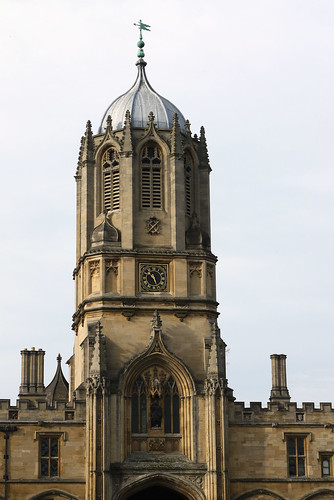
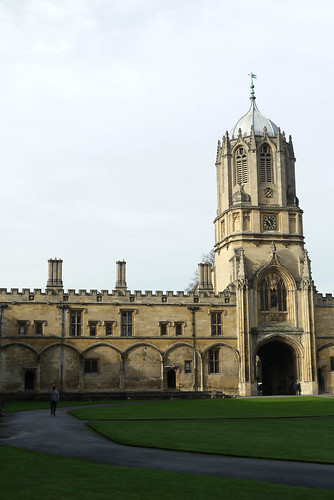
Tom Tower is a bell tower in Oxford, England, named for its bell, Great Tom. It is over Tom Gate, on St Aldates, the main entrance of Christ Church, Oxford, which leads into Tom Quad. This square tower with an octagonal lantern and facetted ogee dome was designed by Christopher Wren and built 1681–82. The strength of Oxford architectural tradition and Christ Church’s connection to its founder, Henry VIII, motivated the decision to complete the gatehouse structure, left unfinished by Cardinal Wolsey at the date of his fall from power in 1529, and which had remained roofless since. Wren made a case for working in a Late Gothic style – that it “ought to be Gothick to agree with the Founders worke”[1] – a style that had not been seen in a prominent building for a hundred and fifty years, making Tom Tower a lonely precursor[2] of the Gothic Revival that got underway in the mid-18th century.[3] Wren never came to supervise the structure as it was being erected by the stonemason he had recommended, Christopher Kempster of Burford.[4]
16 Comments CherryPie on Mar 12th 2015
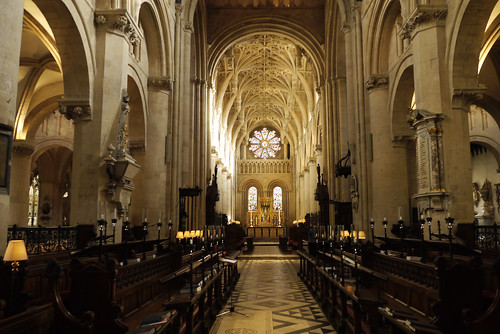
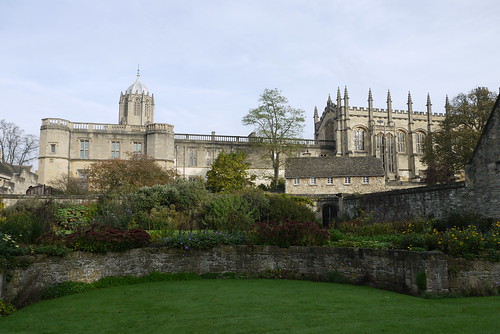
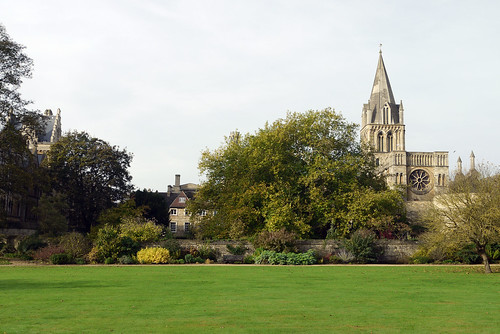
Built during the second half of the twelfth century, Christ Church Cathedral is among the oldest buildings in Oxford and one of the smallest of the 42 Anglican cathedrals in England. It is also, uniquely, both a cathedral and a college chapel, and so, unusually for a cathedral, its centre stalls face inwards in the ‘collegiate style.
It was not, however, until the sixteenth century that it became either a cathedral or a chapel. For 400 years before that it was a priory church belonging to a community of Augustinian Canons (an order of priests who lived a monastic life following the Rule of St Augustine of Hippo). Their church, dedicated to St Frideswide (the patron saint of Oxford), attracted pilgrims who came to venerate her relics, which were housed in her shrine.
The building survived the Reformation of the sixteenth century, at a time when all the other monasteries in Oxford were destroyed, thanks to Cardinal Thomas Wolsey who founded Cardinal College (now Christ Church) here in the 1520s, Wolsey used the land on which the priory had stood to erect his great college, ejecting the Augustinian Canons but incorporating their church into his new project. Most of the monastic buildings survived Wolsey’s work, though part of the cloister was demolished and about 50 ft (15 m) of the nave removed to make way for college buildings.*
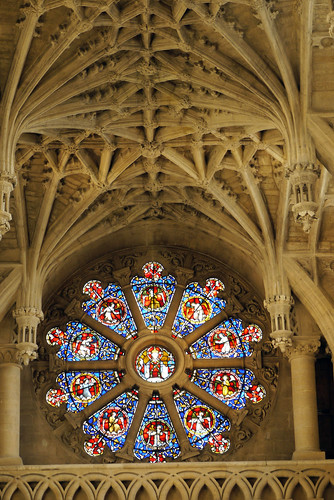
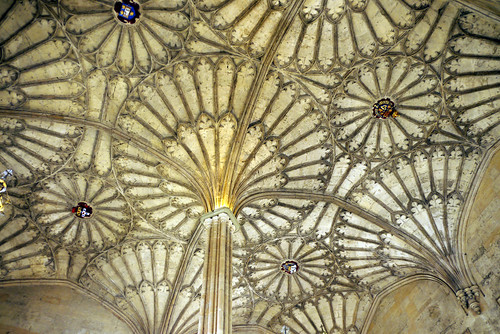
In the chancel can be seen the chief architectural glory of Christ Church; a stone vaulted ceiling considered to be one of the finest examples of its type in any English cathedral. Built in 1500 by the Oxford master mason William Orchard (who also built a similar vault at the Divinity School in the Bodleian Library), its beautiful ribs splay out from 12 stone lanterns which appear to hang miraculously in mid-air. In the centre of the vault small interconnecting ‘lierne’ ribs create eight-pointed stars, forming an image of heaven high above the Cathedral.
At the centre of each section of the vault is a boss, a large carved stone which acts as a keystone, locking the vault in place. The bosses have figures carved on them, which, on moving from west to east, become progressively more significant; a Bishop, an Archbishop, St Frideswide, the Virgin and Child, and finally, in the boss directly above the High Altar, Jesus. One point that is easy to miss is that the very last image, the face of Jesus, is not a star but and octagon. The number eight represents the Resurrection of Christ, which took place on Easter Sunday, traditionally understood as the eighth day of the week, because it follows the Jewish Sabbath, the seventh day of the week. So the stars lead us through the chancel, to the miracle of Christ’s Resurrection.*
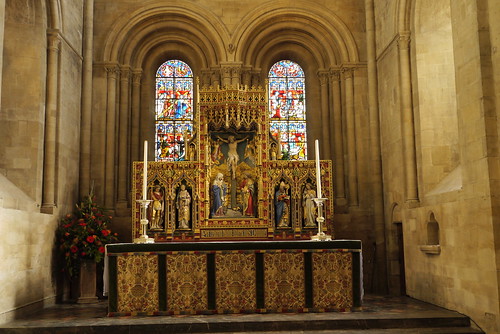
The east end of the Cathedral, the Sanctuary, is the most sacred part of the church, housing as it does the main altar where the congregation meet to share bread and wine in obedience to the words of Jesus at the Last Supper. Behind this altar is a beautifully carved screen or reredos designed by G.F. Bodley in 1881, showing Christ on the cross and a series of Christian saints. They are, from left to right; St Michael, St Stephen, the Virgin Mary, St John, St Augustine of Hippo and St Gabriel.
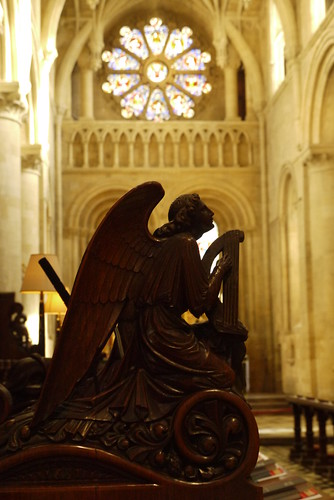
*From Christ Church Cathedral Oxford – A Short Guide
15 Comments CherryPie on Mar 11th 2015
Christ Church was originally founded by Cardinal Wolsey as Cardinal’s College in 1524. The college buildings took over the site of St. Frideswide’s Monastery, which was suppressed by Wolsey to fund his college
The monastery dated back to the earliest days of Oxford as a settlement in the 9th Century AD. When Wolsey fell from power in 1529 the College became property of King Henry VIII. Henry re-founded the College in 1546 and appointed the old monastery church as the cathedral of the new diocese of Oxford. The new institution of cathedral and university college was named Aedes Christi, which is rendered in English as Christ Church. It is due to its ecclesiastical function that Christ Church’s principal, the Dean, is always a clergyman.
During the English Civil War (1642-1646) King Charles I lived at Christ Church. He held his Parliament in the Great Hall and attended services in the Cathedral. After the war and the restoration of the monarchy in 1660, the College was rewarded for its loyalty to the House of Stuart by being able to raise enough money to complete the main quadrangle (Tom Quad).
A former student, Sir Christopher Wren, was commissioned to design a new bell tower in 1682, which houses the bell, Great Tom, from which the tower and the quad get their names.
The Dean who supervised this work, John Fell, was an unpopular man inspired the famous verse, “I do not love thee Dr Fell; The reason why I cannot tell; But this I know and know full well, I do not love thee, Dr Fell”.
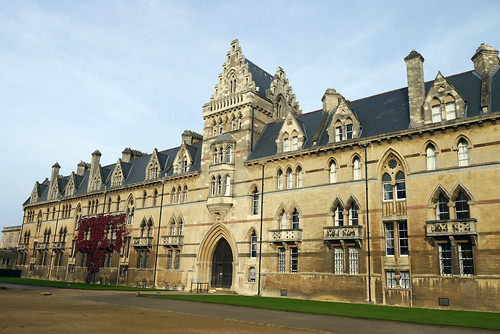
Sitting right in the heart of Oxford but bounded by its Meadow and the Rivers Cherwell and Isis, Christ Church is architecturally stunning. The Cathedral is a Romanesque gem and is entered from Tom Quad (the largest in Oxford and Wolsey’s work). Christopher Wren’s Tom Tower is the college’s most famous feature and an Oxford landmark. Striking additions in the 18th, 19th and 20th centuries complete what is not simply a panorama but a place for living and working.
Follow the footsteps of the world’s favourite wizard through Oxford’s most spectacular College. Many of the scenes in the Harry Potter feature films are shot in various locations of the College and as you walk around the cloisters and quadrangles it is easy to see why.
This continues Christ Church’s long association with children’s literature – Alice’s Adventures in Wonderland were inspired and written here by Lewis Carroll. If you enjoyed the film or the books, come and soak in the atmosphere of a real Hogwarts.
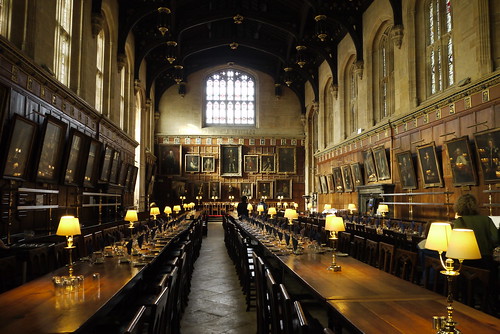
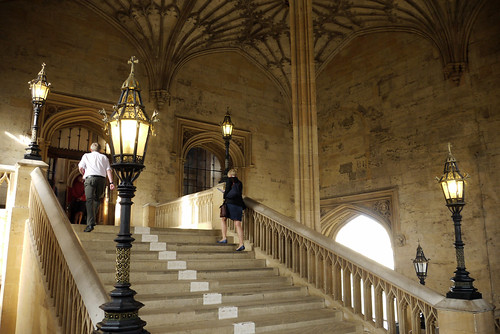
The Great Hall was replicated in the film studios to create Hogwart’s Hall. Only one of our portraits moves, sadly, but many of the faces are the real “Wizards” who have changed the way we understand the world. As Harry and the new first-years enter Hogwarts they are greeted by Professor McGonagall. This scene was shot on the 16th century staircase which leads up to the Great Hall. It was just as well they didn’t film this when the Hall was first built, since the wonderful vaulted roofing was only put up 150 years after the staircase. You would have got very wet going for dinner if it rained!
The cloisters in Christ Church were first built 1000 years ago. This ancient vintage made them the ideal setting for various scenes. It is here that Harry is shown the trophy his father won as a seeker in Quidditch. We don’t know if the monks who originally lived around the cloisters had their own special games. If they did, they took the secret with them when they left 500 years ago. But who knows……….
16 Comments CherryPie on Mar 10th 2015
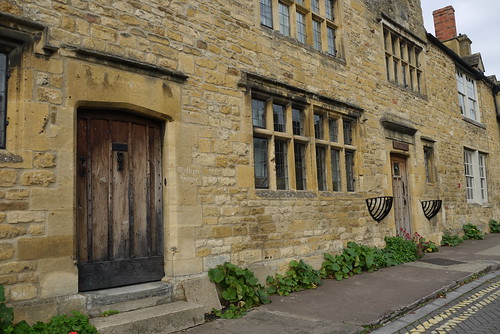
Chipping Campden is one of the loveliest small towns in the Cotswolds and a gilded masterpiece of limestone and craftsmanship. The main street curves in a shallow arc lined with a succession of ancient houses each grafted to the next but each with its own distinctive embellishments.
Pevsner described Chipping Campden as ‘the best piece of townscape
in Gloucestershire, arguably one of the best in England’.As the name suggests (“Chipping” means market or market place from the old English “Ceping”). Chipping Campden was one of the most important of the medieval wool towns and famous throughout Europe. This legacy of fame and prosperity is everything that give the town its character.
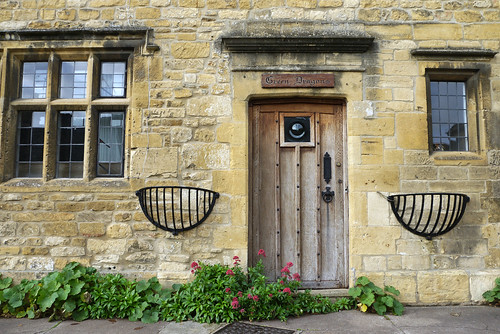
This house is the oldest in Chipping Campden and was built by William Grevel in about 1380. The house would have been one of the first to have chimneys instead of just holes in the roof.
William Grevel was one of the country’s most influential wool merchants, a citizen of London and financier to
King Richard II.Chipping Campden’s wealth came from the Wool Trade.
24 Comments CherryPie on Mar 9th 2015
There has never been a time when you and I and the kings gathered here have not existed, nor will there be a time when we will cease to exist. As the same person inhabits the body through childhood, youth, and old age, so too at the time of death he attains another body. The wise are not deluded by these changes.
The Bhagavad Gita
14 Comments CherryPie on Mar 8th 2015