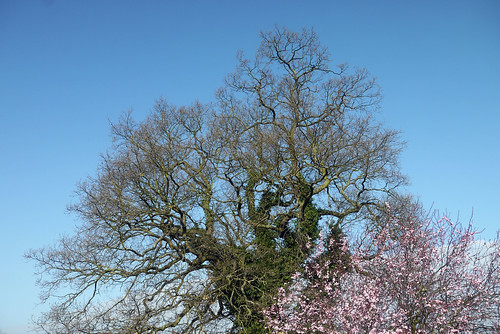
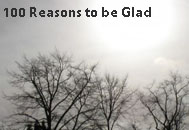
This morning I awoke to a particularly bright and sunny morning. Today was an auspicious day with the Spring Equinox coinciding with a partial Solar Eclipse. The sun was diffused by clouds giving it a pale yellow glow but the moon however was nowhere to be seen. The absence of the illusive moon led me to notice ’my oak tree’ catching the morning sunlight so I took a photo.
I made my way to work and soon after I arrived the daylight dimmed and briefly took on a strange greenish tinge. After this brief interlude the light returned to the more sunny outlook that it had been on my short walk to the office. As to the Eclipse, a small sliver of moon was reported to have passed in front of the sun.
I was reminded of the Solar Eclipse of 11th August 1999. At the time I was working on the third floor of a building that had building wide glass windows. From my desk I was able to watch the sun and moon travelling towards each other. As the time of the eclipse approached I went outside to witness the eerie experience of totality as the moon passes in front of the sun causing the sun’s light to momentarily be erased from the sky.
It’s the first one since 1662 to coincide with the spring equinox. Another unusual feature is that it will beat a path over the Arctic, ending at the North Pole. A further coincidence is that the eclipse will come just a day after a lunar perigee, a point in the moon’s elliptical orbit when it swings closest to Earth and so appears larger than usual.
Coincidentally, a huge solar storm erupted on Tuesday this week and this could affect the eclipse. Researchers in Potsdam, Germany, will be watching closely to see if flares from the storm disrupt the geomagnetic signature of the eclipse, and checking the impact of the eclipse on space weather. There could, with luck, also be an aurora borealis at the same time, although such a coincidence has never been documented before. Eclipses also have a weird effect on gravity .
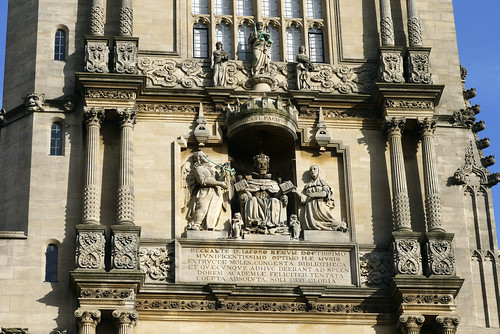
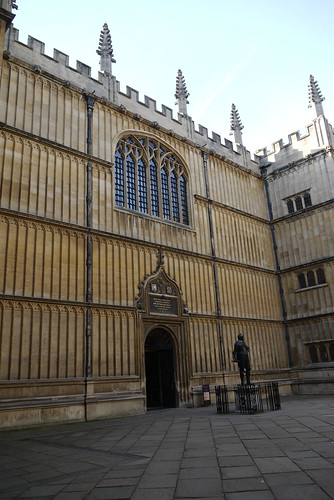
Anthony Wood has given us, along with a detailed description of the carvings, the sad story of the shabby treatment which this magnificent spectacle received at the King’s hands.” ‘The effigies of King James’ he writes’ was cut very curiously in stone, sitting in a throne and giving with his right hand a book to the picture or emblem of Fame, with this prescription on the cm·er: Haec habeo, quae scripsi’, with his left hand he reachetll out another book to our mother, the University of Oxford, represented in effigy kne.ling to the King with this inscription’ Haec haebo quae dedi’, On the verge of the canopy over the throne and the King’s head, which is also most admirably cut in stone, is his motto • Beati pacifici ” over that also are the emblems of Justice, Peace and Plenty and underneath all this an inscription in golden letters: Regnante D. Jacobo, regum doctissimo, munificentissimo, optimo hae musis extractae moles, congesta bibliotheca et quaecumque adhuc deerant ad splendorem Academicae felicita tentata, coepta, absoluta, soli deo gloria, all which pictures and emblems were at first with great cost and splendour double gilt, but when King James came from Woodstock to see the quadrangular pile he commanded them (being so glorious and splendid that none, especially when the sun shined, could behold them) to be whitened over and adorned with ordinary colours, which hath since so continued’ .4′
It was indeed unfortunate that His Majesty first saw the statues in the dazzling brightness of an August afternoon, but it is doubtful if such gaudy city taste would have proved acceptable to him, even in more favourable circumstances, for John de Critz, the King’s painter, had some years previously set on foot a fashion for the more sober hues which were then current in fashionable Court circles.4′*
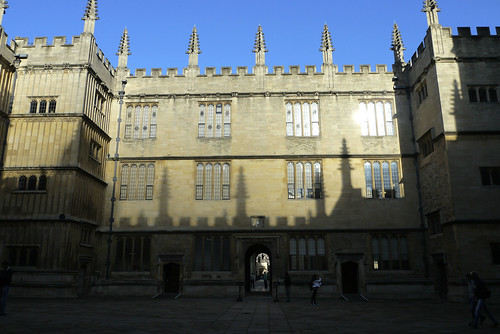
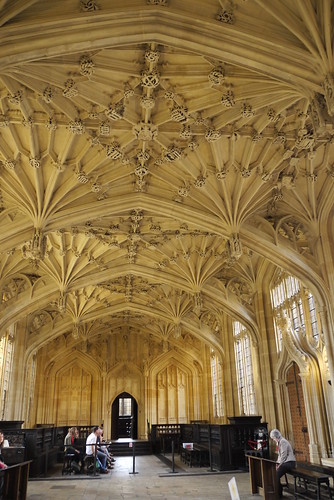
Oxford’s libraries are among the most celebrated in the world, not only for their incomparable collections of books and manuscripts, but also for their buildings, some of which have remained in continuous use since the Middle Ages. Among them the Bodleian, the chief among the University’s libraries, has a special place.
First opened to scholars in 1602, it incorporates an earlier library erected by the University in the fifteenth century to house books donated by Humfrey, Duke of Gloucester. Since 1602 it has expanded, slowly at first but with increasing momentum over the last 150 years, to keep pace with the ever-growing accumulation of books and papers, but the core of the old buildings has remained intact.
These buildings are still used by students and scholars from all over the world, and they attract an ever-increasing number of visitors, for whose benefit this guide has been written.*
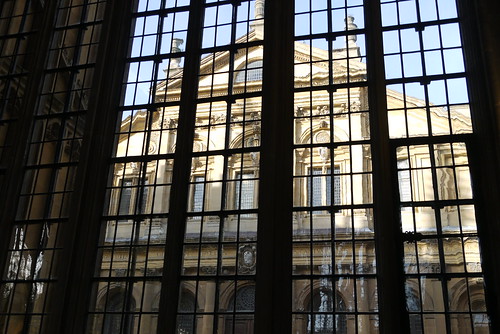
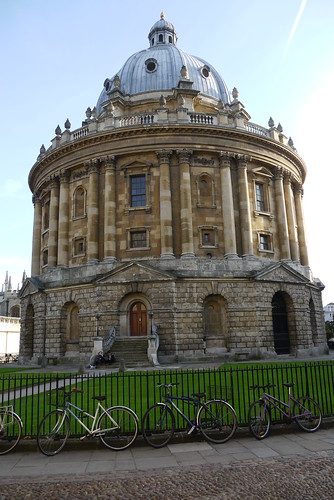
This most memorable of Oxford buildings is now the principal reading room of the nearby Bodleian Library. It was built to house the great library belonging to Dr John Radcliffe, medical adviser to Queen Anne. The concept of a rotunda came from architect Nicholas Hawksmoor, but he died before work was started in 1737 and so James Gibbs made the final design. The word camera means’chamber’ or ‘room’.*
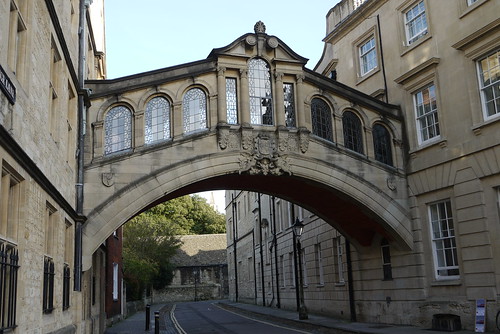
This graceful construction isn’t as old as it looks. It was designed by Sir Thomas Jackson in 1913 to link the Old and New Quads of Hertford College, which are separated by New College Lane. No one calls it by its original name, Hertford Bridge, because of the perceived resemblance to its more famous namesake in the Italian city of Venice.*