From the Royal Pyramids at Nuri

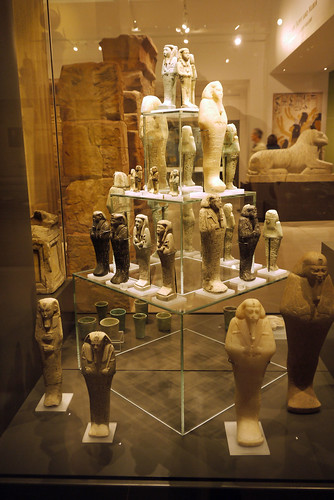
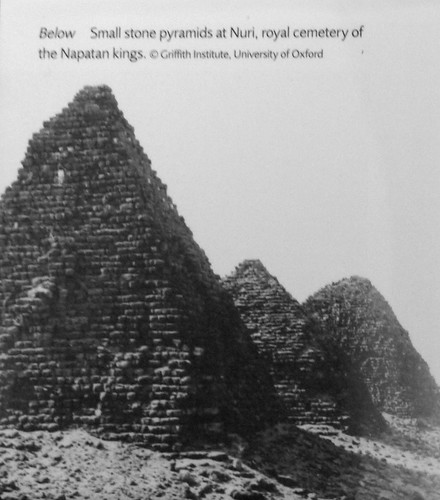
King Taharqa, ruler of Egypt and Kush, was the first Kushite pharaoh to be buried in a tomb at Nuri, cemetery of the captital city, Napata. During the Napatan Period, the adoption of pyramid tombs and objects such as shabtis reflect the extent of Egyptian influence on Napatan culture. The objects in this display were excavated in the royal pyramids at Nuri, and date to the Napatan period.*

Stone Pyramids at Nuri

*From a signboard next to the objects.

12 Comments CherryPie on Mar 27th 2015

University Church - Architecture

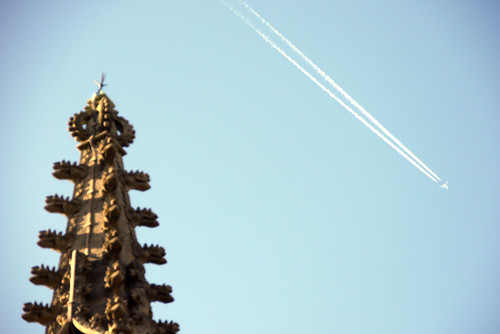
The Church you see today is a mixture of the medieval and the contemporary. It stands as a physical reminder of the deep historic roots of Christianity and of the changing ways in which people have understood God. There was probably a church on the site in Anglo-Saxon times, but the earliest part of the present building is the Tower, built in 1280.  The ornate spire was added a little later, between 1315 and 1325 – giving University Church the most distinctive and beautiful of Oxford’s ‘dreaming’ spires.

The Adam de Brome Chapel

Shortly after the Tower was completed, a Chapel was added to the Church by the Rector, Adam de Brome.  He was an influential clergyman and scholar who also established, in 1324, a new college now known as Oriel.  His tomb was placed in this Chapel and can still be seen, although the brass fittings were stolen from it in the seventeenth century.

For centuries the Chapel was used as a courtroom, from where the Chancellor of the University exercised a surprisingly wide jurisdiction over life within the city.  Records show that he fixed rents, fined sellers of bad meat, and even sent a ‘scolding woman’ to prison.  The woodwork in the Chapel today dates from 1733, and was repainted during the recent restoration.*
University Church - Architecture

The Chancel

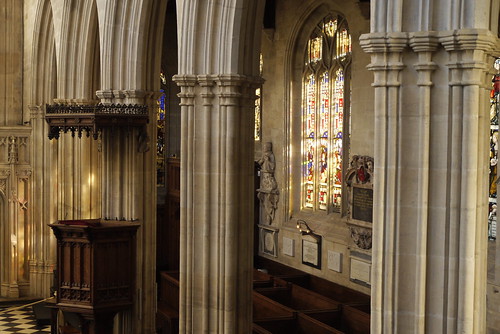
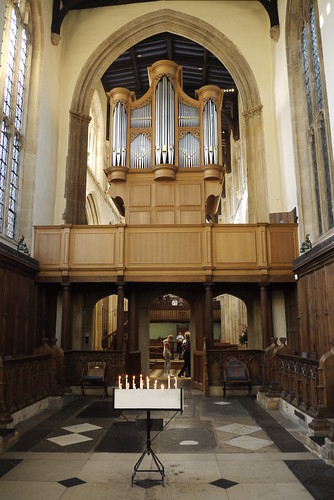
The current Chancel was completed in 1463, in the ‘late perpendicular’ style characterised by large windows and slim stone columns.  The contrast with the flamboyant decoration of the Tower is very clear.  The wooden stalls also date from this period; some even have graffiti marks made by medieval choirboys.

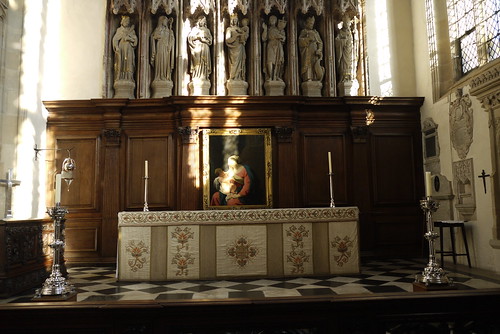
At the East end, the wood panelling and the altar rails were added by the Chancellor, Dr Ralph Bathurst, in the 1670s.  At this time, baroque and classical themes were increasingly common in English church architecture.  The painting above the altar, on loan from the Ashmolean, is from a similar period; named the ‘Virgin & Child of the Column” it is by Simon Vouet (1590-1649), a French artist often credited with bringing the Italian baroque style to France.

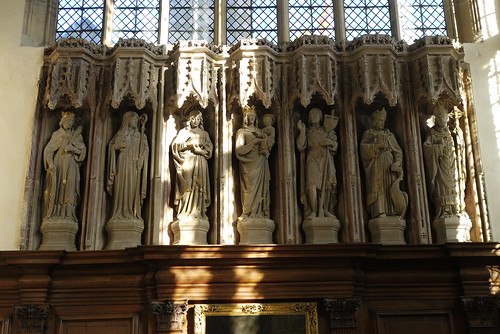
The statues in the niches were placed there in 1933 and commemorate the centenary of the Oxford movement; the niches themselves are medieval and traces of the original pain remain.  The marble stones on the floor record the names of some of those buried here, including Amy Robsart, wife of Robert Dudley, Queen Elizabeth’s favourite, who died somewhat mysteriously in 1560.*
University Church - Architecture

The Nave

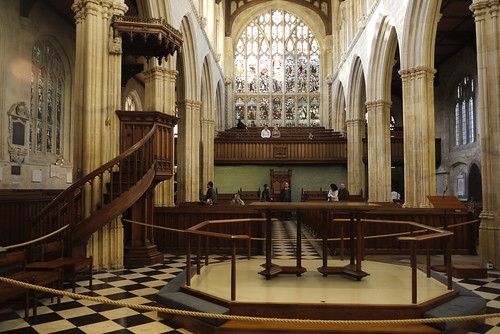
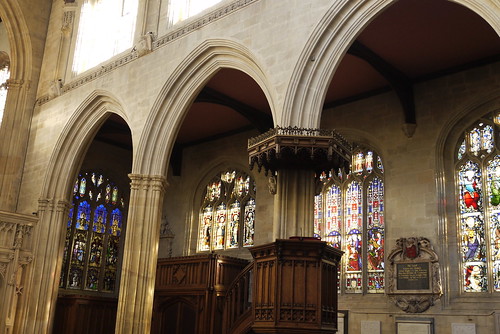
Work began on the present Nave after the completion of the Chancel, and it was finished in about 1510.  It is also in the ‘late perpendicular’ style, with slender columns and large windows to allow light into the building.  A screen has always divided the Nave from the Chancel; our current organ screen was installed as part of the refitting of 1827.

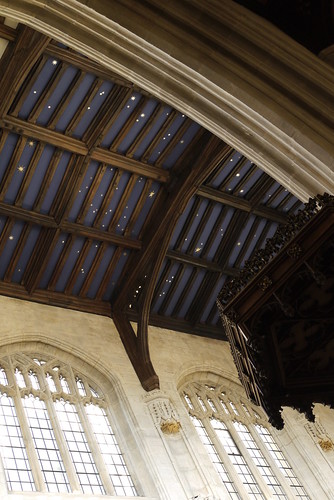
Above the altar in the Nave are painted gold stars on a blue ceiling.  This decoration is called a ‘celure’, from the old-English word ‘celen’ meaning ‘to cover’. This 2012 celure shows the constellation Pleiades, mentioned in the Bible in Job 38.

The six stone carvings on the wall of the South Aisle are “Meditations on the Precious Blood”, showing scenes from the passion and crucifixion of Christ. They were created by a local artist, Bernard Johnson, and are based on drawings by Eric Gill, one of the leading figures in the twentieth-century Arts and Crafts movement.*
University Church - Architecture

The Stained Glass

Apart from a few medieval fragments in the east window, the glass in University Church dates from the 19th century. The great west window above the gallery was designed by Charles Kempe and finished in 1891. It shows the tree of Jesse, surrounded by figures from the Bible. Also notable is the Pugin window at the east end of the south aisle, showing scenes from the life of St Thomas the Apostle.*
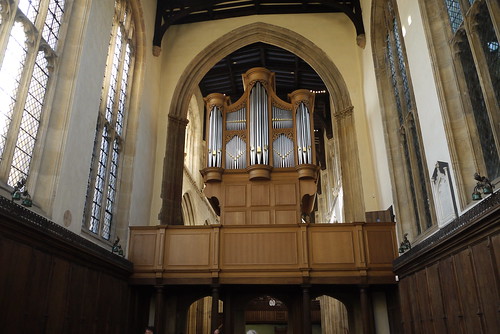
University Church - Architecture

The Organ

In 1947 a disastrous fire destroyed the original 17th-century ‘Father’ Smith organ. Its replacement, by J W Walker, had become unplayable by 1981. The present organ, the third, was built in 1987 by Metzler Orgelbau of Zurich with the intention of recapturing the spirit of the original ‘Father’ Smith. It is undoubtedly one of the finest instruments of its kind, and incorporates the few of Smith’s decorative pipe shades (cases for the pipes) which survived the fire.*
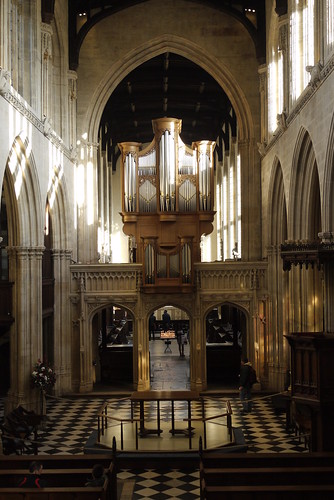
University Church - Architecture

*Quoted text from University Church architecture page.

8 Comments CherryPie on Mar 26th 2015

University Church - Oxford

There has been a church on this site for a thousand years, standing in the very centre of the ancient walled city of Oxford.

In the early thirteenth century the University began to develop as scholars and teachers, with their classes of scholars, moved into small halls of residence here. They needed a central meeting place and they came to this Church, using it for academic lectures as well as for Christian services. Indeed, even the University’s court, treasury and library were housed here for a time!

And that is how a parish church of St Mary became University Church.

By about 1420 the Church had become too small for all these activities. Gradually the University moved its lectures, library and official ceremonies to other buildings nearby, especially the Bodleian Library and Sheldonian theatre, on the other side of Radcliffe Square. But the importance of the Church did not diminish and it is still the site for major events, within the University, the city of Oxford, and the national Church.

Thomas Cranmer

In 1556 Thomas Cranmer, the first Protestant Archbishop of Canterbury, was tried in University Church. One of the pillars in the nave is damaged, and it is thought that this happened when a platform was built for the trial. Cranmer’s trial was organised by the government of the Roman Catholic Queen Mary, who detested Cranmer’s Protestant religion. Moreover, Cranmer had encouraged Mary’s father King Henry VIII to divorce her mother, Katherine of Aragon. Cranmer was responsible for the new English Prayer Book and for many of the Protestant changes to the Church; when Mary came to the throne she was determined to destroy him.  At his trial, he refused to abandon his faith and in March 1556 he was burned at the stake on Broad Street, just round the corner.

University Church - Oxford

University Church - Oxford

6 Comments CherryPie on Mar 25th 2015

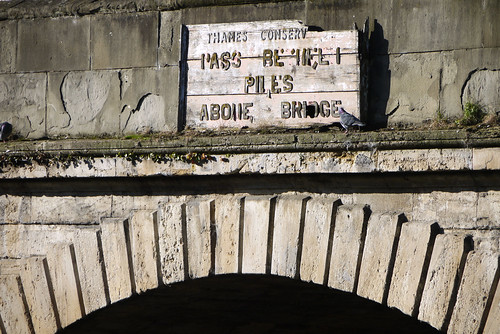
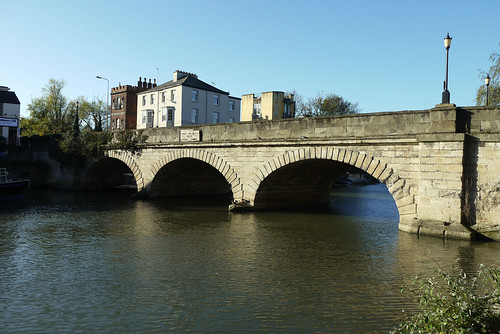
Folly Bridge

The Anglo Saxon Chronicle of 912 records a settlement called Oxenford at a pace where local people would drive their cattle across the river. The popular belief has always been that the city takes its name from the words “ox” and “ford” and that the crossing place was here, at was is now Folly Bridge.

By the 11th century, the low lying lands and river were spanned by a causeway made up of a series of stone bridges, which in medieval times was called Grandpont. The bridges were maintained by charity, with hermits collecting alms at a wayside chapel. In the 19th century a railway station was opened near Folly Bridge and the Grandpont estate laid out on land reclaimed from the marshes. The name Grandpont also lives on in the riverside park whose entrance is on the far right-hand-side of the bridge.

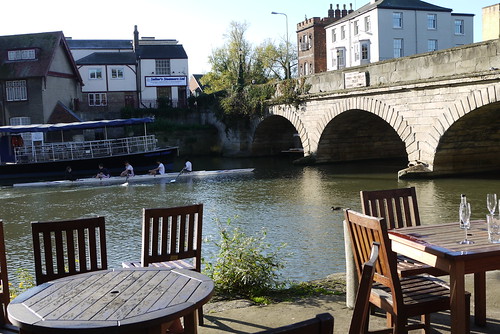
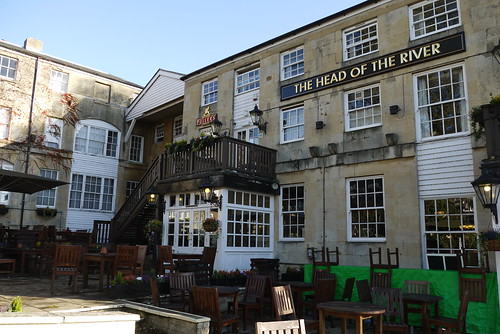
The river here is the Isis, the name given to the Oxford stretch of the River Thames. The “Head of the River” pub takes its name from the finish of the college bumping races held during the Eights week in May. Crews of eight oarsmen race in procession trying to catch and bump the boat the boat in front and thus move up to take the title “head of the river”. The first organised race took place between Brasenose and Jesus Colleges in 1815, but other colleges soon joined in over a set course from Iffley Lock finishing here near Folly Bridge.

Salter Boatyards which operates pleasure cruises was established beside Folly Bridge in 1858. It was from here too that Charles Dodgson (better known as Lewis Carroll) set out on a rowing expedition to Godstow with Alice Liddell and her sisters, the daughters of the Dean of Christ Church. He told them stories from which the “Alice” stories were born. *

Folly Bridge

Folly Bridge

The Head of the River

*From a sign board at Folly Bridge

16 Comments CherryPie on Mar 24th 2015

Edited by Helen Moore and Julian Reid

Synopsis:

Manifold Greatness: the Making of the King James Bible tells the story of the commissioning and translation of the King James version of the Bible, first published in 1611. It is richly illustrated with early printed books, manuscripts, artifacts and archival material, such as an annotated Bishops’ Bible of 1602, notes taken at a meeting of one of the translating committees, pages from the Wycliffite and Tyndale translations of the Bible and an edition of the Bishops’ Bible owned by Elizabeth I. Through detailed chapters written by leading scholars in the field, the narrative explores the cultural, religious and material contexts for the translation, its impact in England and the reception of the King James Bible in America. The collection also features a chapter on the King James Bible and other treasures at the Folger Shakespeare Library, Washington, DC.

Marking the first collaboration of two of the world’s leading libraries, this book brings together key research and documentation to provide a lively and meticulous account of a publishing phenomenon.

Review:

This book was produced to co-incide with an exhibition at the Bodleian and the Folger Shakespearean Libraries. The book charts the genesis and development of the King James Bible into the literary work that it became. The book covers the origins of the project, the translators and the materials and methods used. The book also provides the cultural and political backdrop to the making of the King James Bible.

The book is  informative with lavish illustrations and comes complete with notes and suggested further reading.

16 Comments CherryPie on Mar 23rd 2015

We are what our thoughts have made us; so take care about what you think. Words are secondary. Thoughts live; they travel far.

Swami Vivekananda

From Here to There

23 Comments CherryPie on Mar 22nd 2015

Three Men in a Boat

The Dodo

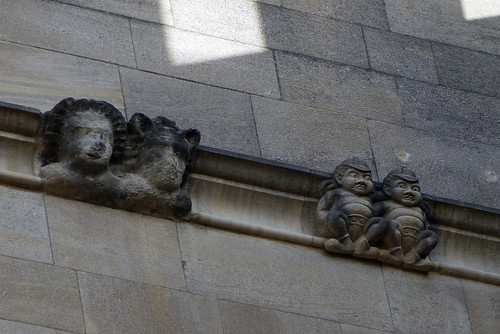
Tweedle Dum and Tweedle Dee

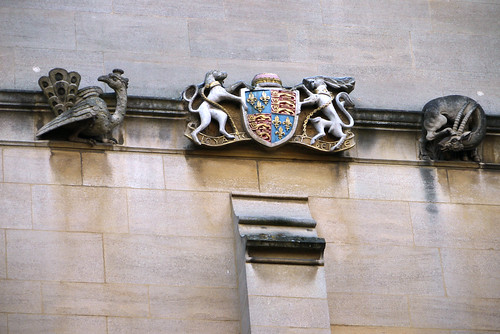
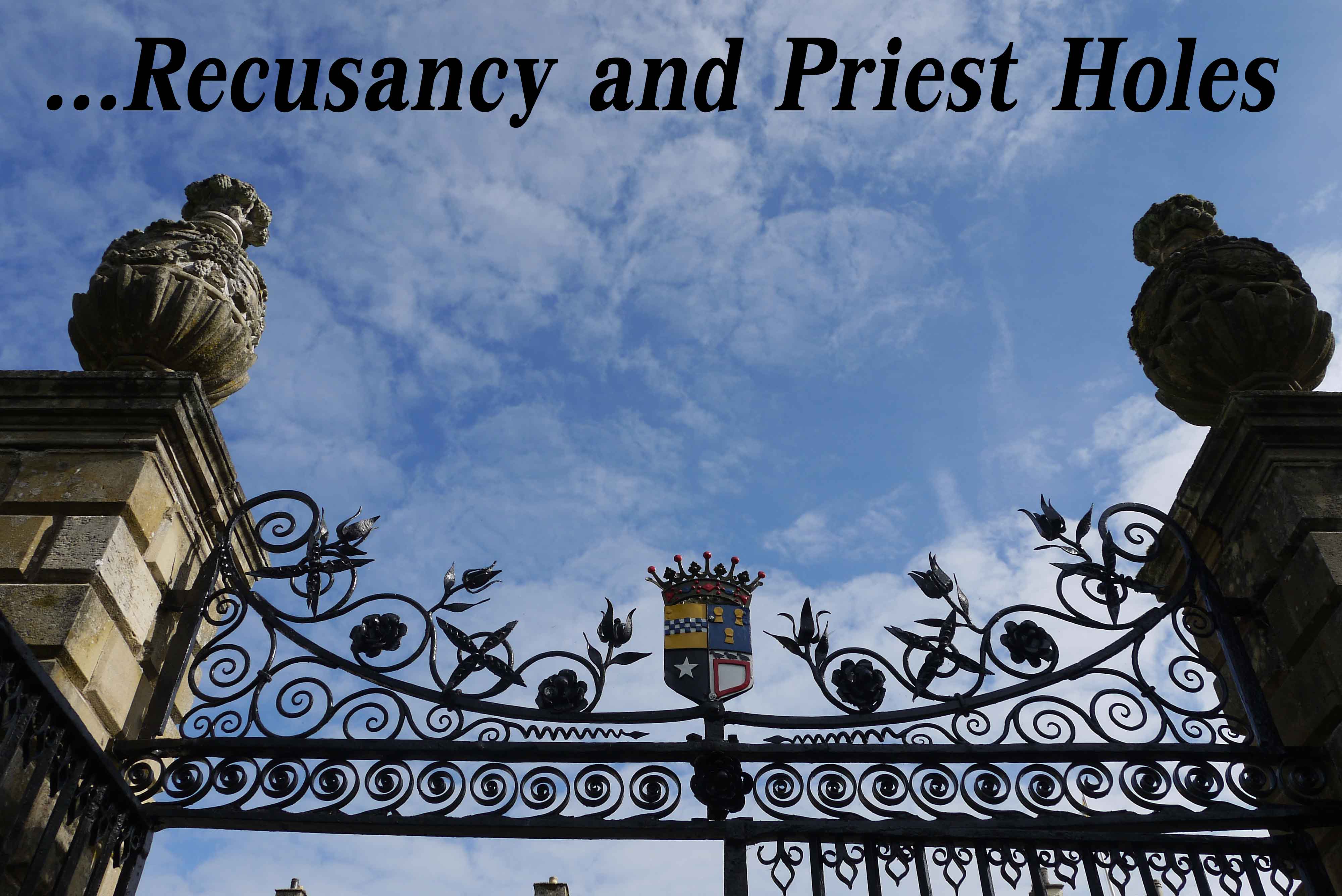
Coat of Arms

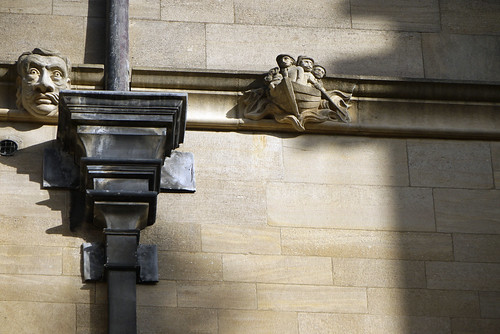
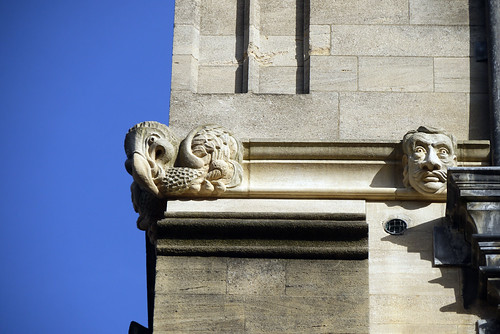
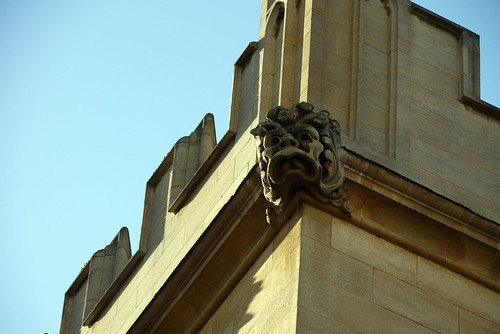
Gargoyle

14 Comments CherryPie on Mar 21st 2015

« Newer Posts - Older Posts »