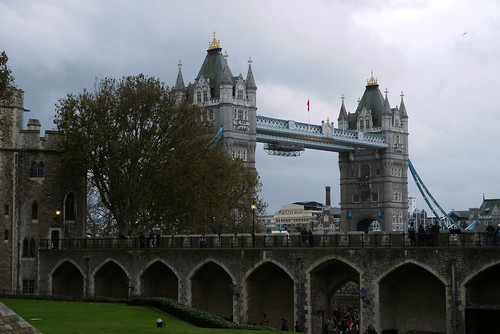
Tower Bridge

Tower Bridge (built 1886–1894) is a combined bascule and suspension bridge in London which crosses the River Thames. It is close to the Tower of London, from which it takes its name, and has become an iconic symbol of London.

The bridge consists of two bridge towers tied together at the upper level by means of two horizontal walkways, designed to withstand the horizontal forces exerted by the suspended sections of the bridge on the landward sides of the towers. The vertical component of the forces in the suspended sections and the vertical reactions of the two walkways are carried by the two robust towers. The bascule pivots and operating machinery are housed in the base of each tower.
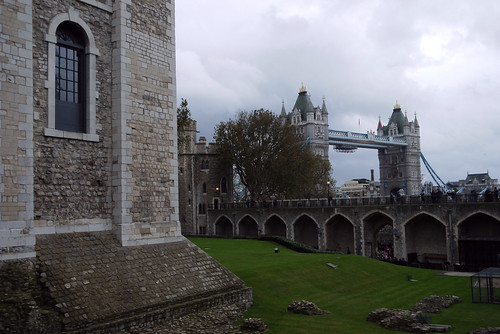
Tower Bridge Viewed from The Tower

History:

A huge challenge faced the City of London Corporation – how to build a bridge downstream from London Bridge without disrupting river traffic activities. To generate ideas, the “Special Bridge or Subway Committee” was formed in 1876, and opened the design for the new crossing to public competition.

Over 50 designs were submitted for consideration, some of which are on display at Tower Bridge Exhibition. It wasn’t until October 1884 however, that Horace Jones, the City Architect, in collaboration with John Wolfe Barry, offered the chosen design for Tower Bridge as a solution.

It took eight years, five major contractors and the relentless labour of 432 construction workers to build Tower Bridge.

Two massive piers were sunk into the river bed to support the construction and over 11,000 tons of steel provided the framework for the Towers and Walkways. This framework was clad in Cornish granite and Portland stone to protect the underlying steelwork and to give the Bridge a more pleasing appearance.

When it was built, Tower Bridge was the largest and most sophisticated bascule bridge ever completed (“bascule” comes from the French for “see-saw”). These bascules were operated by hydraulics, using steam to power the enormous pumping engines. The energy created was stored in six massive accumulators, as soon as power was required to lift the Bridge, it was always readily available. The accumulators fed the driving engines, which drove the bascules up and down. Despite the complexity of the system, the bascules only took about a minute to raise to their maximum angle of 86 degrees.

Today, the bascules are still operated by hydraulic power, but since 1976 they have been driven by oil and electricity rather than steam. The original pumping engines, accumulators and boilers are now exhibits within Tower Bridge Exhibition’s Engine Rooms.

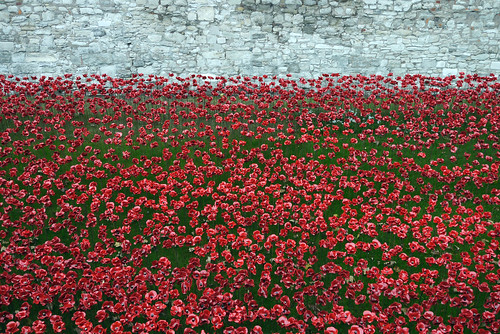
Tower Bridge and the Moat

10 Comments CherryPie on Mar 7th 2015

Filed under Art, Out & About

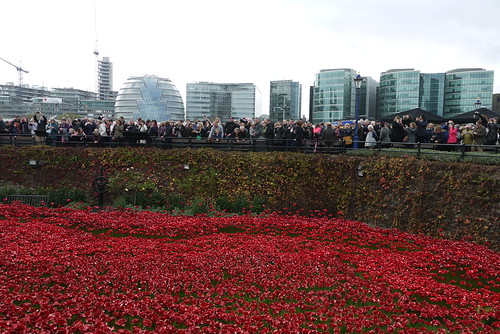
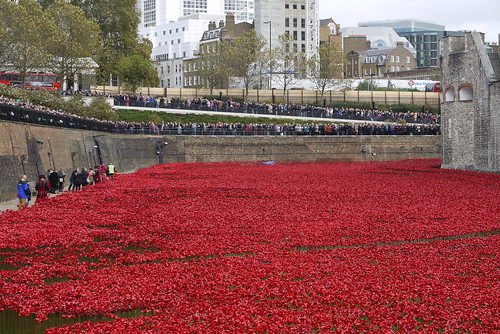
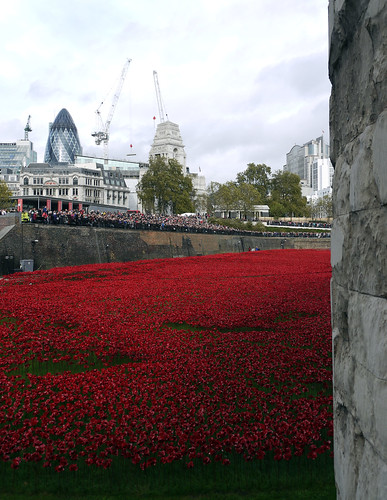
Mass

Untitled

noun

1: a large body of matter with no definite shape.

“the sun broke out from behind a mass of clouds”

synonyms:
pileheapstackclumpcloudbunchbundlelump

2: a large number of people or objects crowded together.

a mass of cyclists”

synonyms:
large number, abundanceprofusionmultitudegroupcrowdmob,rabblehorde,

barragethronghuddlehosttrooparmyherdflock,droveswarmpackpress,

crushmountainflood

“a mass of cyclists”

adjective

1: involving or affecting large numbers of people or things.

“the film has mass appeal”

synonyms:

wholesaleuniversalwidespreadgenerallarge-scaleextensivepandemic

“mass hysteria”

verb

1: assemble or cause to assemble into a single body or mass.

“both countries began massing troops in the region”

synonyms:

accumulateassembleamasscollectgather, gather together, draw together, join together

Untitled

Untitled

Untitled

10 Comments CherryPie on Mar 6th 2015

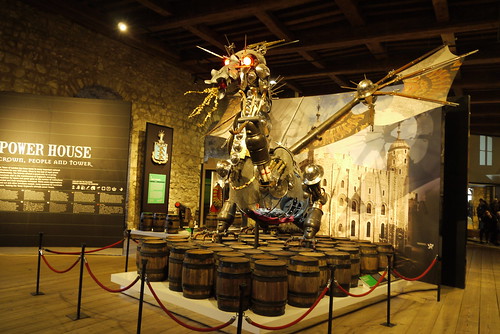
Keeper of the Tower

From The Royal Armouries website:

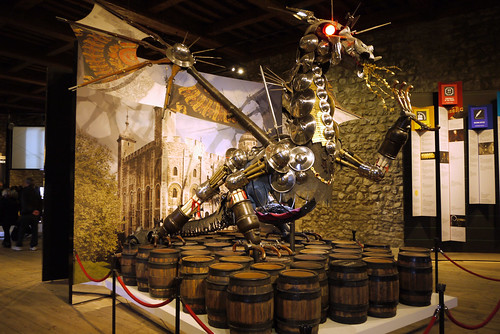
A tradition of displaying British military strength by creating trophies from masses of weapons has long existed at the Tower. From about 1700 visitors to the Grand Storehouse were stopped in their tracks by John Harris’s stunning displays and models, including a serpent and a seven-headed hydra, which he created from a variety of weapons including muskets, pistols and swords.

A sight ‘no one ever beheld without Astonishment…
not to be matched perhaps in the world’.
William Maitland, 18th century antiquarian

Royal Armouries Head of Creative Programmes, Karen Whitting dreamed up the idea for the mighty beast, inspired by the small figures of a dragon and a hydra in the scale model of the Grand Storehouse. Working with the creative team at Haley Sharpe Design a concept drawing was produced which York-based Paragon Creative have brought wonderfully to life.

Building on the tradition of trophies of arms and armour created at the Tower of London from the late 17th century, this new dragon has been constructed using objects and materials that represent ten institutions which were housed in the Tower.

Institutions

Ordnance Office – armour, swords, firearms and cannon to create the head, back and body, including 22 antique pistols, four swords, four rifles, two bronze cannon and 20 bayonets.

Menagerie – a cage for the ribcage

Prison – 30m of chain to create the tail

The Royal Mint – 2,000 gold and silver coins, representing the dragon’s fire plus 50 replica trial plates

Royal Observatory – 26 telescopes

Ordnance Survey – maps for wings

Record Office – scrolls for legs

Jewel House – 400 glass rubies

Constables – keys hanging around the neck

Royal Armouries – 8 breastplates, 6 muskets, 15 pollaxes, 10 mail shirts, 4 shields and bucklers

Our dragon is fittingly named Keeper, following a naming competition run in association with TV channel History™.

No of items used in total

Over 2,672 items including:

  • 8 breastplates
  • 6 muskets
  • 22 antique pistols
  • 40 shields and bucklers
  • 4 swords
  • 4 pairs of pauldrons
  • 4 pairs of gauntlets
  • 4 bronze mortars
  • 8 kettle helmets
  • 4 Enfield rifles
  • 2 bronze canons
  • 20 bayonets
  • 15 pollaxes
  • 10 mail vests
  • 4 horse shaffrons
  • 26 telescopes
  • 2,000 gold and silver coins
  • 30m of chain
  • 400 ‘rubies’
  • 1 replica Henry VIII necklace
  • 50 replica trial plates
  • 1 set of keys
  • Keeper of the Tower

    14 Comments CherryPie on Mar 5th 2015

    and Cast Iron Carriage

    Gun & Carriage

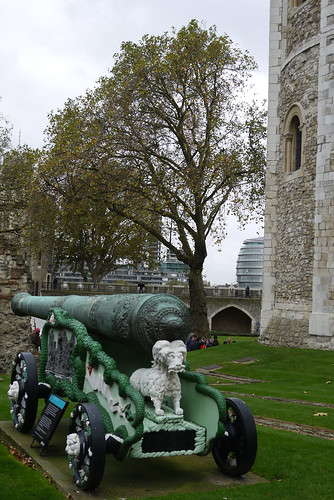
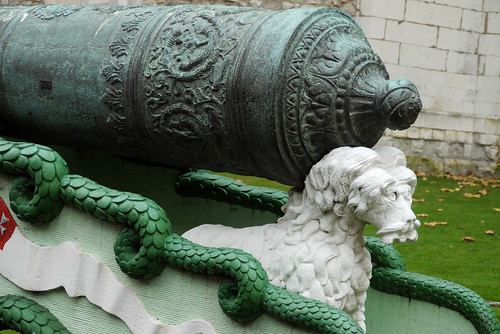
    This gun, which weighs 5 ¾ tons, was probably made in the Low Countries in 1607, commissioned by the Knights of Malta. It is richly decorated with a variety of images representing the Order’s religious and humanitarian role. It was brought to England around 1800 and lay at the Royal Arsenal in Woolrich until 1962, when it was transferred to the Tower.

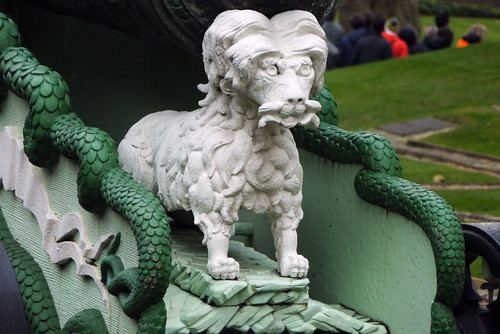
    John Hall of Dartford, Kent, made the carriage for the gun in 1827 on the orders of the Duke of Wellington, Master General of the Ordnance. It shows the Arms of Malta and scenes from the history of the island. The breech of the gun rests on an iron quoin in the shape of a Maltese dog.

    Gun Carriage

    Gun Carriage

    12 Comments CherryPie on Mar 4th 2015

    John Gerard, Catholic Priest, 1597

    The Salt Tower

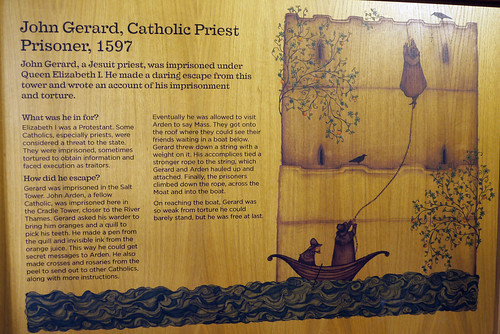
    John Gerard (1564–1637) was an English Jesuit priest, operating covertly in England during the Elizabethan period in which the Catholic Church was subject to persecution.

    John is noted not only for successfully hiding from the English authorities for eight years before his capture, but for enduring extensive torture, escaping from the Tower of London and, after recovering, continuing with his covert mission. After his escape to the continent, he was later instructed by his Jesuit superiors to write a book about his life (Latin text).[2] An English translation was published in 1951.

    Gerard was finally captured in London on 23 April 1594, together with Nicholas Owen. He was tried, found guilty and sent to the Counter in the Poultry. Later he was moved to the Clinkprison where he was able to meet regularly with other persecuted English Catholics. Due to his continuation of this work, he was sent to the Salt Tower in the Tower of London, where he was further questioned and tortured by being repeatedly suspended from chains on the dungeon wall. The main aim of Gerard’s torturers was to identify the London lodgings of Fr. Henry Garnet that they might arrest him. He would not answer any questions that involved others, or name them. He insisted that he never broke, a fact borne out by the files of the Tower.

    Henry Garnet wrote about Gerard:

    “Twice he has been hung up by the hands with great cruelty on the part of others and no less patience on his own. The examiners say he is exceedingly obstinate and a great friend either of God or of the devil, for they say they cannot extract a word from his lips, save that, amidst his torments, he speaks the word, ‘Jesus’. Recently they took him to the rack, where the torturers and examiners stood ready for work. But when he entered the place, he at once threw himself on his knees and with a loud voice prayed to God that … he would give him strength and courage to be rent to pieces before he might speak a word that would be injurious to any person or to the divine glory. And seeing him so resolved, they did not torture him.”[4]

    A famous exploit of his is believed to have been masterminded by Saint Nicholas Owen. With help from other members of the Catholic underground, Gerard, along with John Arden, escaped on a rope strung across the Tower moat during the night of 4 October 1597. Despite the fact that his hands were still mangled from the tortures he had undergone, he succeeded in climbing down. He even arranged for the escape of his gaoler (jailer), with whom he had become friendly, and who he knew would be held responsible for the jailbreak. Immediately following his escape, he joined Henry Garnet and Robert Catesby in Uxbridge. Later, Gerard moved to the house of Dowager Elizabeth Vaux[1] at Harrowden. From this base of operations, he continued his priestly ministry, and reconciled many to the Catholic Church, including Sir Everard Digby (one of the conspirators in the Gunpowder Plot). He later suspected Digby of plotting something, but did not act, thus allowing the plan to proceed undetected. When the plot was discovered, Gerard was a very wanted man due to his links to those involved.

    He was incorrectly implicated by Robert Catesby’s servant Thomas Bates. Staying a while at Harrowden, then escaping from there to London, he left the country with financial aid from Elizabeth Vaux, slipping away disguised as a footman in the train of the Spanish Ambassador[5] on the very day of Henry Garnet’s execution. Gerard went on to continue the work of the Jesuits in Europe, where he wrote his autobiography on the orders of his superiors. He died in 1637, aged 73, at the English College seminary, Rome.

    John Gerard Escape

    12 Comments CherryPie on Mar 3rd 2015

    Traitor's Gate

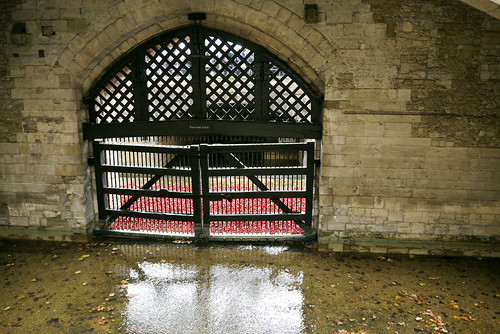
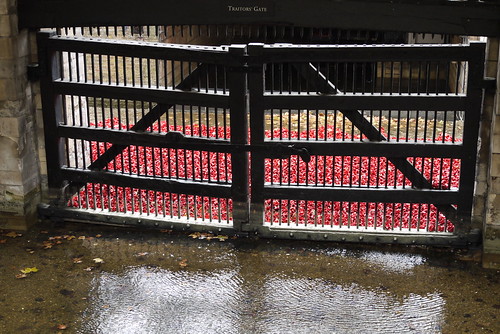
    Traitor’s (or Traitors’) Gate was a watergate – originally simply called the Water Gate – beneath St Thomas’s Tower at the Tower of London.

    The gate was built in the late 1270s on the orders of Edward I to provide a convenient means by which he could arrive by barge. It acquired its present name as the Tower evolved into a place of imprisonment – and sometimes torture – for those accused of treason, notably in the 16th century during the reigns of Henry VIII and Elizabeth I.

    The archway was bricked up in the mid-​​19th century because the embankment works caused the river to run deeper, making the gate of little practical use for would-​​be visitors – traitorous or not – at most phases of the tide.

    Traitor's Gate

    8 Comments CherryPie on Mar 2nd 2015

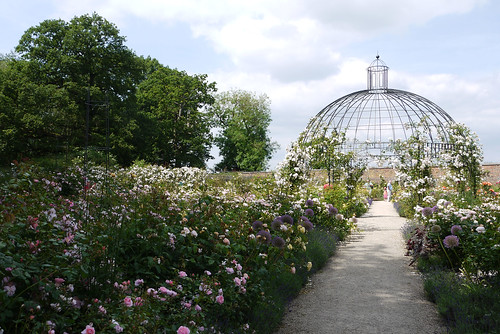
    What sunshine is to flowers, smiles are to humanity. These are but trifles, to be sure; but scattered along life’s pathway, the good they do is inconceivable.

    Joseph Addison

    Garden Pathway

    13 Comments CherryPie on Mar 1st 2015

    « Newer Posts - Older Posts »