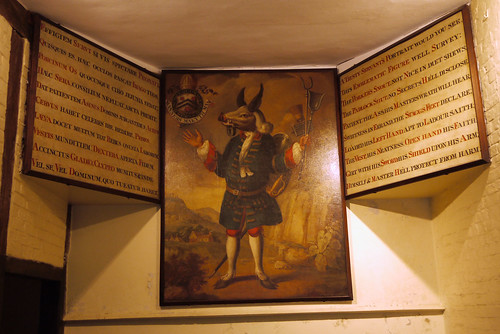
The Language and Meaning of the College Motto:
‘Manners makyth man’ is the motto of both the institutions founded by William of Wykeham, New College and Winchester College. Although no contemporary record attests to this, it is often thought that Wykeham devised it himself and appended it to his coat of arms.1 We do not know when he first used either the arms or the motto, but his seal as Archdeacon of Lincoln displays the arms and he was appointed to this position in 1361. Neither is likely to predate his rise to prominence as Clerk of Works and Surveyor to Edward III in the late 1350s, and the motto, if indeed composed by him as a motto, cannot predate the arms. In English heraldry, however, mottoes are personal, they do not normally form part of a grant of arms, and their use with the coat is accordingly optional. The absence of the motto from the seal does not,therefore, necessarily indicate that the motto had not yet been devised. In 1367,Wykeham was appointed Bishop of Winchester, by virtue of which he also became Chaplain to The Order of the Garter at Windsor and entitled to the use of the famous motto, Honi soi qui mal y pense. He could hardly have felt a need to add to this a superfluous one of his own with which to clutter his arms. We may accordingly date Wykeham’s creation of his motto most probably to the period between the late-1350s and 1367.
Tags: Vacation, Winchester, Winchester College

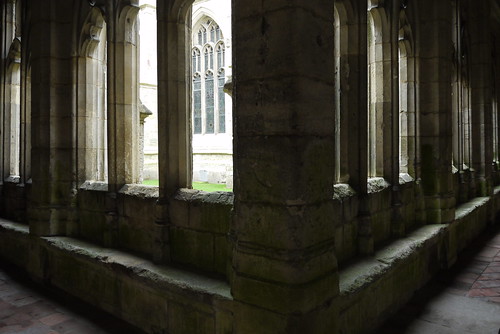
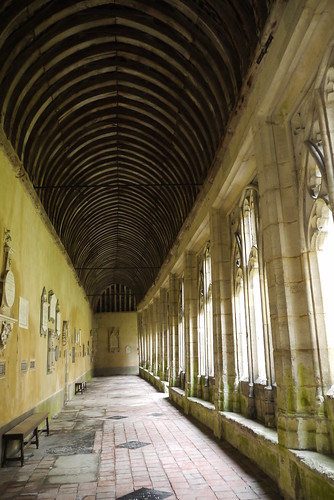
All students who attend Winchester college are required to attend Sunday services in the chapel.

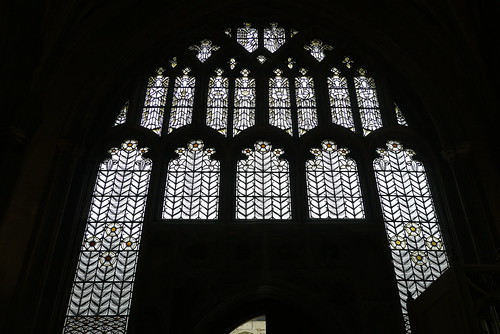
The guide who took us round the college explained that the main window in the church was a replica. The original had gone for cleaning and those undertaking the operation damaged some of the pains of glass. So they made a new window instead of continuing with the cleaning. The colours are not at all the same as the original window as can be seen in the second and third photos which are windows using the original glass which was located after the fraud had been discovered.

The guide also told us that she thought some of the original glass could be seen in a church in Shrewsbury, I must find time to go and investigate.
Tags: Chapel, Vacation, Winchester, Winchester College
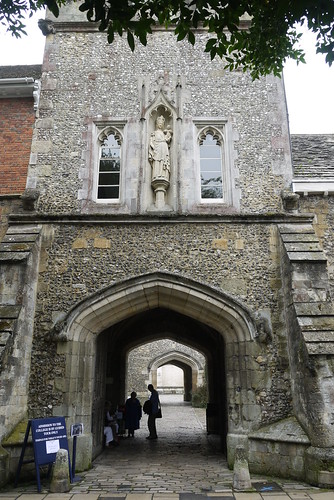
From the college website:
William of Wykeham, Bishop of Winchester and Chancellor (or, as we would now say, Prime Minister) of England, was a self-made man born at Wickham, Hampshire, in about 1323. By his personal talents, by a patron’s gift of an education, and above all by a certain natural toughness, he worked his way to the top of the executive class of his day and amassed a considerable fortune. In an age when literacy, learning and government were the province of the Church, Wykeham wished to see the central government served by a well educated clergy. Placed as he was at the top of the tree, enjoying contacts with the throne and the Holy See, he was ideally situated to see to the meeting of this need. And his personal revenues lay ready to hand.
In 1382 he obtained his charter to found Winchester; the buildings were begun in 1387, and occupied, though incomplete, in March 1394. Meanwhile by 1386 his other and senior foundation at Oxford (New College, or Saint Marie College of Winchester in Oxford) had begun operations.
Thus by the end of the fourteenth century Wykeham’s great scheme for the supply of educated men dedicated to God and the public service, was realised and in working order. His seventy scholars at Winchester were to go on to New College, and thence out into the world, ready and equipped to serve.
From that day to this Wykeham’s seventy Scholars have lived in College. The original community was self-contained in the mediaeval manner. It numbered 115 persons, governed by the Warden and ten Fellows, with two schoolmasters and three chaplains. Sixteen quiristers (choristers) and three lay clerks completed the foundation proper, but Wykeham also allowed the education he provided to be shared at their own expense by ten others, the sons of gentry and particular friends of the College. These were the forerunners, if not the germinal idea, of the present Commoners.
When Henry VI founded Eton College, he took Winchester as his model, visited it on many occasions, borrowed its Statutes and removed its Headmaster and some of the Scholars to start his new school but apart from that interruption Winchester carried out its Founder’s intentions with great distinction until the Reformation.
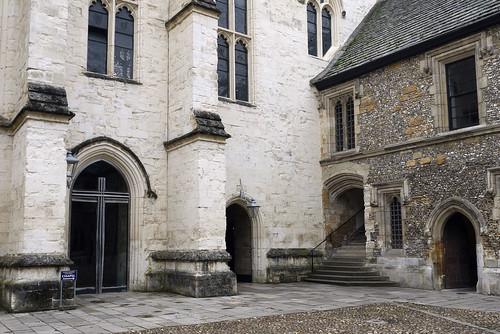

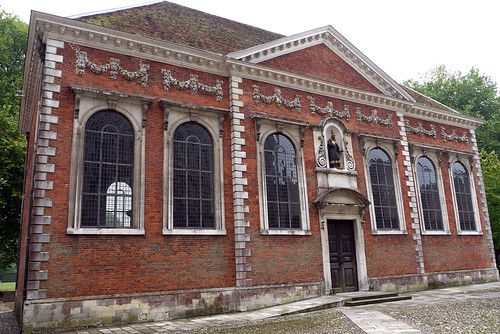
Tags: History, Vacation, Winchester, Winchester College
Friendship is always a sweet responsibility, never an opportunity.
Khalil Gibran

Tags: Cherie's Place Thought, Friendship, National Trust, Wallington

At the beginning of the week I was notified that my ‘Poppy from the Moat’ was due to be delivered within the next two days. After a delay it turned up yesterday and upon opening the parcel I found the poppy was still slightly damp after several weeks residing in the ‘Tower Moat’. I am pleased with it and I am pondering on where to plant it. A photo will follow in due course, today I was far to occupied with another of this weekend’s deliveries…
My new computer (a belated birthday present, mostly from Mr C) arrived and I was busily copying files from the old computer and installing a virus checker, office and publisher on the new computer. What took up most of my time was trying to get my Outlook files copied across, on that front I have so far failed. The files that I saved from the old computer are not the files with the data I need… The newer versions of Outlook work in a very esoteric way!! I will have to go back to the old computer and try to figure out exactly where all that data is stored.
Apart from my frustration with Outlook my new computer is a joy; it is fast, it doesn’t freeze and lock up and above all it has sound which I have been missing for many months. There will be a bit of a learning curve with Windows 8.1, but I will soon get to grips with that 
As to the other deliveries they were all to do with Christmas…
Tags: #TowerPoppies, Email, Life, New Computer, Poppies

The ruins of Wolvesey Palace are situated next to the current residence of of the Bishop of Winchester.

The surviving ruins of Wolvesey were largely the creation of one man, Bishop Henry of Blois (1129-71), who built a palace befitting his immense wealth and powerful position.
When Henry of Blois became bishop of Winchester in 1129, the residence consisted of a large hall block (the ‘west hall’), which had been built in about 1110 by the previous bishop, William Giffard (1107 – 29).*
Until his death 42 years later, Henry continually added new buildings. Starting with another hall block (the ‘east hall’), he then added a keep, a defensive tower and two gatehouses.
Although subsequent bishops carried out various repairs and alterations to the buildings, Henry’s palace survived virtually intact for the next 500 years. It is his work that comprises most of the ruins we see today.*


*From an information board with in the ruins
Tags: English Heritage, History, Vacation, Winchester, Wolvesey Palace