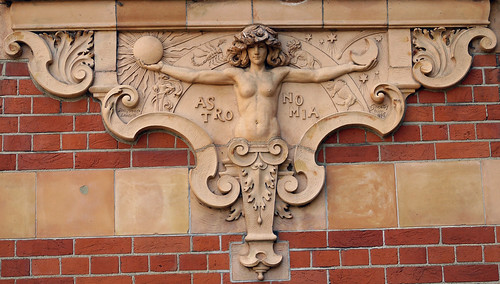
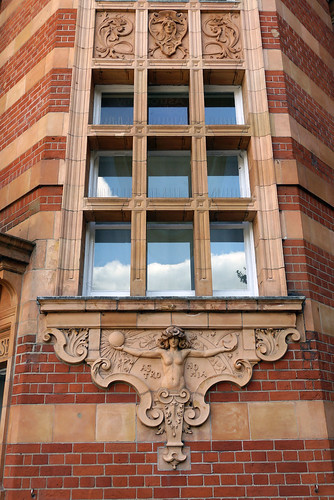
One of the Royal Observatory buildings is decorated with terracotta tiles and sculptures. Astronomia, a figure representing Astronomy particularly caught my eye.
The terracotta tiles and decorative sculpture are the work of Doulton & Co, of Lambeth. An art nouveau-inspired figure of Astronomia on the northwest side at the bottom of the old staircase is signed `WJ Neatby 1895′. The names of 24 important figures in English, and more particularly, Greenwich astronomy are displayed above the first floor windows. The seven previous Astronomers Royal – Flamsteed, Halley, Bradley, Bliss, Maskelyne, Pond and Airy take pole position with Newton at the cardinal and ordinal points. A cast of instrument makers, clockmakers and others of influential astronomers take up the rest – Wren, Horrox, Adams, Herschel, Sheepshanks, Baily, Simms, Troughton, Ramsden, Bird, Sharp, Graham, Dollond, Earnshaw, Arnold and Harrison.
Each of the windows on the ground floor (except those on the ends of the wings), has a Tudor Rose above them. These are of three slightly different designs, corresponding to the three phases in which the wings were built. At the upper levels, the ends of each wing are highly ornate. A bust of Flamsteed sculpted by J Raymond Smith is mounted above the front door on the north wing. The end of the south wing has a tribute to Queen Victoria. The end of the east wing commemorates the Royal Society and the west wing the Royal Astronomical society.
Tags: Astronmia, London, Royal Observatory, Weekend away
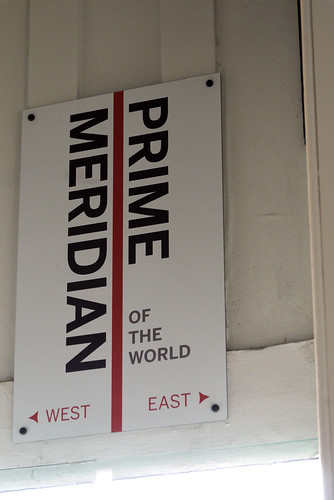
The Royal Observatory in Greenwich is the home of Greenwich Mean Time (GMT) and the Prime Meridian of the world.
What is a meridian?
A meridian is a north-south line selected as the zero reference line for astronomical observations. By comparing thousands of observations taken from the same meridian it is possible to build up an accurate map of the sky.
Hemispheres
The line in Greenwich represents the Prime Meridian of the World – Longitude 0º. Every place on Earth is measured in terms of its distance east or west from this line. The line itself divides the eastern and western hemispheres of the Earth – just as the Equator divides the northern and southern hemispheres.
Where is the meridian?
In 1884 the Prime Meridian was defined by the position of the large ‘Transit Circle’ telescope in the Observatory’s Meridian Observatory. The transit circle was built by Sir George Biddell Airy, the 7th Astronomer Royal, in 1850. The cross-hairs in the eyepiece of the Transit Circle precisely defined Longitude 0° for the world. As the earth’s crust is moving very slightly all the time the exact position of the Prime Meridian is now moving very slightly too, but the original reference for the prime meridian of the world remains the Airy Transit Circle in the Royal Observatory, even if the exact location of the line may move to either side of Airy’s meridian.
Tags: London, Prime Meridian, Royal Observatory, Weekend away
Lead me from the unreal to the real,
Lead me from darkness to light,
Lead me from death to immortality,
Brihadaranyaka Upishand
Tags: Cycle, Death, Life, Love
…The Observatory Time-Ball
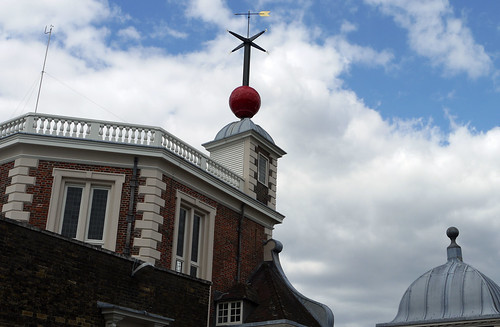
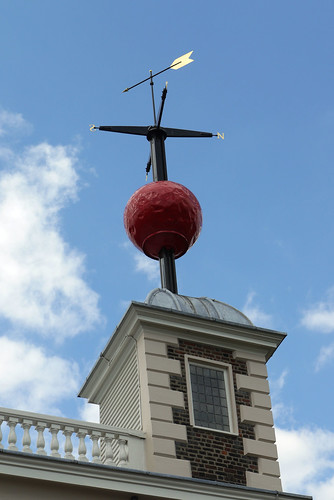
The first public time signal was broadcast from the roof of Flamsteed House in 1833. The idea of dropping a ball at a predetermined time was the brainchild of Captain Wauchope, RN, and was tested at the Naval College at Portsmouth before Maudslay & Field were commissioned to install the first Greenwich time-ball in that year.
The signal was (and is) given at 1 p.m. because the astronomers would be busy checking the rates of their clocks against the sun’s transit at noon. At 12.55 p.m. the ball is hoisted half-way up the mast – originally a signal for navigators on ships in the Thames and London docks to be ready. At two minutes to the hour the ball is hoisted to the top of the mast and then drops precisely at 1 p,m. From this, sea captains about to sail could check the rate of their marine chronometers, which were in wide use by the 1830s.*
*From the Royal Observatory Greenwich Souvenir Guide
Tags: Greenwich, London, Time, Weekend away
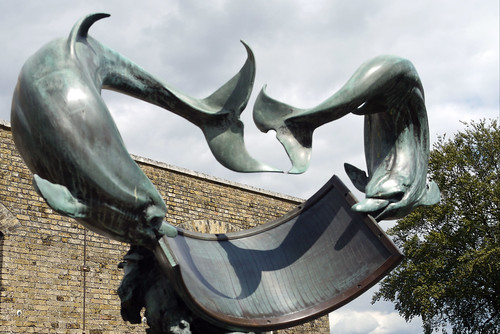
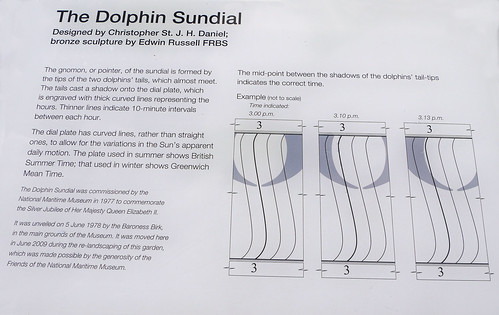
The gnomon or pointer of the sundial is formed by the tips of two dolphins’ tails, which almost meet. The tails cast a shadow onto the dial plate, which is engraved with thick curved lines representing the hours. Thinner lines indicate 10-minute intervals between each hour.
The dial plate has curved lines rather than straight ones, to allow for the variations in the Sun’s apparent daily motion. The plate used in summer shows British Summer Time; that used in winter shows Greenwich Mean Time.
The mid-point between the dolphins tail-tips indicates the correct time.
Tags: Greenwich, Greenwich Park, London, Sundial, Weekend away
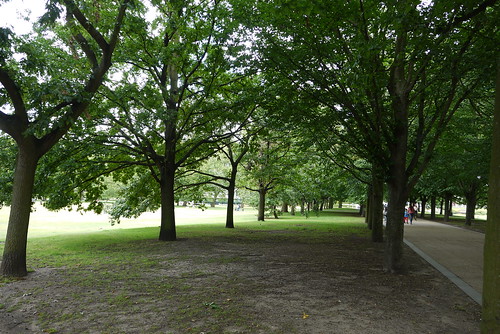
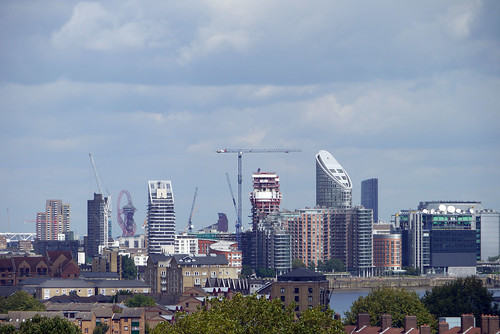
Greenwich Park hosts the Prime Meridian Line and Royal Observatory as well as being part of the Greenwich Maritime World Heritage Site which is home to The National Maritime Museum and Old Royal Naval College.
The oldest enclosed Royal Park, Greenwich dates back to 1427 and offers spectacular views across the River Thames to St Paul’s Cathedral and beyond.
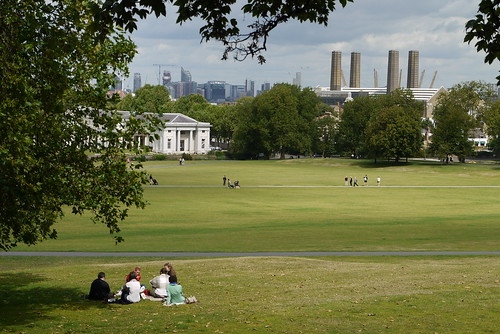
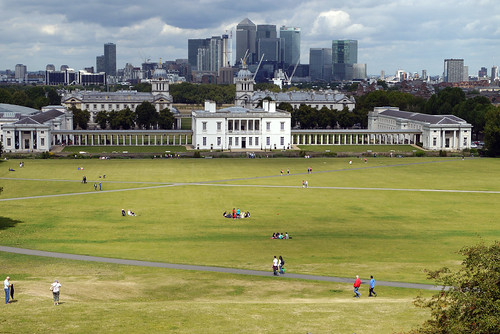
There has been a settlement on this site since Roman times, but Greenwich has always been strongly associated with royalty. Since the land was inherited by Henry V’s brother, generations of monarchs have taken this magnificent park to their hearts.
There is a large grassland enclosure, covering almost 13 acres which serves as a sanctuary for deer, foxes and birds.
Tags: Greenwich, Greenwich Park, London, Weekend away
This above all: to thine own self be true,
And it must follow, as the night the day,
Thou canst not then be false to any man.
William Shakespeare
Tags: Cherie's Place Thought, Kent, Mizmaze, Mount Ephraim Garden, Weekend away