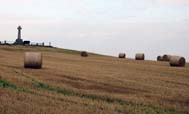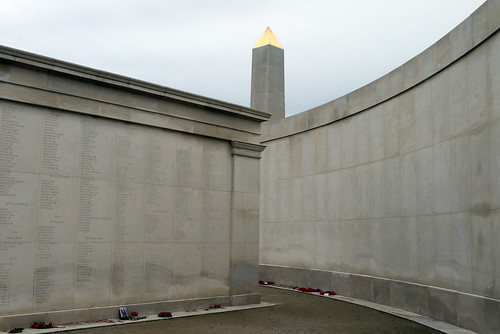
Armed Forces Memorial

The men and women of our Armed and Merchant Services who have lost their lives in conflict, as a result of terrorist action or on training exercises since the end of  World War II are remembered here. Unlike the World War memorials in towns and villages across the Nation, there is nowhere else that records almost 16,000 names of those who have been killed on active duty in recent times.

Since 1945 the men and women  of the Armed and Merchant Services have taken part in more that 50 operations and conflicts across the world, often as part of  United Nations, NATO or other international coalitions. These actions have ranged from hot war to peacekeeping; from humanitarian assistance to fighting terrorism; from the jungles of Malaysia to the storms of the South Atlantic; from the seaport of Aden to the streets of Northern Ireland.

It is not just service men and women who have made sacrifices. Behind every name on the Memorial there are the wives, husbands, partners, parents, children and colleagues who loved them and who will live with the pain and consequences of their loss every day.*
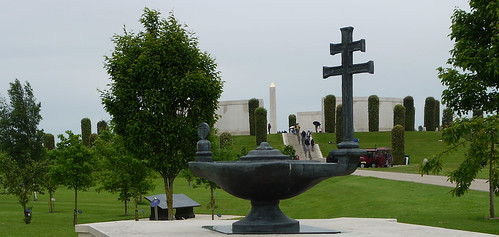
TOC H

The Memorial is a stunning piece of architecture designed by Liam O’Connor which draws its inspiration from the ancient landscapes of prehistoric Britain and the classical forms of Ancient Rome. It consists of a six metre high earth mound, 100 metres wide at the base reducing to just 50 metes wide at the top,  which is based on  early British barrows or tumuli. The spiral walkway up the grassy, tree-planted slopes provides accessibility to people of all ages and mobility. At the top of the mound stands a 43 metre  diameter stone structure, comprising two curved walls and trow straight walls which are constructed of 200.000 bricks faced with Portland stone panels.

The Memorial is particularly important for the many families and friends who have no grave to visit, or who remember those graves in far-off places. The Memorial plays a valuable role in helping all who grieve for a Service person to come to terms with their loss, by providing focus for their grief as they pass through the different stages of their lives.*
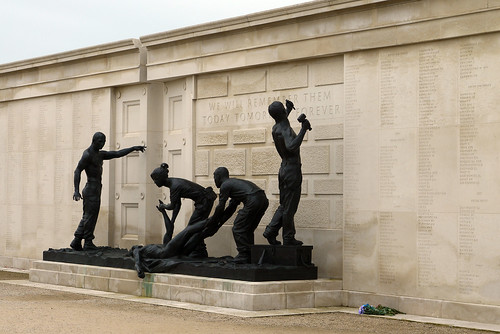
Armed Forces Memorial

At the centrepiece of the memorial two evocative bronze sculptures, the embodiment of loss and sacrifice. Created by Ian Rank-Broadley,  best known for his image of HM Queen Elizabeth II which has appeared on all UK and Commonwealth coinage since 1988, the sculptures bear silent witness to the cost of the armed conflict.*
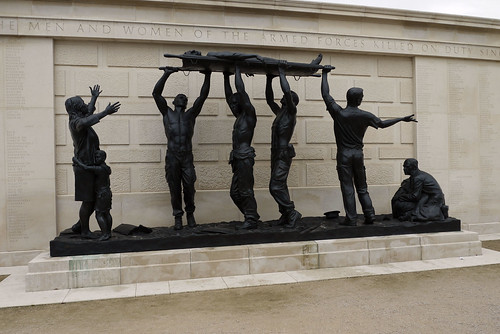
Armed Forces Memorial

*From the National Memorial Arboretum Guidebook Edition 4
8 Comments CherryPie on Aug 9th 2014

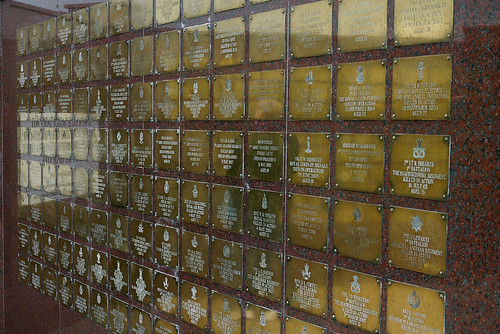
Basra Memorial Plaques

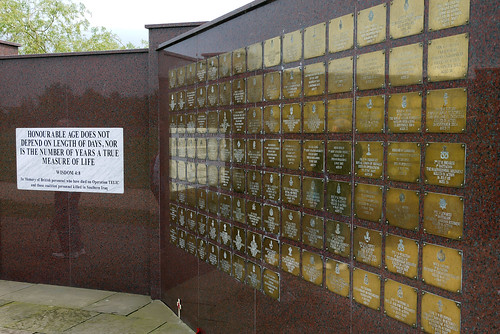
The Basra Memorial Wall is a truly poignant monument to the 178 UK service personnel and one Ministry of Defence (MoD) civilian who lost their lives on combat operations in Iraq and also lists members of Coalition Forces who were killed whilst under UK command during six years of conflict.

The original memorial was built in Basra in 2006 and stood outside the front of the Head quarters of the Multi-National Division (South East). Following the end of operations, the Basra Memorial Wall was brought back to the UK and rebuilt. The original  wall was built and dismantled, and the new wall constructed at the Arboretum by British soldiers from 37th Armoured Engineer Squadron in a personal gesture to commemorate their fallen comrades.

The brass plaques on this memorial are the originals place on the wall when it was in situ in BAsra, Iraq. The Plaques are cleaned twice a year; before the anniversary of the end of combat operations in Iraq and before Armistice, but in between they will be allowed to weather naturally. This will allow the detail on these original plaques to last for as long as possible for the benefit of future generations.*

Basra Memorial Wall

*From the National Memorial Arboretum Guidebook Edition 4
14 Comments CherryPie on Aug 8th 2014

Royal Air Force Association Remembrance Garden

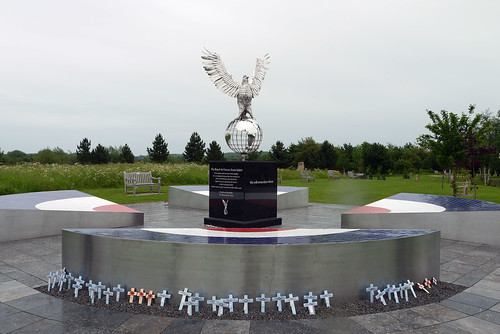
The inspiration for the Remembrance garden comes form the RAF Association’s Dedication, the last in line of which is “we will remember them”. The central feature of the  50 metre-long garden is the RAF Association emblem – a magnificent stainless steel eagle sitting on top of a globe.  The eagle, named Winston, is made up of over 1,000 hand-forged feathers and is surrounded by a segmented RAF roundel separated into four quarters to depict the RAF Association at the heart of RAF welfare.*

The RAF Association Remembrance Garden will preserve the memory of the serving and ex-serving members of the RAF for many years to come.*

Some shared thoughts:

I visited the National Memorial Arboretum today and the Eagle in the attached photo was quite stunning against the skyline inviting closer inspection. When I got up close I found that it was the centerpiece of Royal Air force Association Memorial Garden.

It is a wonderful piece of artwork, a fitting memorial for those who served in The Royal Air Force. The crosses beneath have been placed there by friends, family and colleagues of those who served. Unfortunately the drizzly weather dulls the shine of the eagle against the sky… I thought you might enjoy it anyway…

*From the National Memorial Arboretum Guidebook Edition 4
8 Comments CherryPie on Aug 7th 2014

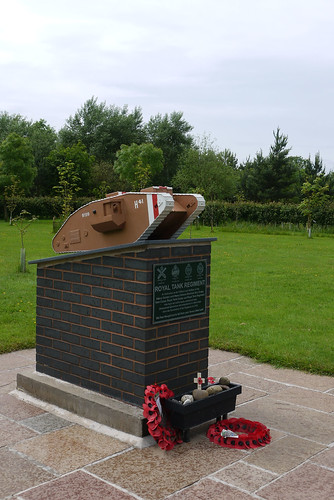
The Royal Tank Regiment

The very first battle involving tanks took place on the Somme when approximately 30 tanks attacked German positions between the villages of Flers and Courcelette on Friday 15 September 1916. This was one of the largest battles of World War I, with more than one million casualties. At dawn on 20 November 1917 the first successful tank battle was fought at Cambrai involving some 300 Mark IV tanks. The arrival of the tank signaled the end of trench warfare and established the tank as a dominant factor of battle right up until the present day.

The design of the Royal Tank Regiment grove reflects these events with a collection of Ash trees, a tree of significance to the Regiment, some of which have been propagated from trees from the battlefield at Cambrai whilst inside the circular seat is an oak tree from Flers. On the brick plinth is a model of a Mark IV, one of the earliest tanks. In the spring the Grove bursts into colour with hundreds of daffodils planted in the pattern of tank tracks. On the flagpole flies the Regimental flag of brown, red and green signifying ‘through mud and blood to green fields beyond’.*

*From the National Memorial Arboretum Guidebook Edition 4
8 Comments CherryPie on Aug 6th 2014

Lights Out - 4th August 2014

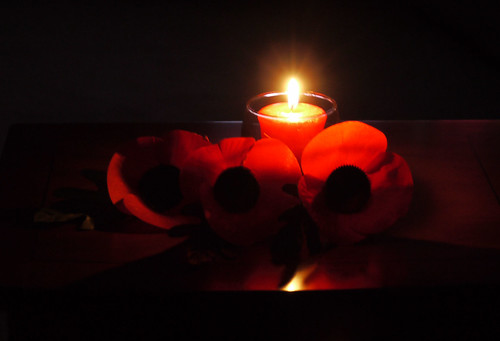
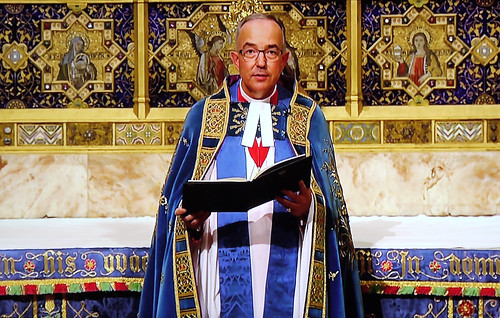
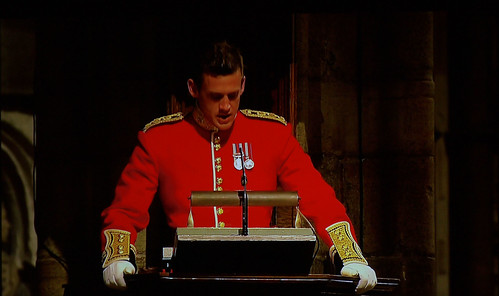
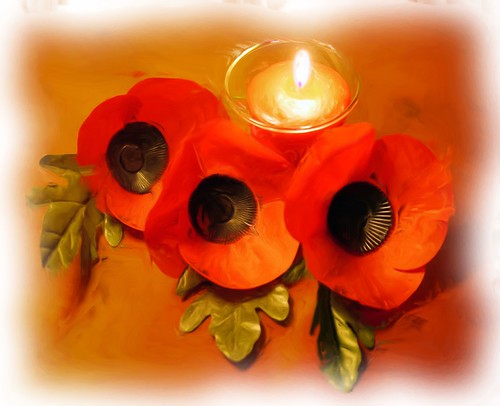
Above is the single candle that I lit for a shared moment of reflection, marking the centenary of the First World War. To reflect on the occasion I tuned into the BBC2 broadcast of the Vigil Ceremony at Westminster Abbey.

Drawing upon Sir Edward Grey’s famous remark that “the lights are going out all over Europe”, Westminster Abbey will mark the centenary by moving from light into darkness, until one candle remains at the Grave of the Unknown Warrior, which will be extinguished at 11.00pm to mark the moment of the declaration of war.

The Abbey Vigil will metaphorically “pause” in penitence on the moments leading up to the outbreak of the war and on those first months of conflict without rushing to conclusions or adopting particular narratives. The Service will not be a premature marking of armistice, but rather a particular commemoration of the centenary of the beginning of the war: remembering the effects of human frailty and failure, as well as the looming violence which characterised so much of that lengthy and devastating conflict.
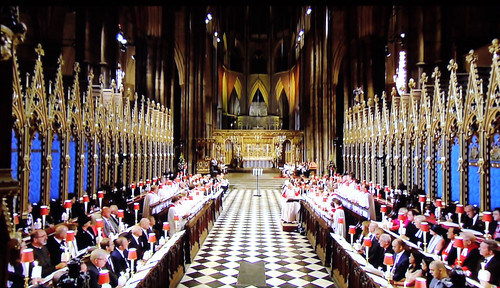
The Abbey will be lit so that the light falls away from the East to the West until the Procession reaches the Grave of the Unknown Warrior, where a single light will remain. The congregation will be given hand-candles, which will be extinguished in blocks as the Vigil proceeds. In the structure which follows, there are four moments where light can be extinguished before the final, symbolic flame is put out at 11.00pm.

The order of service can be found here.

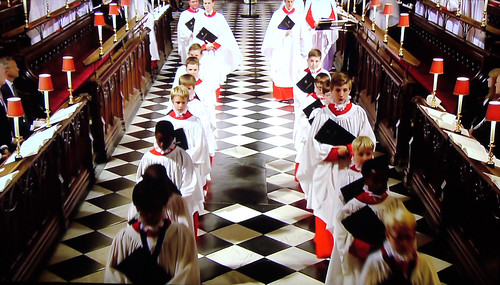
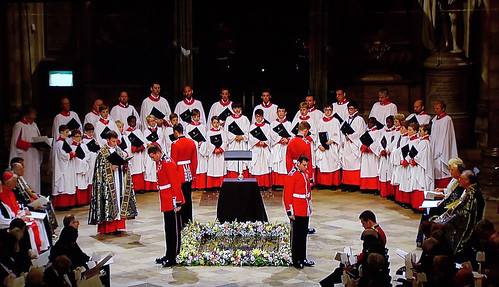
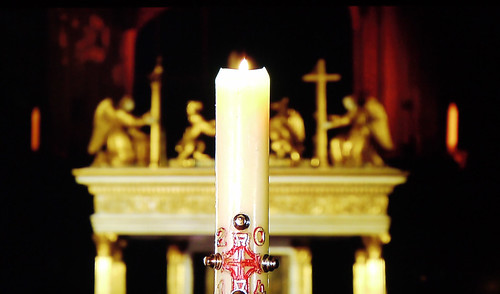
Photographs of the BBC2 footage of the vigil:

Westminster Abbey - First World War Vigil

Westminster Abbey - First World War Vigil

Westminster Abbey - First World War Vigil

Westminster Abbey - First World War Vigil

Westminster Abbey - First World War Vigil

Westminster Abbey - First World War Vigil

10 Comments CherryPie on Aug 5th 2014

Filed under Art

Lights Out

Lights Out

Lights Out

4 Comments CherryPie on Aug 4th 2014

The lamps are going out all over Europe; we shall not see them lit again in our lifetime.

Sir Edward Grey, British Foreign Secretary, August 1914

Lights Out

Photo Copywright – www.1418now.org.uk/lights-out/

Lights Out

The outbreak of the First World War was a cataclysmic event in world history. We know now that the enormous losses, huge economic cost and unprecedented political upheavals incurred by the conflict would change the world forever. With the benefit of hindsight, it seems extraordinary to us that no one was able to intervene to halt the slow descent into war triggered by the unexpected assassination, in distant Sarajevo, of a foreign royal by a 19-year-old terrorist. Were Europe’s statesmen blind to the catastrophe that they were bringing down upon the world?

The British Foreign Secretary, Sir Edward Grey, was among those to glimpse the enormity of the imminent war. For almost ten years he had aligned Britain into a deepening friendship with the great European powers of France and Russia. Although this new relationship had alienated Germany, Grey had tried to keep Britain free from any firm commitment to intervene should a wider European war break out. Yet in July 1914 he stood at the heart of the crisis as ultimatums came and went, and the political and military decisions were taken that made it increasingly likely that Britain would stand beside France and Russia if either was attacked by Germany or Austria-Hungary. The German invasion of Belgium en route to France finally tipped the balance, making Britain’s entry into war inevitable.

Late in the afternoon of 3 August, on the last day of peace, Grey stood at the window of his office in Whitehall and was overwhelmed by a sense of foreboding tragedy. As he looked out he saw that the streets lights were being lit down below. He turned to a visiting friend and observed, ‘The lamps are going out all over Europe; we shall not see them lit again in our lifetime.’

ON MONDAY 4 AUGUST 2014, EVERYONE IN THE UK IS INVITED TO TURN THEIR LIGHTS OUT FROM 10PM-11PM LEAVING ON A SINGLE LIGHT OR CANDLE TO MARK THE MOMENT THE UK ENTERED THE FIRST WORLD WAR, ONE HUNDRED YEARS AGO.

12 Comments CherryPie on Aug 3rd 2014

« Newer Posts - Older Posts »