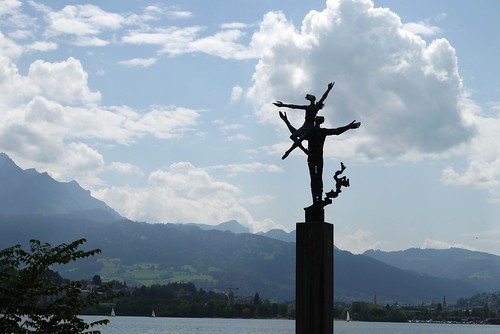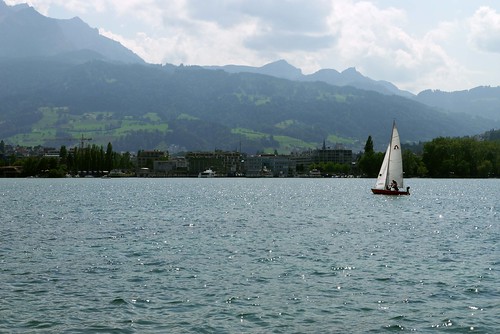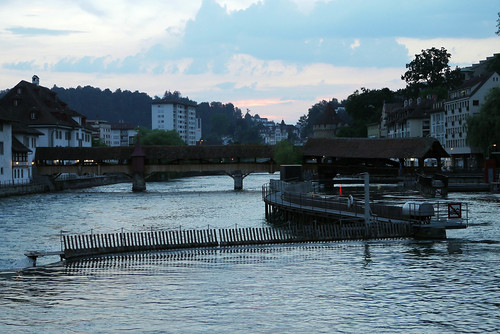
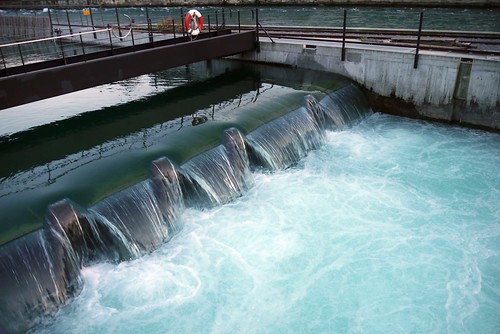
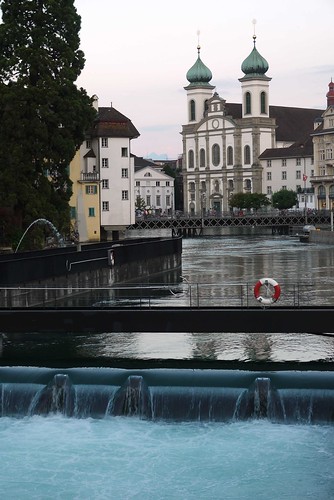
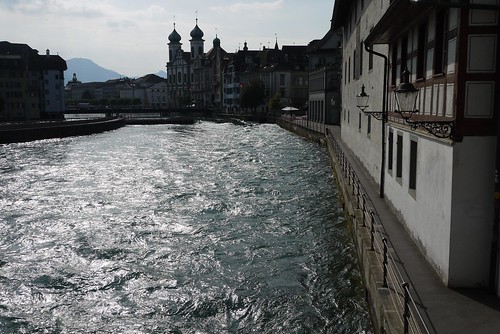
Built in 1859/1860 following the clever style developed by Poiree, the Needle Dam is a unique attraction in terms of both technology and history. From 2009-2011 the facility was renovated and the city’s flood protection was improved. Even today, the level of Lake Lucerne is regulated by hand through the removal and placement of the co-called needles (wooden posts).*
*Lucerne City Guide 2013
Tags: Lucerne, Luzern, Needle Dam, Switzerland, Vacation
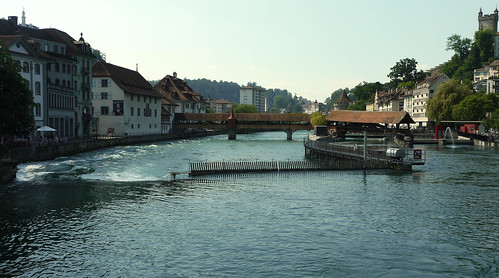
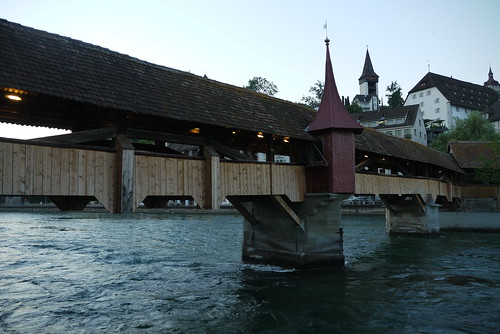
The original Spreuer Bridge was erected around 1400 (first mentioned in 1408), but destroyed by storm in 1566, and rebuilt in 1568. The small chapel on the bridge also dates back to 1568, it has been renovated in 1889. An older small bridge at the location connected Mühlenplatz [Mill's place] with the city mills built on a small island in River Reuss already in the 13th century, however.
The 1408 bridge was built to connect the mills with the baker’s quarter in Pfistergasse [Pfister = medieval German word for baker] on the left bank of River Reuss. While the major part of medieval Lucerne is located on the right bank of River Reuss, the bakers had to stay on the left bank because they kept the fire in their stoves alive during night. The fear that fire might destroy the whole town was not unrealistic, in fact there are no old wooden houses left within the old town of Lucerne, the exceptions are located just outside the medieval ramparts.
What is the meaning of the name Spreuer Bridge?
Spreuer Bridge is situated at the lower end of medieval Lucerne. Though medieval towns in Europe were known to be quite filthy and sophisticated Roman sewage techniques had been forgotten over the centuries, they still made some elementary provisions to restrict immissions. In medieval Lucerne, it was allowed to throw Spreu [chaff] into River Reuss, but only from this lowest bridge in town.
City Mills and Power Plants
The city mills were destroyed in 1875 by fire. Instead, turbines were built and used to drive a variety of machines. But 50 years later the mechanical transmission of power was outdated and replaced by an electricity generator. In 1998 the power plant was completely redesigned and equipped with the latest technology available, delivering 4.3 million kWh per year (which equals the consumption of about 1,500 households in Lucerne). So you can find here a well-preserved example of 16th century art of engineering next to state-of-the-art 21st century technology.
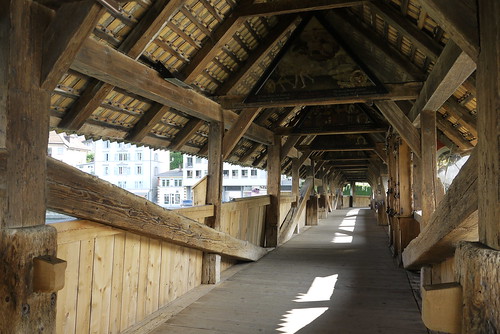
Tags: Lucerne, Luzern, Spreuer Bridge, Switzerland, Vacation

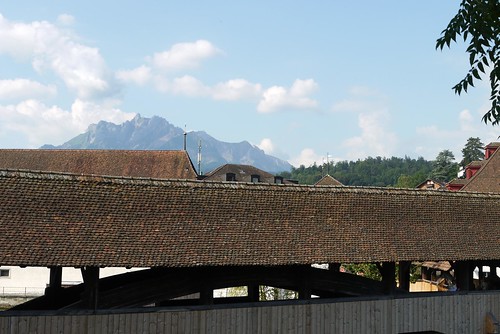
Under the roof of Spreuer Bridge, 67 paintings dating from 1626 to 1635 represent a “Dance of Death”. Death, represented as a skeleton or as the “Great Reaper” urges everybody to dance with him, i.e. to die. Death makes no difference between old and young, churchmen and laymen, rich and poor. This kind of paintings were often placed on cemetary walls. They expressed people’s feeling in the face of death especially during times of epidemic pestilence and were widespread all over late medieval Europe, but only very few examples have survived to date. The fascination for this theme has not completely gone, however, as the dedicated German website www.totentanz.de shows. Lucerne’s Dance of Death was designed by chief painter Kaspar Meglinger.
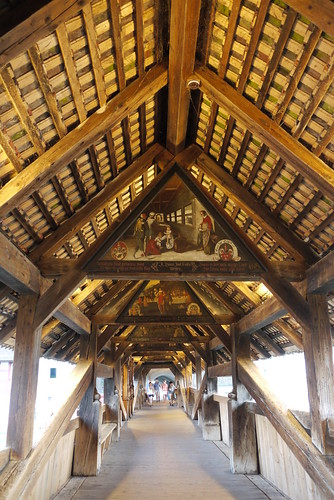
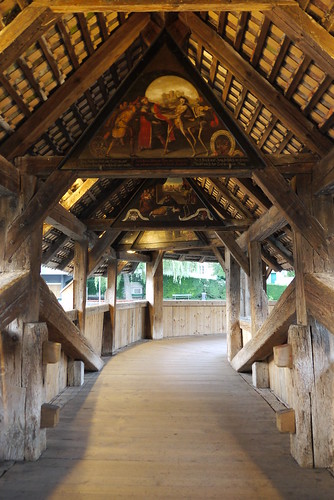
Tags: Lucerne, Luzern, paintings, Spreuer Bridge, Switzerland, Vacation
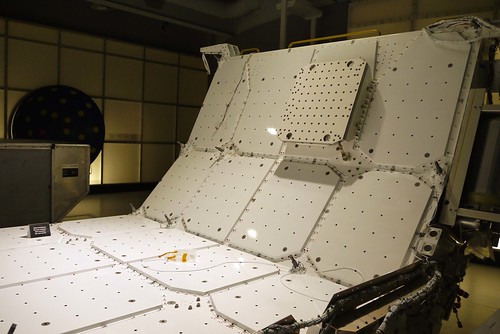
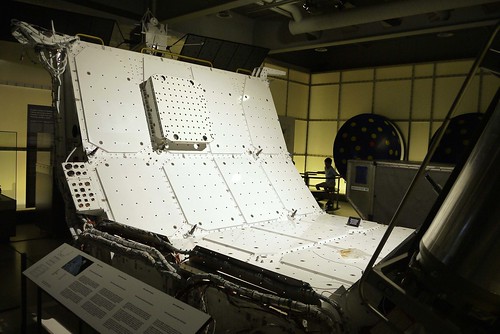
From the signboard:
British Aerospace Spacelab Pallet F003/MD004
The use of pallets for transport is not restricted to rail trucks. During the 1980s, British Aerospace produced a series of pallets for carrying experiments and cargo on the American space shuttle as part of the European Spacelab programme.
To utilise the available space as efficiently as possible, the Spacelab Pallet is U-shaped like an aircraft container. The aluminium structure incorporates cooling panels, connected to a Freon circuit. Up to 5 pallets can be joined together, each with its own electricity and data connections. A special version of the normally fixed pallet can even be unloaded in space.
Tags: Lucern, Luzern, Spacelab Pallet, Swiss Museum of Transport, Switzerland, Vacation
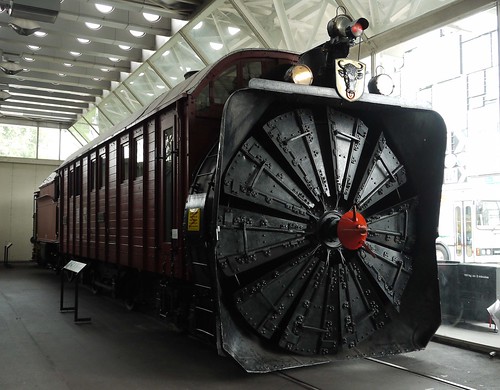
From information signboard:
Rotary snow-plough Xrot m No 100 Rotary Gotthard Railway GB 1895
The snow-plough body contains the boiler and a twin-cylinder steam engine driving the bucket wheel, which is nearly 3 metres in diameter. The cutting blades were adjustable to cope with the varying hardness of the drifts. The jet of snow that was hurled away could be directed as far as 90 m sideways and up to 18 m in height. This patent was developed by Leslie Brothers for the Rocky Mountains in North America, and was superior to competitive products available there.
Tags: Lucerne, Luzern, Snow Plough, Swiss Transport Museum, Switzerland, Vacation
You cannot conceive the many without the one… The study of the unit is among those that lead the mind on and turn it to the vision of reality.
Plato
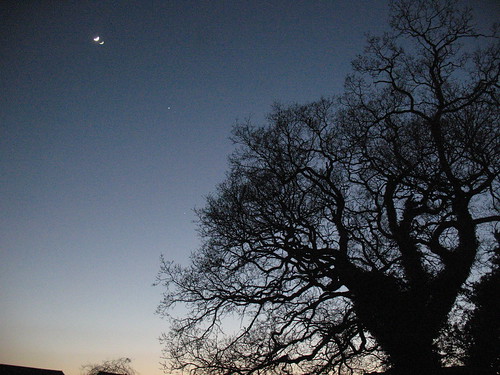
Tags: Cherie's Place, Cherie's Place Thought, Moon, My Oak Tree, Oak Tree, Shropshire, Star, Tree, Twin Moons