The town has given its name to the Cromerian Stage or Cromerian Complex, also called the Cromerian, a stage in the Pleistocene glacial history of north-western Europe.
Cromer is not mentioned in the Domesday Book of 1086. The place-name ‘Cromer’ is first found in a will of 1262[7] and could mean ‘Crows’ mere or lake’.[8] There are other contenders for the derivation, a north-country word ‘cromer’ meaning ‘a gap in the cliffs’ or less likely a direct transfer from a Danish placename.

Tags: Cromer, Norfolk, Vacation

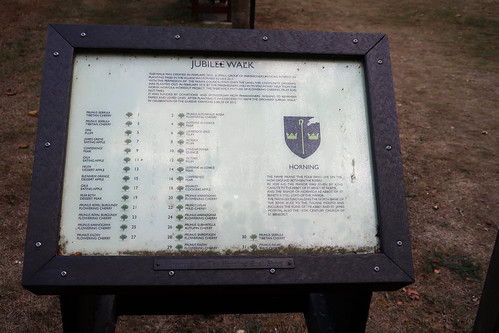
The name [Horning] means “the folk who live on the high ground between the rivers”.
In 1020 A.D. the manor was given by King Canute to the Abbey of St. Benet at Hulme, and the Bishop of Norwich as Abbot of St. Benets is still Lord of the Manor.
The Parish extends along the north bank of the river Bure to the Thurne Mouth and includes the ruins of the abbey and St. James hospital also the 13th. century church of St. Benedict.
Tags: Horning, Norfolk, Vacation
When your mind is empty of prejudices you can see the Tao. When your hearth is empty of desires you can follow the Tao.
Robet M Pirsing

Tags: Cherie's Place Thought, Norfolk, Sandringham, Sandringham Estate, Vacation

Castle Rising Castle is one of the most famous 12th Century castles in England. The stone keep, built in around 1140ad, is amongst the finest surviving examples of its kind anywhere in the country and, together with the massive surrounding earthworks, ensures that Rising is a castle of national importance.
In its time Rising has served as a hunting lodge, royal residence, and for a brief time in the 18th century even housed a mental patient. The most famous period in its history was when it came to the mother of Edward III, Queen Isabella, following her part in the murder of her husband Edward II. The castle passed to the Howard family in 1544 and it remains in their hands today, the current owner being a descendant of William D’Albini II, the Norman baron who raised the castle.
The great earthworks which form the whole site and extent of the castle cover an area of between 12 and 13 acres, and comprise a main central enclose, or inner bailey, and two lesser outworks respectively to east and west. The central enclosure, in shape something between a circle and an oval about 73m north to south and 64m east to west, has a circumference around its crest of about 320m, and is far and away the strongest, with it banks, even now after the cumulative and combined effects of erosion and in-filling, rising to a height of some 18m.
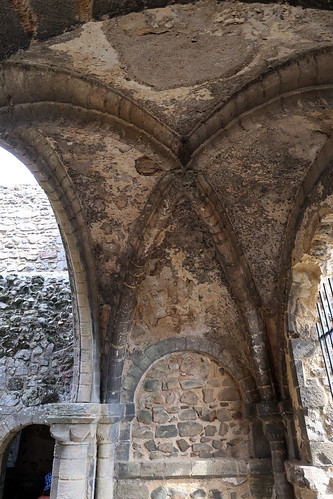
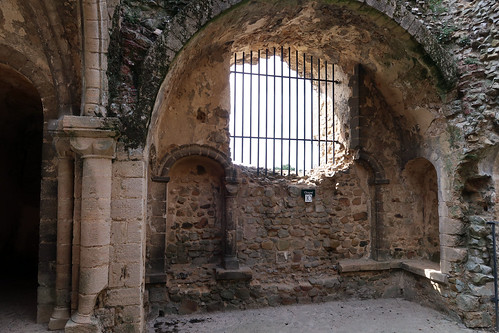
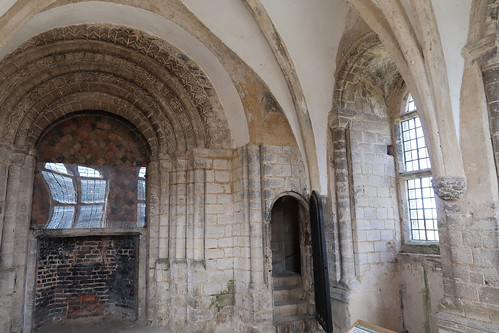
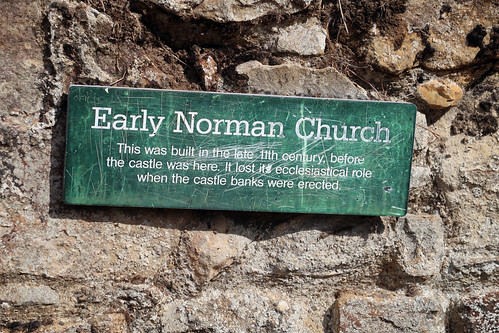
Within the inner bailey can be found the remains of an early Norman Church. Discovered in the early nineteenth century when the bailey was cleared of accumulated sand and soil, it is the earliest building within the site, pre-dating even the castle itself. Dating from around the late eleventh century it is thought to be the first parish church of Rising (no earlier church has been discovered) and was probably replaced by the current twelfth-century church when the castle was founded.




Tags: Castle Rising, Kings Lynne, Norfolk, Vacation
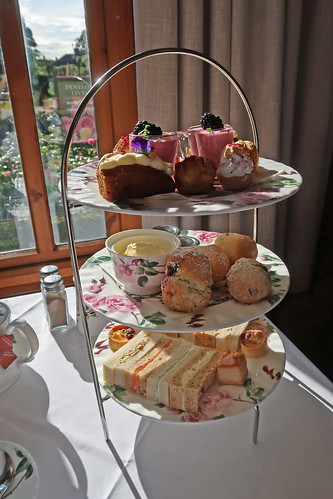
Taking advantage of a Christmas gift voucher we had Afternoon Tea at David Austin Roses. The weather was perfect, after several rainy days the sun came out allowing us to enjoy the gardens before indulging in tasty treats in the tea room.


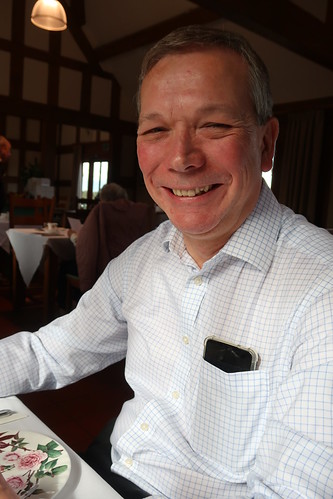
Tags: Afternoon tea, David Austin Roses, Me by another, National Trust, Portrait, Shropshire, There's Always One

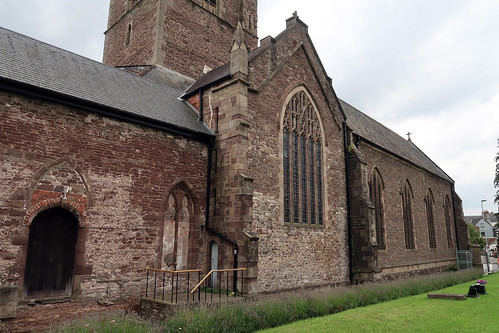
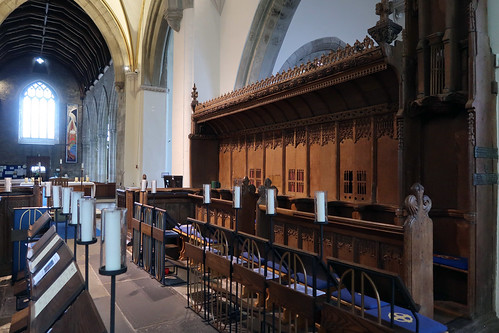
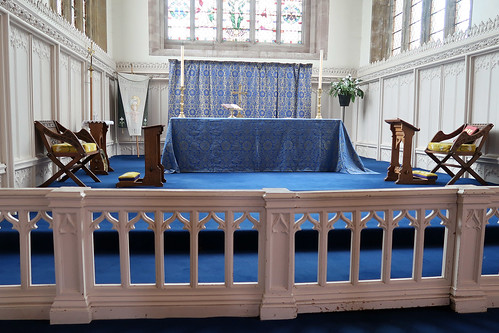
The current structure was originally the church of the Benedictine Priory, established under Hamelin de Balun the first Norman holder of the title Lord Abergavenny, which in the 1090s became Baron Bergavenny. At this time it was a cell of the Abbey of Saint Vincent at Le Mans in France. Henry de Abergavenny was a prior here and later at Llandaff in the late 12th century and was chosen to assist at the coronation of King John I of England in 1199. Successive Lords of Abergavenny were by necessity also benefactors, including William de Braose, 4th Lord of Bramber. In 1320 John Hastings, 2nd Baron Hastings, called on the Pope to set up an investigation into the Priory, in which the monks were accused of failing to maintain the Benedictine Rule. The prior, Fulk Gaston, absconded to the mother Abbey with the church silver.
By the time of the Dissolution of the Monasteries the Priory had only the prior and four monks. Due to the close connections between the Lords of Abergavenny and the Tudor dynasty the priory was spared and became the parish church.[4] *

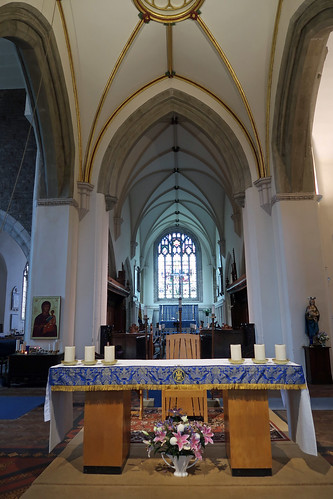

The Herbert Chapel contains recumbent monuments and effigies, in both alabaster and marble, associated with the ap Thomas and Herbert families. These include Sir Richard Herbert of Coldbrook, executed with his elder brother William, Earl of Pembroke after the Battle of Edgecote in 1469 and William’s illegitimate son Richard Herbert of Ewyas. The latter was brought up with Pembroke’s ward Henry Tudor, later Henry VII, and fought on his side at Bosworth in 1485.[6]
Within the chapel are also monumental brasses dating from the 16th and 17th centuries.
In 2018 the chapel was dedicated to St Benedict whose rule the Priory monks followed.*


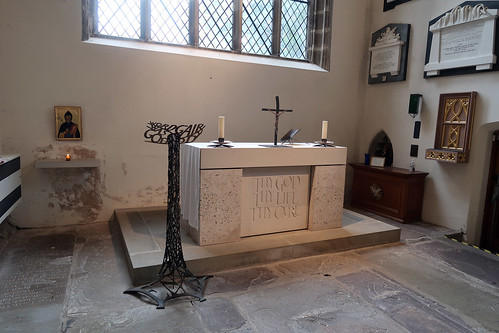
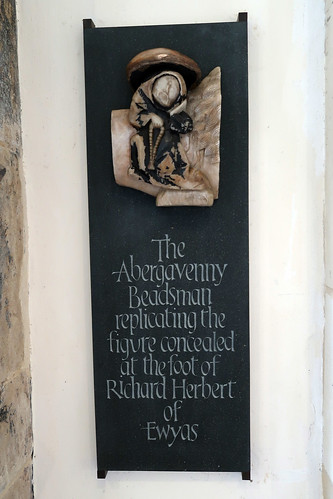
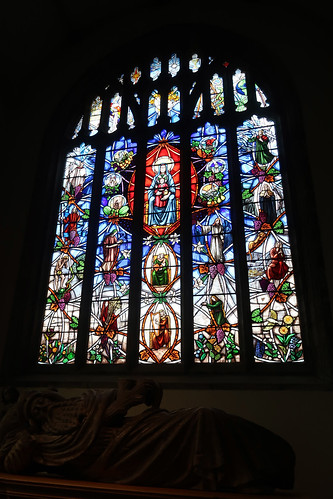
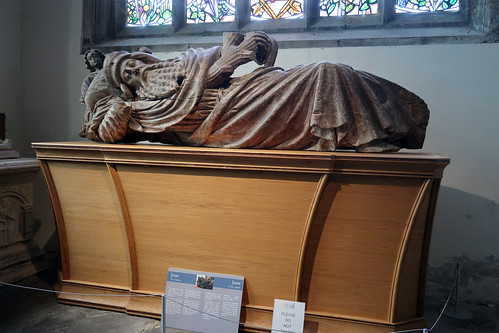
The Jesse is an elaborate, very large, 15th-century wooden carving which would have once been part of an even larger carving forming a Jesse Tree telling the lineage of Jesus Christ based on that in the Bible. It is unique in Britain and described by Tate Britain as one of the finest medieval sculptures in the world. The art historian Andrew Graham-Dixon called it the one “unarguably great wooden figure” remaining from the Middle Ages.[7] In 2016 a new stained-glass Jesse window designed by Helen Whittaker was installed in the Lewis Chapel, incorporating the wooden Jesse at its foot.[8][9][10] The project was visited in April 2016 by the Archbishop of York, the Most Revd John Sentamu;[11] and the completed work was dedicated in the presence of Charles, Prince of Wales, on 7 July 2016.[12] The Jesse effigy was placed on a newly designed plinth in position below the Jesse Window in 2017.*

* Information from Wikipedia
Tags: Abergavenny, The Priory Church of St Mary, Vacation, Wales

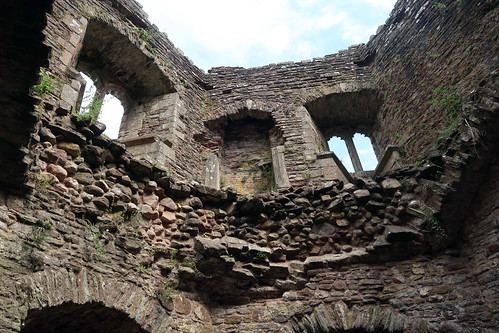
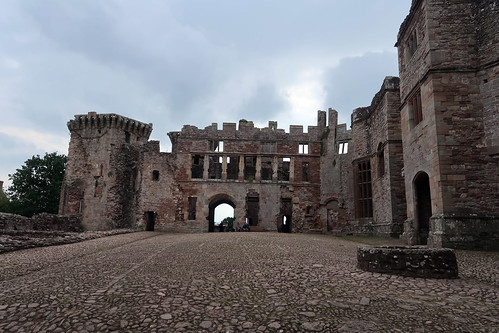
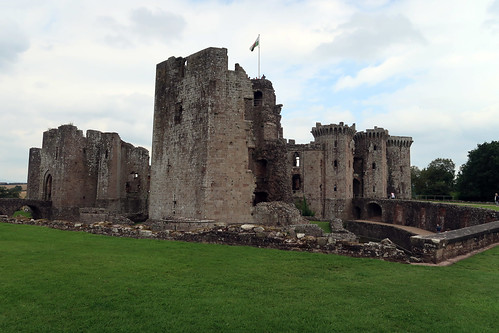
The unmistakable silhouette of Raglan crowning a ridge amid glorious countryside is the grandest castle ever built by Welshmen.
We can thank Sir William ap Thomas, the ‘blue knight of Gwent’, for the moated Great Tower of 1435 that still dominates this mighty fortress-palace. His son Sir William Herbert, Earl of Pembroke, created the gatehouse with its flared ‘machicolations’.
These stone arches allowed missiles to be rained down on attackers. But Raglan came 150 years later than the turbulent heyday of castle-building. It was designed to impress as much as to intimidate.
Under various earls of Worcester Raglan was transformed into a magnificent country seat with a fashionable long gallery and one of the finest Renaissance gardens in Britain. But loyalty to the crown was to prove its undoing.
Despite a garrison of 800 men and one of the longest sieges of the Civil War, it fell to parliamentary forces and was deliberately destroyed. Among the looted treasures was a piece of Tudor wooden panelling, now proudly displayed in the visitor centre after being rescued from a cow shed in the 1950s.





Tags: Raglan, Raglan Castle, Usk, Vacation, Wales