The magnificent keep at Conisbrough Castle is one of South Yorkshire’s most striking landmarks. The castle was the centre of a great Norman lordship, given by William the Conqueror to William de Warenne. The keep was probably built in the 1170s or 1180s. Escaping damage in the Civil War, it became a picturesque ruin in the 18th and 19th centuries, and inspired Sir Walter Scott’s most famous novel, Ivanhoe, published in 1819.


Tags: Conisbrough Castle, English Heritage, Vacation, Yorkshire

Bebra Gardens is a small, attractive park close to Knaresborough Castle.
This hidden gem, which provides a haven from the hustle and bustle of the town centre is named in honour of the town’s links with Bebra, Germany.
The gardens are on a steep slope and there are sloping, meandering pathways leading through mature trees and conifers. The paths lead to the paddling pool at the lowest point and onto Waterside below.

Tags: Bebra Gardens, Knaresborough, Vacation, Yorkshire

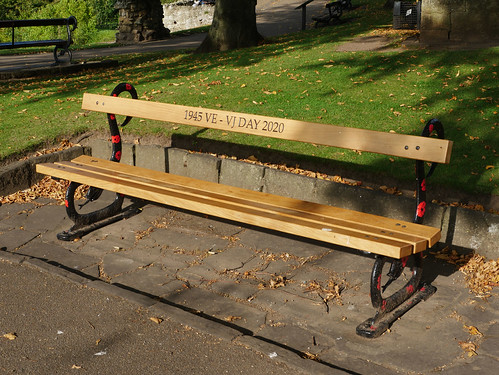
The memorial commemorates the residents of Knaresborough who were killed or missing in World War I (155 names) and World War II (54 names).


Tags: Knaresborough, Vacation, War Memorial, WW1, WW2, WWI, WWII
When you are going to hike – pack a light heart
Dan May

Tags: Cherie's Place Thought, Heart, Knaresborough, Love, Nature, Vacation, Yorkshire

The viaduct connects Knaresborough with Harrogate on the Harrogate line, in North Yorkshire, England.[8] The line was built in 1848 with the Leeds and Thirsk Railway creating a branch from their line at Starbeck railway station to go through Knaresborough and connect with the line that was being built westwards from York as part of the East and West Yorkshire Junction Railway.[9] Just as the viaduct had been almost completed, it collapsed into the River Nidd on 11 March 1848.[10] The resultant noise of the falling masonry was said to have lasted for five minutes. Whilst there was no official inquiry, it is believed that the collapse of the viaduct was down to a combination of bad workmanship, poor materials and excess water in the swollen river below as a result of heavy rain over a period of two months.[11] Despite the collapse, the centre span was still in-situ and had to be demolished before work could start again on a replacement viaduct.[12]


Tags: Harrogate, Knaresborough, Knaresborough Viaduct, Vacation, Viaduct, Yorkshire
…Courtroom Museum

There has been a castle in Knaresborough for over 900 years. Over the centuries there have been significant periods of building and repair work as the castle was adapted to meet changing military requirements, fashions and historic events.
The early castle
We know very little about the castle’s origins but there may have been an Anglo-Saxon fortification in ‘Chednaresburg’. Burg is an Old English word for a defended enclosure, and could refer to a bank and ditch surrounding a settlement here.
The earliest castle was built by the Normans who recognised the superb natural defences of this rocky promontory high above the river Nidd. We find the first written evidence of a castle in Knaresborough in financial records called the Pipe Rolls dating from the reign of Henry I (1100-1135). These show that £11 was spent in 1129-1130 on strengthening the ‘King’ Works at Knaresborough’ by custodian Eustace Fitz-John.
Some years later, the castle played a part in one of the more infamous stories of the medieval period. In 1170 the Constable of Knaresborough Castle Hugh de Morville and his followers took refuge there after they had murdered Thomas Becket , Archbishop of Canterbury.


Tags: Courtroom Museum, Harrogate, Knaresborough, Knaresborough Castle, Vacation, Yorkshire

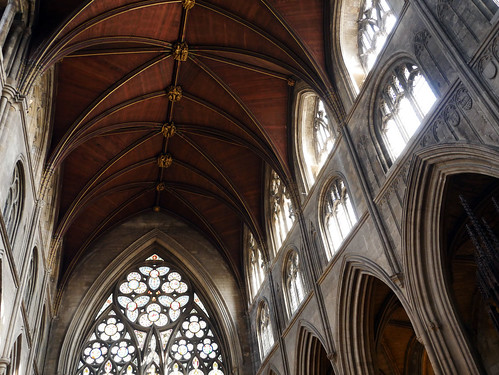
The Cathedral Church of St Peter and St Wilfrid, commonly known as Ripon Cathedral, and until 1836 known as Ripon Minster, is a cathedral in the North Yorkshire city of Ripon. Founded as a monastery by Scottish monks in the 660s, it was refounded as a Benedictine monastery by St Wilfrid in 672. The church became collegiate in the tenth century, and acted as a mother church within the large Diocese of York for the remainder of the Middle Ages.[2] The present church is the fourth, and was built between the 13th and 16th centuries. In 1836 the church became the cathedral for the Diocese of Ripon.[3] In 2014 the Diocese was incorporated into the new Diocese of Leeds, and the church became one of three co-equal cathedrals of the Bishop of Leeds.
The cathedral is notable architecturally for its gothic west front in the Early English style, considered one of the best of its type, as well as the Geometric east window.[3] The seventh-century crypt of Wilfrid’s church is a significant example of early Christian architecture in England.[3] The cathedral has Grade I listed building status.



Tags: Ripon, Ripon Cahtedral, There's Always One, Vacation, Yorkshire