The memorial chapel on the south side, was once the chantry chapel of John Argentein. Provost 1501-1507, who was physician to Edward IV and the young Edward V and his brother, the murdered princes in the Tower. His brass lies before the altar, and in this chapel there is also a record of the Provosts of King’s through the centuries. The chapel was converted into a war memorial in 1920-1921 and renamed All Souls Memorial Chapel. A tablet recalls college members who died in the two world wars, among them the poet Rupert Brooke.*


*From a guide to King’s College Chapel, Cambridge
Tags: Cambridge, Chapel, King's College, King's College Chapel, Weekend away
It is the beautiful task of Advent to awaken in all of us memories of goodness and thus to open doors of hope.
Pope Benedict XVI
Tags: Duomo di Salerno, Relics, Salerno, St Mathew, Tomb, Vacation

King’s College Chapel is arguably the most magnificent example of late medieval English architecture in the entire country. Guidebooks run out of superlatives to describe the richness of its interior decoration and the sumptuous flowing lines of the structural elements.
The Chapel was founded by Henry VI in 1441 as part of his grand scheme for creating at King’s a college to take graduates of Eton, founded the previous year. The chapel was intended to form one side of a grand court but the residential ranges planned for the other three sides of the court were never completed.
Henry compelled landowners in the town to sell him plots along the river, and he proceded to pull down residences, shops, and even a parish church to make room for his creation. Henry intended his chapel to be without equal.
He employed his royal architect, Reginald of Ely, to draw up plans for a church along the lines of a cathedral choir, and Henry himself laid the foundation stone of the new chapel on 25 July 1446.
Building continued until 1461, through the opening hostilities of the Wars of the Roses. But when Henry VI was taken prisoner by thefuture Edward IV, workmen packed up their tools and went home. It is said that a half-cut stone left by the workmen was eventually used as the foundation stone for the Gibb’s building in 1724.
The extent of this early building phase is clearly noticeable. The builders used white Tadcaster limestone, and the upper limit of this stone can be traced, particularly in the butresses. Very little building was done under Edward IV, but Richard II’s short reign saw the first 5 bays of the chapel completed and put into daily use.
Henry VII provided the necessary funds to turn the half-finished chapel into a complete building. The chest which carried Henry’s initial gift of money is preserved in the Chapel Exhibition in the northern side chapel. The main structure was finished in 1515, and Henry VIII funded the interior woodwork and screen.
The magnificent – there is no other word to describe it – fan vaulting was completed in just 3 years, between 1512-1515 by master mason John Wastell.
The chapel surprisingly escaped major damage during the Civil War, despite the fact that Cromwell’s troops used it for a training ground in inclement weather. It is possible that Cromwell himself, being a Cambridge student, gave orders to spare the chapel. Most of the stained glass was removed during WWII, and the Chapel again escaped damage.


Tags: Cambridge, Chapel, Church, King's College, King's College Chapel, Weekend away

King’s College was founded in 1441 by Henry VI, who had founded Eton College (qv) in 1440 and subsequently linked the school to King’s in order to supply college scholars. King’s College chapel was begun in 1446. Following Henry’s deposition in 1461, the college’s income was much reduced, and the only building of his great scheme to be built was the chapel, which took about a century to complete. The initial court, Old Court, was built north of the chapel (this area, since 1829, part of the Old Schools precinct owned by the University), with the intention that it should be superseded by the great scheme, of which the chapel would have been the north side of the resultant court. Building was slow and piecemeal throughout the following centuries, Front Court not being finished until the early C19. The site remains (1998) in college use.


Tags: Cambridge, King's College, Weekend away

The presence of Presbyterianism in Cambridge had dwindled through the eighteenth century. In the nineteenth century, many Scots and Irish Presbyterians began to move to the area to pursue careers in business, the professions and academia. This gave Presbyterianism in Cambridge a fresh impetus.
Until 1871, members of Cambridge colleges were required to attend worship in the Anglican college chapels. As this regulation was relaxed, more and more Presbyterians, mostly Scots, entered the University, and the demand for a congregation of the Presbyterian church in Cambridge grew. In 1879, the first congregation of the Presbyterian church in Cambridge met in the Guildhall. Work on the present church building began in 1890, and the new church was opened on 7 May 1891. In November 1893 the Presbytery approved the name of St Columba, ‘the presbyter-apostle of Iona’.
Westminster College, a theological college of the Presbyterian Church of England came to Cambridge in 1899. This had a great influence over the life of St Columba’s, with many prominent theologians teaching at the college also becoming deeply involved in the life and preaching of the church. To this day, St Columba’s continues to benefit from the intellectual and spiritual work of those who teach at Westminster.
In 1972, the Presbyterian Church of England united with the Congregational Church in England and Wales to form the United Reformed Church, of which St Columba’s is now a part, with further unions in 1981 with the Churches of Christ and in 2000 with the Congregational Church of Scotland.


Tags: Church, Columba's Church, The Duchess of Cambridge, United Reformed Church, Weekend away
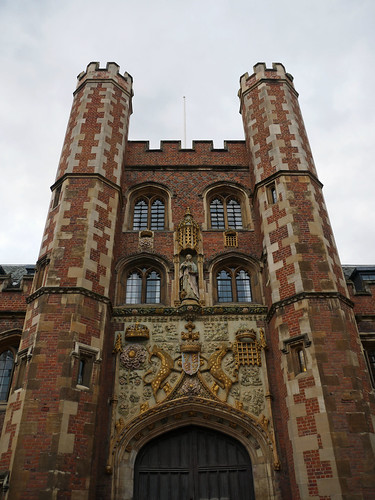
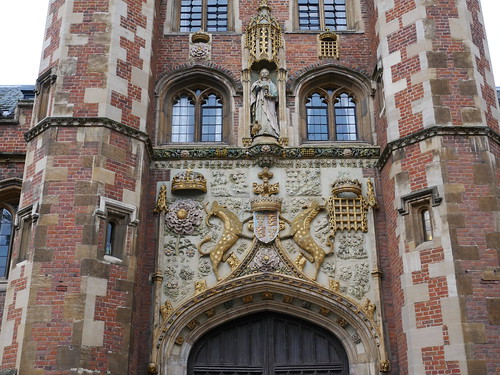
St John’s distinctive Great Gate follows the standard contemporary pattern employed previously at Christ’s College and Queens’ College. The gatehouse is crenelated and adorned with the arms of the foundress Lady Margaret Beaufort. Above these are displayed her ensigns, the Red Rose of Lancaster and Portcullis. The college arms are flanked by curious creatures known as yales, mythical beasts with elephants’ tails, antelopes’ bodies, goats’ heads, and swivelling horns. Above them is a tabernacle containing a socle figure of St John the Evangelist, an Eagle at his feet and symbolic, poisoned chalice in his hands. The fan vaulting above is contemporary with tower, and may have been designed by William Swayne, a master mason of King’s College Chapel.
Tags: Cambridge, St John's College, The Great Gate, University, Weekend away
In Christ there is no Jew or Greek, no slave or free, no male or female, for all of you are one in Christ.
Galatians 3:28
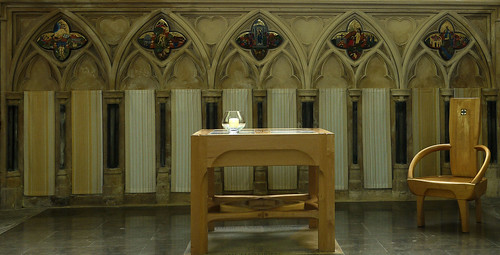
I was inspired to post the above thought when it was quoted on an inspirational blog that I regularly read . I wondered what photograph I would use to go with the quote and I was directed (in my mind) to click on a folder and this image was the first photo in the folder.
I searched the Bishop’s Palace website to view details of the chapel and altar.
The page about the chapel revealed an additional quote that connects and chimes with the quote I was inspired with…
The new altar, made of maple and Ancaster stone, was designed by David John and made by Richard Richardson. The altar stands above engraved stone work by John Rowlands Pritchard, with the text, ‘God was in Christ reconciling the world to himself; and has given us the ministry of reconciliation’. (2 Corinthians 5:18).
The things that I refer to as ‘my strange coincidences’ are at work again…
Tags: Cherie's Place Thought, Christ, God, Jesus, Teachings, The Bishop's Chapel, Wells