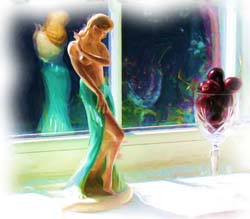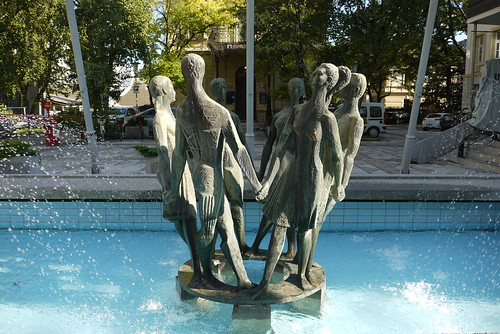
A bronze sculpture by Stojan Batič.
Batič was born in a working-class family in Trbovlje, a mining town in central Slovenia, then part of the Kingdom of Serbs, Croats and Slovenes. Already as a teenager, he worked in the local coal mine. At the age of 19, he joined the partisan resistance, which fought the Nazi German forces. After World War II, he was the first to enroll at the newly established Academy of Fine Arts at the University of Ljubljana, where he studied sculpture under Boris Kalin and Frančišek Smerdu.[1] In 1957, he received a scholarship, which enabled him to study in Paris with the sculptor Ossip Zadkine.
Batič lived and worked in Ljubljana. In 1995, he had a show at Ljubljana City Gallery.[2] In 2015, the Jakopič Gallery held a retrospective exhibition of his work under the title “The Man and The Myth” (Človek in mit).
Batič, predominantly a figurative sculptor, is known for about 40 public monuments depicting events from Slovene history, as well as European and Oriental myths and legends. His best-known works include the monument to the Slovene peasant revolts at Ljubljana Castle featuring a group of men holding war scythes, and the Itaka series of figurative sculptures. His 1957 bronze sculpture Balet (Ballet) stands in front of Tivoli Castle in Tivoli Park in Ljubljana. In the 1960s, he created a mining-related series in lignite, and in the 1970s a series of glass sculptures, the two representing his most significant approach to abstract art.
Tags: 1962, Ljubljana, Sculpture, Slovenia, Stojan Batič, Vacation

Filed under Art
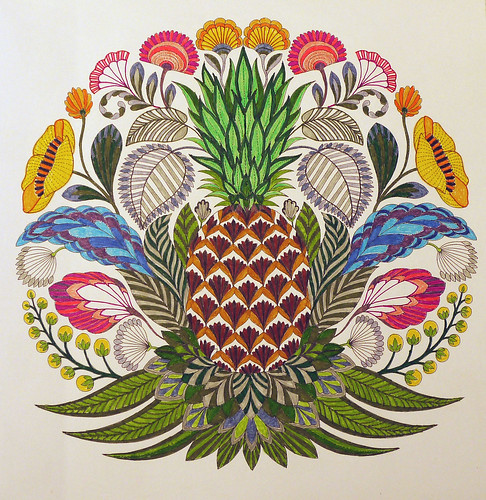
For Christmas my mum asked for some adult colouring books which are currently popular in the UK. Whilst I was choosing which books to buy for her I was inspired to have a go at colouring too. I ordered a book and some felt pens. The pens arrived quickly but the book was not due to arrive for a few days. So when I was out at Attingham Park I picked up a different colouring book to try out whilst I waited for the one I had ordered to arrive. When I arrived home I was amused to find that my order that wasn’t due for several days had been delivered whilst I was out 
Here is my first experiment at colouring for the first time for many years. I chose an image in the book that I bought at Attingham Park. For colouring I used Staedtler triplus fineliners and Staedtler triplus color. I was tempted to use coloured pencils to obtain a pastel contrast from the vibrant colours, but I resisted the urge and left some parts white instead.
My photograph has dulled the colours which are very bright (and beautiful) on paper.
Tags: Colouring, MillieMarotta, Staedtler, Triplus Color, Triplus Fineliners, TropicalWonderland
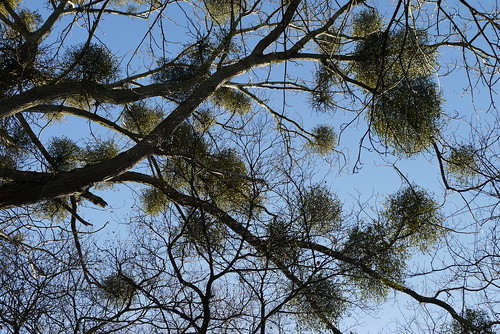
I have been away on a mini break to the land where mistletoe grows and am currently working through the photographs I took while I was away. Work is also rather manic at the moment so bear with me until normal service is resumed
Tags: Herefordshire, Mini Break, Mistletoe, Valentine's Break
Love is like a beautiful flower which I may not touch, but whose fragrance makes the garden a place of delight just the same.
Helen Keller
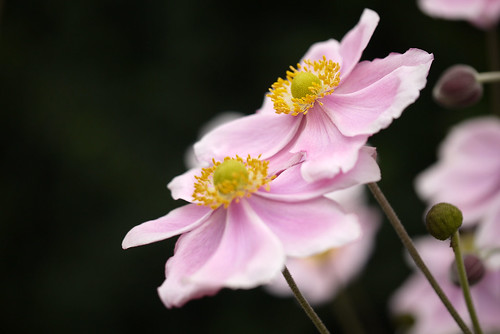
Tags: Cherie's Place Thought, Happy Valentine's Day, With Love
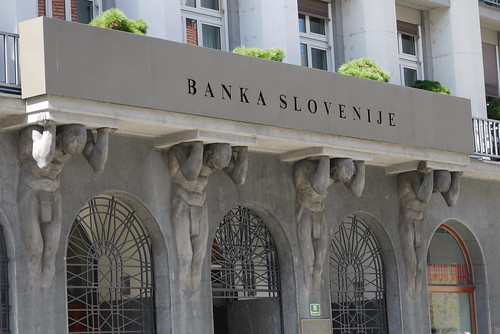
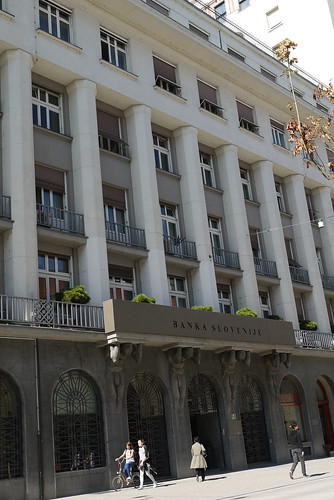
In line with the first project prepared in 1918, LJUBLJANSKA KREDITNA BANKA (LKB) planned to construct buildings on the entire ground of the former Austrian military supply warehouse (Militär-Verpflegungsmagazin). This included the block between Tyrševa (now Slovenska Cesta) and Beethovnova Ulica, and between Kidričeva (now Štefanova Ulica) and Cankarjeva Ulica. The project was never realised: it was overruled by the majority of the municipal council in disfavour of the modern bank.
Between 1919 and 1923, LKB therefore constructed only a five-storey office building at the crossing of Slovenska Cesta and Cankarjeva Ulica, and a five-storey residential building for the employees on Beethovnova Ulica (then No.16, now 14). The office building is constructed in modernistic style. LKB was tightly linked with the Živnostenska Banka in Prague: all the leading staff, directors and clerks were of Czech nationality. This may be the reason why the office building was designed by the Czech architect František Krasny from Prague. The formal construction decision was issued on 10 July 1920. The main entrance is decorated by four telamones supporting the first-floor balcony. The telamones were sculpted by the Slovenian sculptor Franc Berneker (1874-1932). Berneker shaped the telamones in a generic manner, as athletic bodies without excessive muscles, well in line with the architecture of the building. The location of the entrance door has been moved and the original entrance door replaced many times, last time in 2007.
Tags: Banka Slovenije, Ljubljana, Slovenia, Vacation
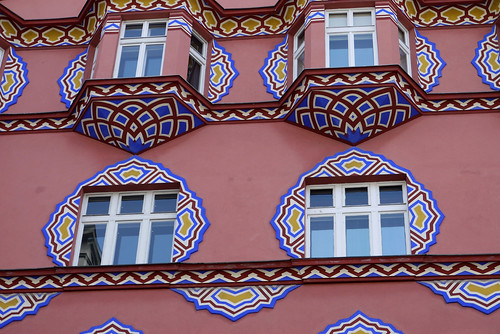
The most vibrantly decorated building in downtown Ljubljana, the Cooperative Bank was designed by Ivan Vurnik (1884-1971)m a Radovljica-born architect who studied under Otto Wagner, the doyen of Viennese Art Nouveau. Vurnik was keen to develop a Slovenian national style of architecture by blending traditional folk motifs with the best in modern design; this building is his ideological statement.
Begun in 1921, it represents a unique mixture of ethnographic detail and Art Nouveau, with jazzy chevrons and zig-zags weaving around the oriel windows on the facade. Rich in blues, yellows and brick-reds, the decorative scheme is inspired by the embroidery of rural Slovenia. Vurnik clearly, was also influenced by folk-art patterns found throughout Slavic Europe.
The Cooperative Bank now houses the Ljubljana Land Registry Office.*
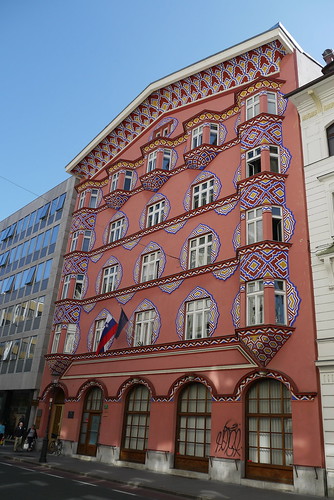
*From the Eyewitness Travel Guide to Slovenia
Tags: Cooperative Bank, Ljubljana, Slovenia, Vacation
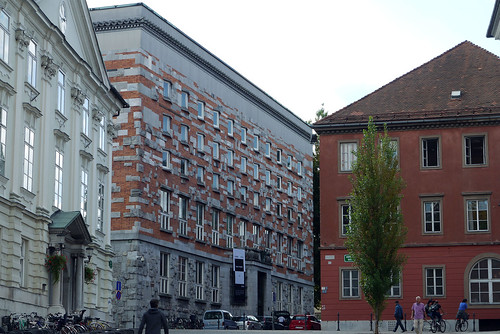
The National and University Library is an exceptional piece of Plečnik’s architecture, shaped by the block of Vegova, Gosposka and Turjaška Streets. The library was built between 1936-1941 according to plans by Jože Plečnik drawn in 1930-1931. The location was selected at the edge of the medieval town core, at the place of the former Prince’s Manor (Knežji dvorec). Plečnik clothed the four and more storey ashlar building in symbolic facades decorated with red bricks and limestone from Podpeč. The hard membrane is softened by the two glass walls of the great reading room, accentuated by two columns with unusual volute capitals in the middle of the windows. The side entrance is decorated with a statue of Moses by Dolinar with portrait features of the painter Jakopič. On the terrace with benches between Vegova Street and the library, statues of Slavicist scholars stand in a line, and at the end of the terrace is a monument dedicated to the poet Simon Gregorčič (sculptor Zdenko Kalin). The portal and the floor plan of the four surrounding wings with a ceremonial staircase at the core are of especially refined design.