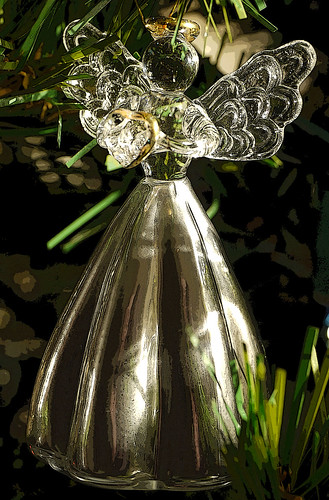
The Angel that presided o’er my birth
Said, “Little creature, form’d of Joy and Mirth,
“Go love without the help of any Thing on Earth.”
William Blake
Random thoughts and photos of my journey through life…
The Angel that presided o’er my birth
Said, “Little creature, form’d of Joy and Mirth,
“Go love without the help of any Thing on Earth.”
William Blake
2 Comments CherryPie on Jan 10th 2016
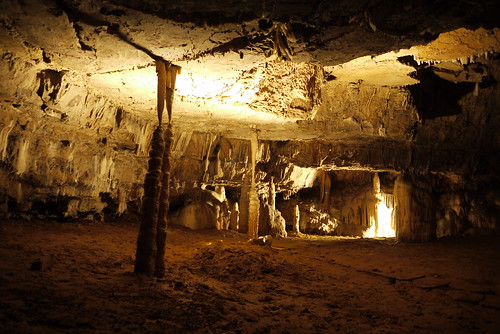
The cave was first described in the 17th century by the pioneer of study of karst phenomena, Johann Weikhard von Valvasor.[4] In 1818, when the cave was being prepared for a visit by Francis I, the first Emperor of the Austria-Hungary, a new area of the cave was discovered accidentally by local Luka Čeč.
- First tourist guide and electric lighting
In 1819, Archduke Ferdinand visited the caves, this is when the caves became officially known as a tourist destination. Čeč became the first official tourist guide for the caves when the caves were opened to the public. Electric lighting was added in 1884, preceding even Ljubljana, the capital of Carniola, of which the cave was part at the time, and further enhancing the cave system’s popularity.
- Cave rails
In 1872, cave rails were laid along with first cave train for tourists. At first, these were pushed along by the guides themselves, later at the beginning of the 20th century a gas locomotive was introduced.
- Blackening of the entrance
During World War II, German occupying forces used the cave to store nearly 1,000 barrels of aircraft fuel, which were destroyed in April 1944 by Slovene Partisans. The fire burned for seven days, destroying a large section of the cave and blackening the entrance.[5][6][7]
- After World War II
After 1945, the gas locomotive was replaced by an electric one. About 5.3 kilometres (3.3 mi) of the cave system are open to the public.[8] In June 2015 the cave administration reported that cave divers managed to explore a further underwater section of the cave leading towards Planina Cave, thus lengthening the cave system from 20,570 m (67,490 ft) to 24,120 m (79,130 ft).[9]
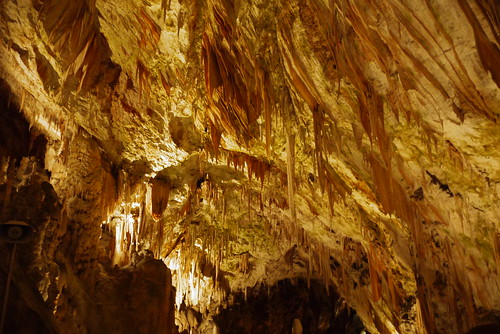
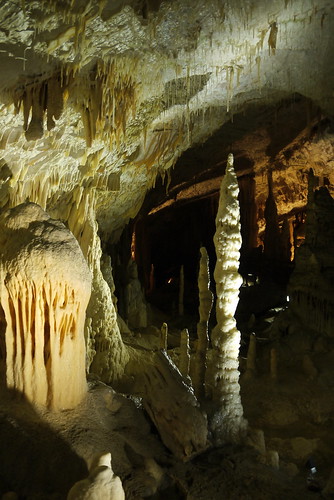
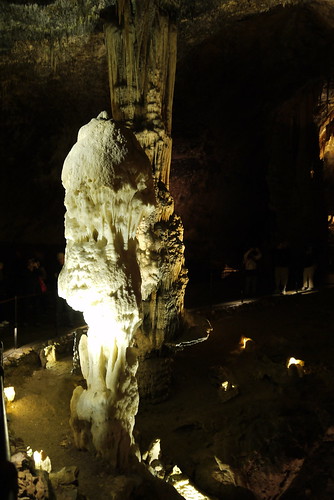
Postojna Cave’s most beautiful stalagmite is called the Brilliant. Looking at this marvellous shiny white limestone formation, you cannot but agree that it is entirely worthy of its name. The approximately 5-metre-tall stalagmite ‘Brilliant’ is located at a spot with a strong and even drip from the ceiling. A thin layer of pure calcite sinter is deposited constantly and evenly by the water trickling down the rounded crown of the stalagmite, which gives the stalagmite an outstandingly white and shiny appearance. It therefore comes as no surprise that the stalagmite has been the symbol of Postojna Cave and the Slovenian Karst for decades. Standing right next to it is a baroque-like pillar.

Picture from Wiki
The olm (Proteus anguinus) has always excited people’s imagination. Initially, it was believed it was the dragon’s offspring brought onto the surface by high waters. As a matter of fact, there might be some truth to these old beliefs. The olm is a neotenic animal, which means that adult olms retain most of their juvenile features. And if the olm decided to grow up… wouldn’t it perhaps really turn into a dragon?
The olm or proteus (Proteus anguinus) is an aquatic salamander in the family Proteidae, the only exclusively cave-dwelling chordate species found in Europe. In contrast to most amphibians, it is entirely aquatic; it eats, sleeps, and breeds underwater. Living in caves found in the Dinaric Alps, it is endemic to the waters that flow underground through extensive limestone of karst of Central and Southeastern Europe, specifically southernSlovenia, the Soča river basin near Trieste, Italy, southwestern Croatia, and Herzegovina.[2]
It is also occasionally called the “human fish” by locals because of its skin color, similar to that of white people (translated literally from Slovene: človeška ribica and Croatian: čovječja ribica), as well as “cave salamander” or “white salamander”.[3] In Slovenia, it is also known by the name močeril, which translates as “the one that burrows into wetness”.[4] It was first mentioned in 1689 by the local naturalist Valvasor in his Glory of the Duchy of Carniola, who reported that, after heavy rains, the olms were washed up from the underground waters and made local people believe that they saw a cave dragon’s offspring.
This animal is most notable for its adaptations to a life of complete darkness in its underground habitat. The olm’s eyes are undeveloped, leaving it blind, while its other senses, particularly those of smell and hearing, are acutely developed. It also lacks any pigmentation in its skin. It has three toes on its forelimbs, but only two toes on its hind feet. It also exhibits neoteny, retaining larval characteristics like external gills into adulthood,[5] like the American amphibians, the axolotl and the mudpuppy. The olm is the only species in the genus Proteus and the only European species of the family Proteidae.
12 Comments CherryPie on Jan 9th 2016
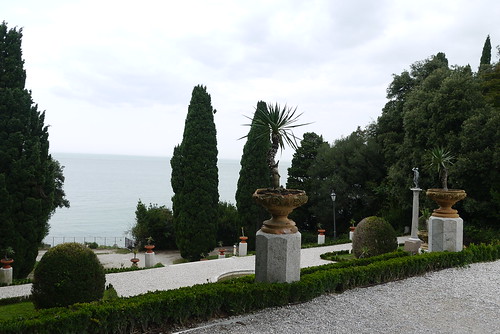
Miramare Park, which at one time had no vegetation, and has now a surface area of 22 hectares (54 acres), stands on a rocky promontory overlooking the Adriatic Sea. The site was planned and arranged by Carl Junker, according to the wishes of Archduke Maximilian who carefully followed the building of his residence. As far as the botanical aspect was concerned, a gardener, Josef Laube, was called in but was replaced in 1859 by Anton Jelinek, a Bohemian who had taken part in the frigate Novara’s expedition around the world.
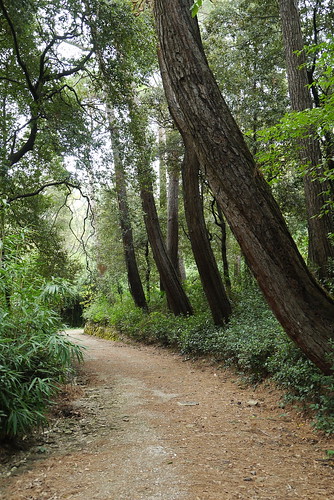
The park, on which work began in 1856, represents a classic example of a mixed, artificial implantation of ligneous forest-trees and bushes and it succeeds in blending the charm of a typically Northern environment and a Mediterranean context. In contrast to the baroque garden, the English one – on which Miramare is modelled – introduces a new relationship with nature, resulting from a different sensibility towards the material world. This is why, when strolling along the paths in the park, you can breathe in an atmosphere that is tightly bound up with the life of its owner and his romantic relationship with nature, which was typical of his epoch.
Before 1856, the park area was bare, with only some shrubs and thorny bushes. Today, on the other hand, there is a group of different species of trees that are, for the most part, of non-European origin or in any case, that are not native to the area. Within a period of ten years, cedars of Lebanon, North Africa and the Himalayas were planted, along with firs and spruces from Spain, cypresses from California and Mexico, various species of pine fromAsia and America, to which some exotic specimens, such as the giant sequoia and theginkgo biloba, were added. Miramare was conceived as a private garden and not as a park. In fact it does not have a monumental entrance or a driveway up to the castle. It was a garden of wonders, not intended for public use, even though the archduke opened it to the public a few days per week. Watercourses, pools, twisting paths, trees placed according to natural models, some grassy areas, are typical of English gardens. The roughness of the ground favoured the irregular lay-out of the promontory, combining the artificial transformation with the natural environment.
The park is also characterised by the presence of some buildings included in Junker’s project: the Castelletto – inhabited off and on by Maximilian and Charlotte – on which work began at the same time as work on the castle; the greenhouses, intended for the growing of the plants to be placed in the park; the ruins of the chapel dedicated to Saint Canciano, in whose apse is preserved a cross made from the wood of the frigate Novara, which was laid up in 1899; and lastly a little house, used nowadays as a coffee-shop, the “Swiss house“, placed at the edge of the swans’ lake.
Up until 1954, Miramare became the headquarters for German, New Zealand, British and American forces of occupation respectively. Finally in 1955, the complex was reopened to the public under the name Miramare Park, whose management was entrusted to the Sopraintendenza per i Beni Architettonici ed il Paesaggio e per il Patrimonio Storico, Artistico ed Etnoantropologico of the Friuli-Venezia Giulia region.
Today the gardens play host during the summer season to spectacles such as the musical “Sissi“, reliving the story of the Empire in its natural setting, and various concerts.
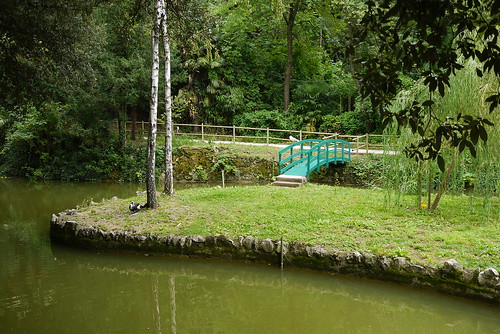
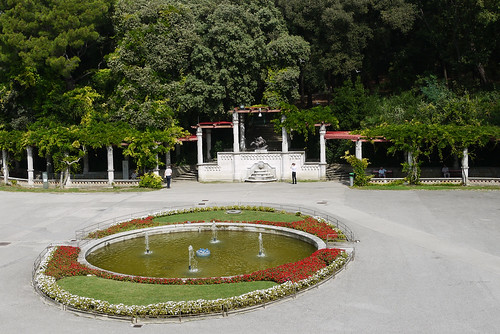
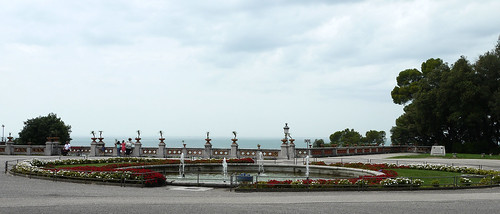
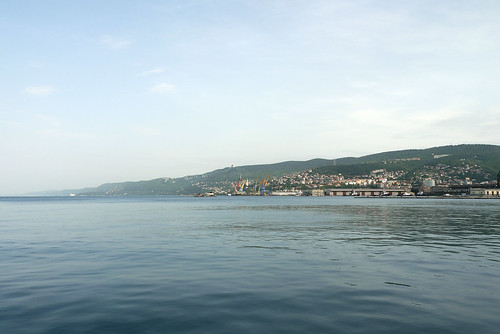
We have been to Trieste where we spent a week in our delightful villa, a veritable jewel in this southern clime, and facing one of the most beautiful gulfs in the world. It is impossible to imagine so thoroughly blue a sea in the North. When I first discovered it, I was overcome by an indescribable enthusiasm.
Charlotte of Belgium. 1857*
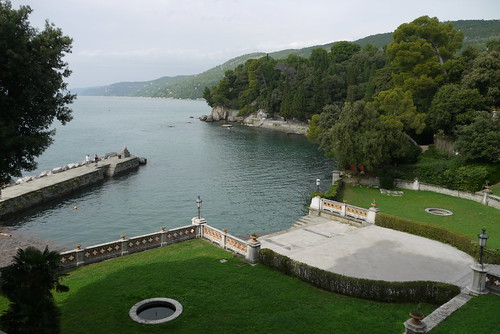
*From Castle Miramare historical and museum park by Rossella Fabiani
6 Comments CherryPie on Jan 8th 2016
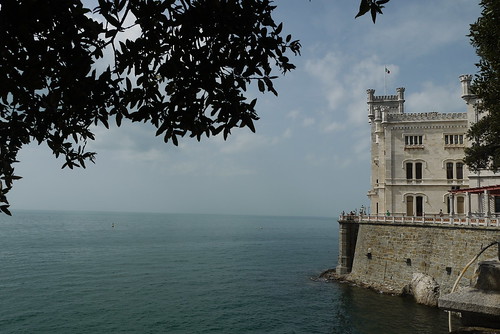
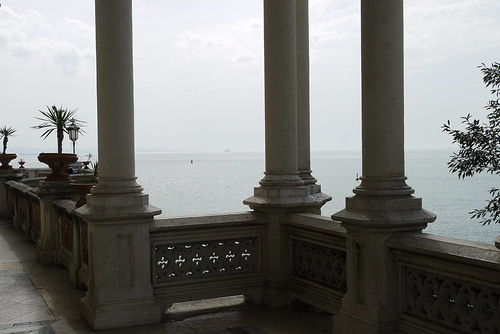
Within the Gulf of Trieste, the Bay of Grignano is enclosed on one side by a promontory that extends northwards. Tradition has it that this was the place where, on a cold spring day in 1855, Maximilian of Hapsburg had to put ashore from a boating trip because of a sudden squall of bad weather and strong gusts of the local wind, the Bora. Struck by the tough untamed beauty of the coastline and the nearby hilly outcrop the archduke is said to have decided to buy this entire site and use it to realize what had perhaps been the dream of his life: the creation of a park and palace befitting his rank. He would name the place using the Spanish word Miramar, though he himself often used the Spanish version, Miramare – the name which is still used today.
The entire zone would become a key feature of the Trieste coastline. Now owned by the state, both the castle and the park were the fruit of the decisions taken by Maximilian himself, given that he personally oversaw the stages of design and construction. As a result, the building and grounds as they stand today are an expression of Maximilian’s character and passion, a unique testimony to his wide-ranging cultural interests. The furnishings and interiors of the castle are almost entirely original, and the park contains various rare species personally chosen by the archduke himself. To know Miramar is to know Maximilian – and, through him, to become aware of the various trends in architecture in the mid nineteenth-century Europe.*
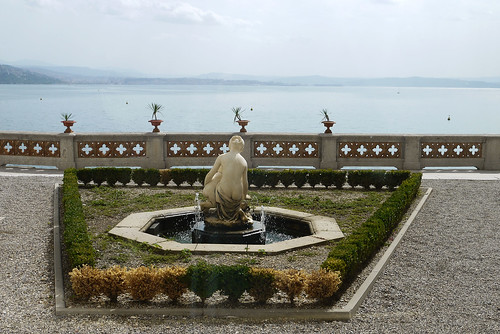
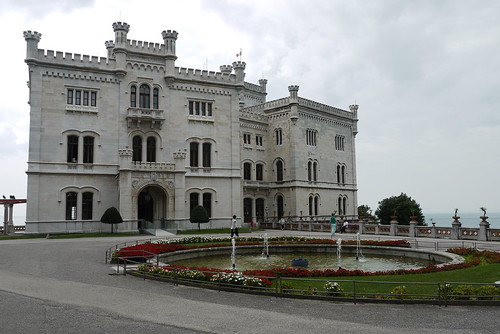
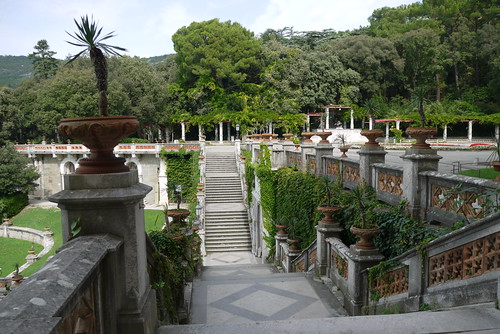
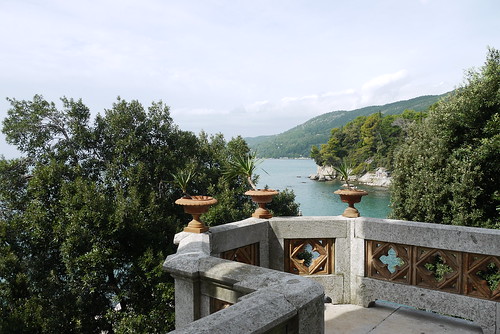
Miramare is a delightful place. We have apartments – warm in winter and cool in summer – from which one can hear the murmuring of the sea and observe all the fishing boats as they cut through the blue waves.
Charlotte of Belgium, 1861*
*From Castle Miramare historical and museum park by Rossella Fabiani
8 Comments CherryPie on Jan 7th 2016

I was a little bit slow off the mark this morning. Mr C left the house for work earlier than usual because he had to catch an early train to London for a meeting. The lack of movement in the house and the fact that the radio’s Breakfast Show had a different presenter than normal which led to me to sleeping through the alarm. I managed to recover the lost time but as I was leaving the house I heard the phone ring. I realised that it was my mum so I answered the phone.
She sounded flustered and said, ‘Oh you’re still at home! I have a sorry tale to tell you.’ My heart had that sinking feeling as I wondered what she was about to tell me. She went on to say that Mr C’s car had rolled off her drive (she lives near the railway station) coming to rest against the wall across the road and that the car’s bumper was hanging off. Not exactly good news, but not exactly bad news either; my heart resumed its normal position. She asked me to bring the spare key so that I could move the car. I went round straight after I had phoned work to let them know I would be late.
I drove to my Mum’s house and was pleasantly surprised to see that although the car was at a jaunty angle, it was taking up no more room than other cars that park on the side of the road. As I walked up my mum’s drive I saw a man coming out of the property behind the wall and we met on mum’s drive. I told him that I had the key to move the car but was not sure if I knew how to move the car because I had never driven it and it has a silly automatic handbrake and a quirky way of starting! I have often quipped with Mr C that his car is a gadget and not a car.
We went over to the car and I unlocked it. We both pondered the handbrake and decided we didn’t know how to work it… We considered various options and I elected to phone Mr C but his phone went to voicemail. The gentleman assistant suggested that I leave the car in neutral and he would push it back onto the driveway if I would steer the car. Whilst doing this we encountered two problems at the same time… The steering lock was on (even though the key was in the ignition) so it was hard to line up the car with the drive and, once we got the car to the curb, it started to roll backwards. I was worried that it might knock my gentleman assistant over so I applied the foot brake. Now that the car was away from the wall I tried to start the engine so I could drive it and in the process managed only to activate the automatic handbrake. No matter what I tried the handbrake would not turn off and the engine would not start up!
By now the car was blocking the road and another man had stopped to assist. He looked at the handbrake and shook his head. At this point Mr C rang back and I was able to ask him to tell me how to get the car started. He told me the exact same procedure that I had just tried and the car started like a dream… Then he gave instructions for the handbrake and I found that I had been doing the right thing but for some reason it hadn’t worked. At this point I said I would call him back when the car was safely on mum’s drive. By this time a lady had also come to assist. She mentioned that her husband had an older model of the same car and that its automatic handbrake had failed on more than one occasion… I left the car in first gear and mum put bricks behind the rear wheels before I left for work.
The really puzzling thing is that my mums drive is level which means some form of manual intervention, accidental or deliberate, must have set the vehicle in motion…
18 Comments CherryPie on Jan 6th 2016
13 Comments CherryPie on Jan 5th 2016

Filed under Faith Foundations, Heritage, Holidays, Piran & Ljubljana 2015
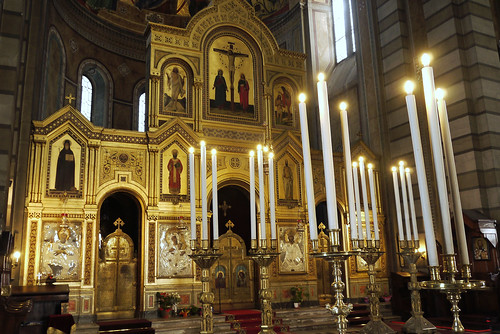
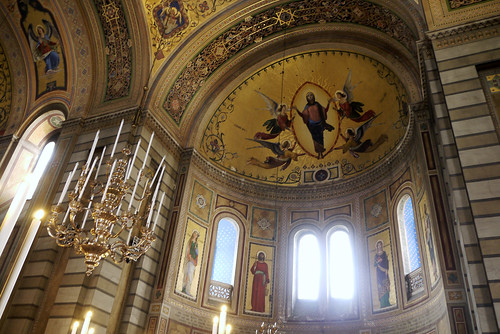
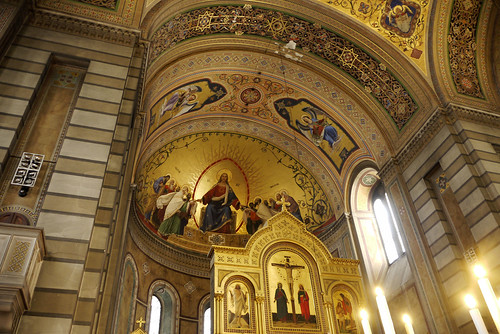
The church was inspired by the Byzantine tradition and built on the plan of a Greek cross, surmounted by a light-blue coloured dome and four smaller domes in the corners. The exterior is decorated with mosaics, alternated with marble and coloured stone.
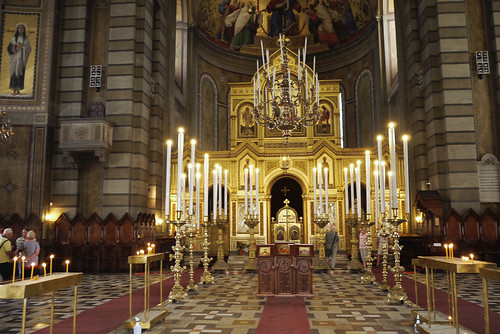
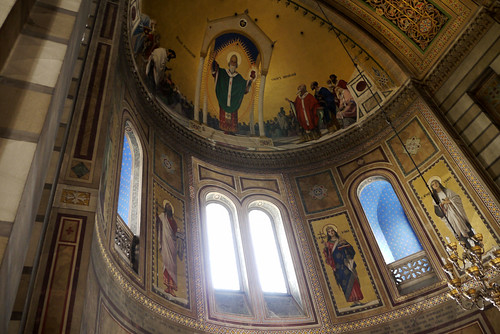
The interior is characterized by frescoes and precious paintings, together with a solid wood iconostasis that separates the presbytery and is the keeper of very valuable icons.
The Church contains a silver candelabra donated by the future Tsar, Paul I, during a visit to Trieste in 1772.
14 Comments CherryPie on Jan 4th 2016