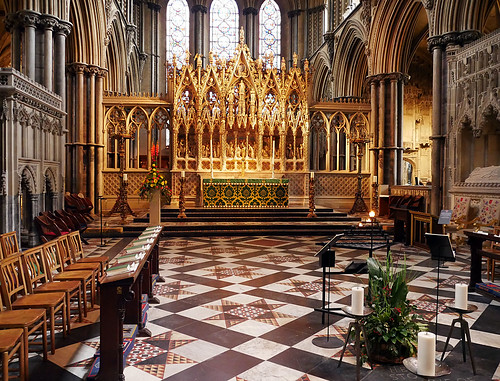
The Presbytery is so named because it is here that the priests, or presbyters, officiate. It was dedicated in 1252 in the presence of King Henry III and Prince Edward. The Norman church ended just east of the steps to your left. In the thirteenth century Bishop Hugh Northwold rebuilt the whole of the east end to provide a magnificent setting for the shrine of St Etheldreda and to accommodate the growing number of pilgrims who came to pray there. The shrine was destroyed on the orders of Bishop Goodrich – a black marble stone marks its position. This part of the Cathedral, built in the Early English style, has a particular gracefulness, the Purbeck marble columns leading the eye past the arches to the rib vault of the ceiling.
In 1109, not long after it was built, the monastery church became a cathedral. It is here that the Bishop has his Chair, or cathedra, the symbol of his authority as a teacher of the faith – in the same way university professors also occupy Chairs. Today the diocese has two bishops, and they use the two chairs on the south side of the Presbytery, which were made for the Queen and Prince Philip for the Royal Maundy Service in 1987.
At the east of the Presbytery is the High Altar. The marble reredos, in the Italian style, was designed by George Gilbert Scott, the architect of the Victorian restoration. Its five panels depict the events of Holy Week, the last week of Jesus’ life, from his entry into Jerusalem on Palm Sunday to his death on Good Friday. The central panel shows the last supper, which is recalled in the Eucharist celebrated at this altar every Sunday.
People look at Jesus in various ways. Christians believe that he is the human face of God and call him God’s Son. His life was so significant that the calendar was stopped and started again from the date of his birth. In Jesus we see the wholeness of our humanity – a human life lived to its full potential. Jesus commanded his followers to love one another as he had loved them. Love has many meanings, but at its heart is a willingness to put others before oneself and to take their interests seriously. Ely Cathedral is home to a group of people who seek to follow Jesus, striving to be a Christian community of worship, welcome and care.
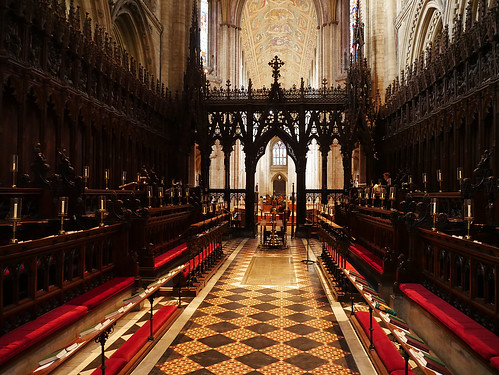
After the central tower collapsed the opportunity was taken to rebuild the first three bays of the choir in a style similar to the new octagon. The work was commissioned by Bishop John Hotham at his personal expense of 2034 pounds, 12 shillings, 8 pence and 3 farthingsl Its style is a development of the Early English known as Decorated, which is lighter, slender and with more embellishment.
The rear rows of the Choir stalls date from the fourteenth century. Underneath the seats are carved panels known as misericords.
The desks and the front stalls are Victorian, with some fine angel end pieces. On the canopies above the stalls are a series of nineteenth-century carvings, which are the work of Michel Abeloos from Louvain in Belgium. Scenes from the Old Testament are on the south side, and on the north side are corresponding scenes from the New Testament. At the west end, the birth of Jesus (panel 1 ) is paralleled with the creation of Adam; his baptism (panel 7) is paralleled with Noah and the Flood, and his ascension (final panel) with Elijah being taken up to heaven.
The Choir screen and the organ case are by Scott, the latter being modelled on the medieval organ in Strasbourg Cathedral. Music is an essential part of worship. It has a unique capacity to speak to the spirit, to convey truths that cannot be expressed in words. When the monastery was dissolved in 1539 King Henry VIII provided for a full time choir in Ely, and, apart from a short break during the time of Oliver Cromwell, the choral tradition has been maintained here ever since.
Tags: Camridgeshire, Ely, Ely Cathedral, Weekend away
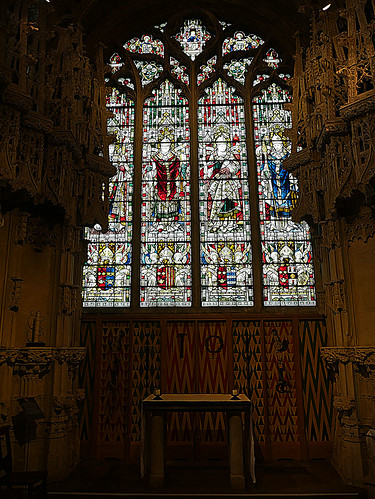
St Dunstan (909- 988) and St Ethelwold (908 – 984)
Together these two churchmen were responsible for the revival of monasticism in England. In 970, one hundred years after it was sacked by the Danes, Ethelwold, Bishop of Winchester, re-established the monastery in Ely as a Benedictine foundation.
The Rule of Benedict, written in the 6th century, still underpins the worship and life of the Cathedral today.
‘Whoever you are, then, who are hurrying forward to your heavenly Father, with Christ’s help fulfil this little rule, which is written for beginners.’
Rule of Benedict, Chapter 73*
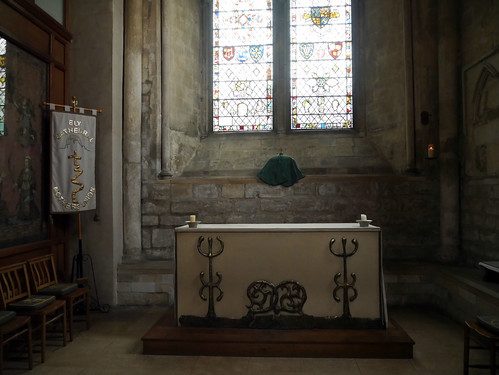
*from an information board next to the chapel
Tags: Cambridgeshire, Chapel of St Dunstan & St Ethelwold, Ely, Ely Cathedral, Rule of Benedict, Stained Glass Window, Weekend away
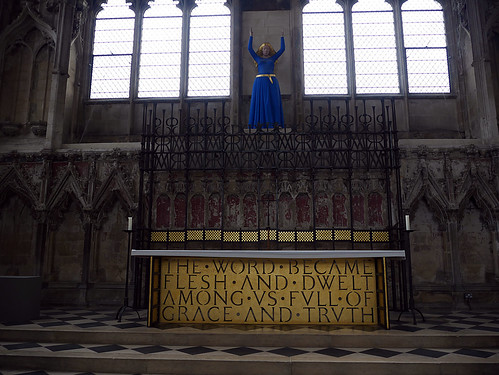
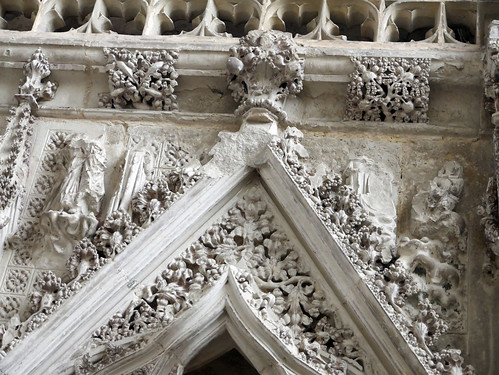
Entering the Lady Chapel you meet a gracious, light and open space. The thirteenth and fourteenth centuries saw the rise of the cult of the Virgin Mary, and chapels in her honour were added to many churches and cathedrals, including Ely. This chapel is exceptional as it is by far the largest attached to any British cathedral. Its foundations were laid in 1321, just before the collapse of the central tower, and work continued despite the disaster. Its construction was overseen by John of Wisbech, whose memorial lies just in front of the doors.
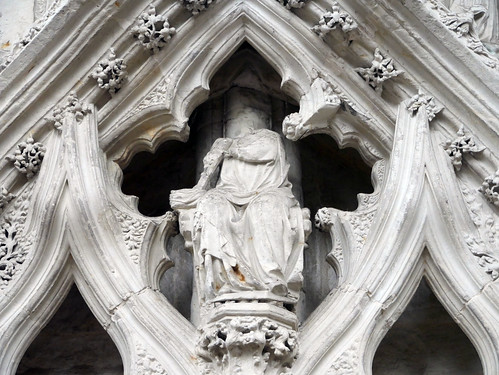
It was completed in 1349, when it would have looked very different from today. It was highly coloured, with windows alive with stained glass and painted statues in the niches.
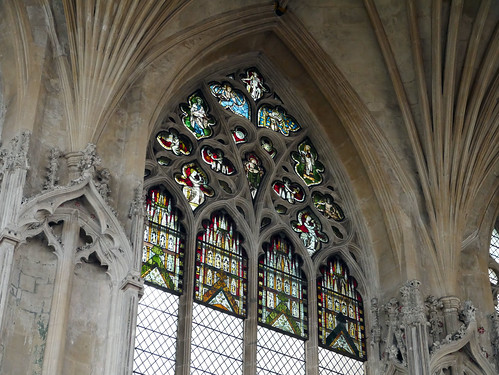
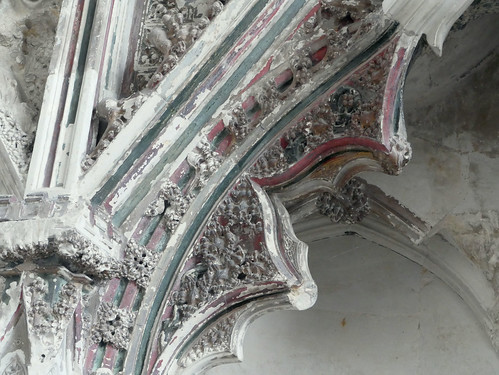
All this was destroyed in the sixteenth century during the Reformation, which, in keeping with Puritan convictions, rejected all forms of religious decoration. Traces of the paint can still be seen, and fragments of the glass survive in the central window on the south side. You can see the damage clearly – the exquisite figures in the lower niches have been defaced. and above these are the empty pedestals where the statues stood. It is believed that the carvings told the story of Mary’s life and miracles. Despite its beauty this is a place of brokenness; you may like to pause here and pray about the brokenness, grief or loss that you have experienced.
Above the altar is a new statue of Mary by David Wynne. It was installed in the year 2000, the third of the millennium sculptures. Most representations of Mary are passive, holding the child Jesus on her knee. Here she is expressive, exulting in the news that she is to be the mother of the Saviour. On the base of the statue are her words from St Luke’s Gospel: ‘Behold the handmaid of the Lord’ (Luke 1.38).
Tags: Cambridgeshire, Ely, Ely Cathedral, Lady Chapel, Mary, Reformation, Weekend away
Working in the garden… gives me a profound feeling of inner peace.
Ruth Stout

Tags: Bees, Cherie's Place Thought, Jesmond Dene, Jesmond Dene House, Sunflower, Vacation
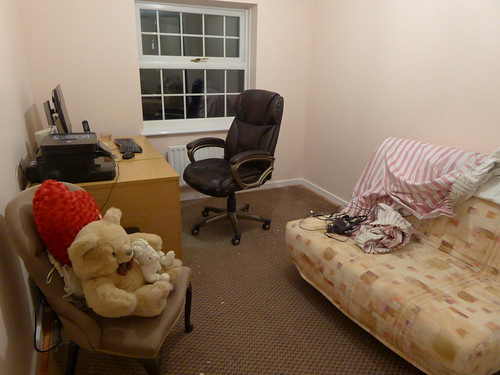
With one thing and another I have been rather busy recently. Christmas preparations are a little behind…
Stage two of our house decoration project was delayed (due to unexpected circumstances) from the expected October schedule until last week. This meant last minute furniture relocation from three rooms in readiness for the decorator to perform his magic. The room where my computer is located needed decorating throughout rather than a refresh that was needed in the other two rooms. The wall colour is much warmer and richer in colour than my photos show.
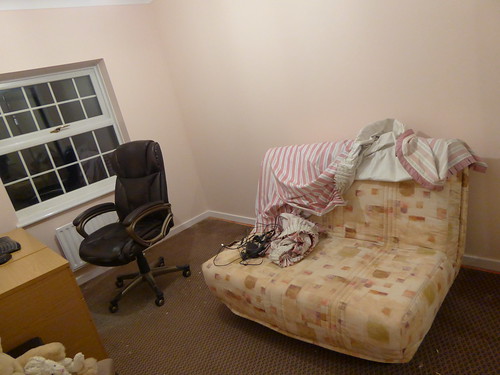
My computer was temporarily located in the living room which was not ideal for creative thinking (for blogging). Now my computer is back where it belongs, but as you can see the room is a work in progress. New carpet is on order and when Mr C and I have time we will take a trip to our local curtain shop.
But for now we have Christmas cards to make and post, trees to put up, one or two more presents to buy and finish planning our boxing day meal, working around numerous food allergies…
Tags: Cherie's Place, Decorations, Work, Work in progress
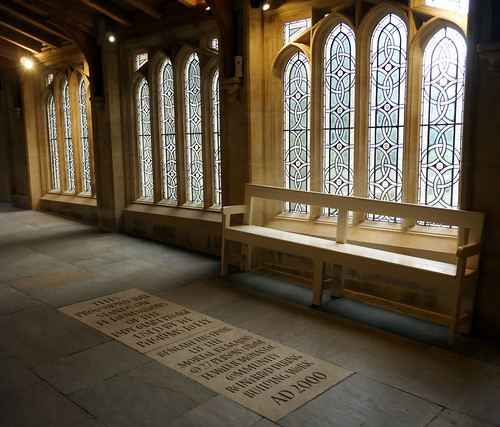
The Processional Way replaces a medieval passageway that pilgrims used to pass from the shrine of St Etheldreda to the Lady Chapel. It was dedicated in the year 2000, and is the first substantial addition to the Cathedral since the fifteenth century. The dedication is recorded in a stone slab set in the floor.
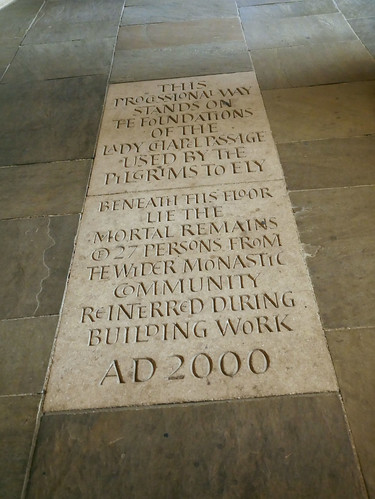
This processional way stands on the foundations of the Lady Chapel Passage used by the pilgrims to Ely. Beneath this floor lied the mortal remains of 27 persons from the wider monastic community reinterred during building work.
AD 2000
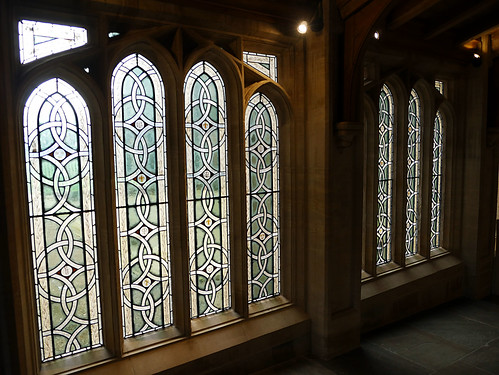
The three, four-light windows and flanking door-panel lights are based on geometric principles, glazed in tints and colours of the 14th century. The symbols are encompassed by decorative borders, foliated motifs and cross-hatching. The painting is traditional in subject matter and format, though contemporary in technique.
Tags: Cambridgeshire, Ely, Ely Cathedral, Pilgrims Way, Weekend away

On one of the walls just inside the entrance to Ely Cathedral there is a large modern sculpture of a cross.
On the North West Transept wall there is a magnificent sculpture called ‘The Way of Life‘ by Jonathan Clarke. One of three sculptures specially commissioned for the millennium, Jonathan Clarke’s The Way of Life is made of cast aluminium and has nine sections, each differently jointed. Like the journey of faith, its path is irregular and unpredictable; and just as the journey is sometimes hard, sometimes joyful, the surface texture and colour also vary. On the top arm you might be able to make out a minute human figure, someone who is perhaps on the journey.
Tags: Cambridgshire, Cross, Ely, Ely Cathedral, Faith, Jonathan Clarke, Life, Weekend away