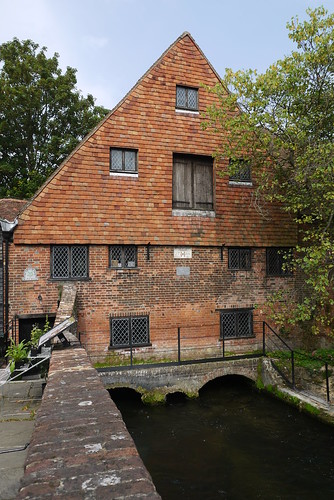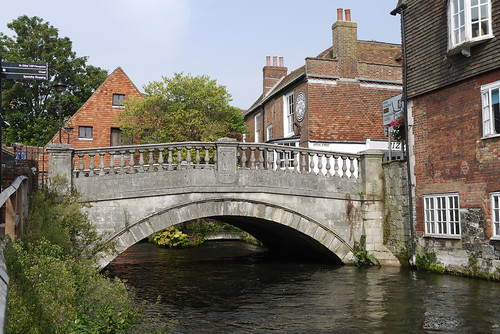
The Winchester City Mill is a restored water mill situated on the River Itchen in the centre of the ancient English city of Winchester. The mill is owned by the National Trust.
The mill was first recorded, milling corn, in the Domesday Book of 1086. The mill was last rebuilt in 1744 and remained in use until the early 1900s. The mill was then used as a laundry until 1928 when it was offered for sale. In order to prevent its demolition, a group of benefactors bought the mill and presented it to the National Trust. In 1932 the mill was leased to the Youth Hostels Association for use as a hostel, a usage that continued until recently.
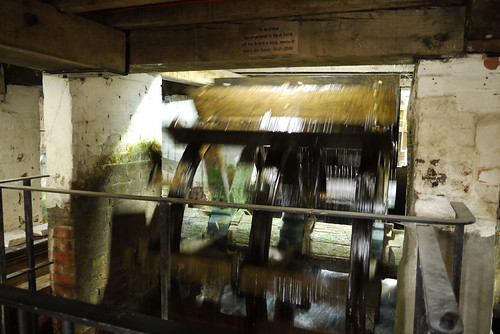
In 2004, a 12 year restoration program came to a successful conclusion, and after a hiatus of at least 90 years the mill again milled flour by water power. The water wheel can be seen working daily throughout the year and flour milling is demonstrated every weekend of the year, and most Wednesdays during the Summer.
14 Comments CherryPie on Dec 16th 2014
The work ‘chesil’ is in fact a derivation of ‘Cheeshill’ which in turn heralds back from the Anglo-Saxon word ceosel, meaning ‘gravel’. Chesil Street’s origins go back to the time King Arthur. Once know as ‘Cheese House’ the timber framed building is situated in a very prominent position, directly at the foot of what was then the only road to London. The Chesil Rectory, built between 1425-1450, is the oldest commercial property in Winchester & is one of the city’s best preserved medieval buildings. Built by a wealthy merchant, the right hand side of the building was used for commerce, the left hand side a private dwelling.
The front of the building is almost all original apart from the windows which would have been simple wooden bars & shutters. The famous oak doorway is the original entrance & is also where the livestock would have been led through on a stone pathway, from the front to the back of the house. The 2 fireplaces were a later extension in the C16th . Originally, simple vents in the roof would have let out the smoke & the walls & roof space would be blackened & the air quality very poor.
The building was taken by Henry VIII during 1500’s when he disbanded many religious building in England & Wales, know as “the dissolution of the monasteries. He subsequently gave the Chesil Rectory to his daughter, Queen Mary, known as Mary Tudor. Queen Mary’s lavish wedding to King Philip of Spain in 1554 at Winchester Cathedral almost bankrupted the city & as part payment for her expensive wedding celebrations & feast, Mary Tudor bequeathed the Chesil Rectory in 1555 to the City of Winchester. The building continued to be used as a private dwelling & in the late 1700s the house was divided into two tenements, with families living in each side. One family was a shoemaker who, in the large upstairs room, started Winchester’s first Sunday School
During the 1800s the house gradually deteriorated until it was deemed unfit for human habitation & was very nearly demolished by the Council. Fortunately it was bought & saved by Thomas & Co general stores in 1892 & it was thoroughly restored.
A one-time merchants house, antique shop, tannery, Rectors home, general store & tea rooms, the building housed a number of eateries for the past 50 years.*
The building is now a modern restaurant serving meals using local Hampshire produce.
*From a leaflet provided by Chesil Rectory
14 Comments CherryPie on Dec 15th 2014
10 Comments CherryPie on Dec 14th 2014
Subtitled…
Yodel Ho Ho Ho!!
You might recall my recent day of successful deliveries that arrived on 6th December. One of the Christmas deliveries I mentioned was a part delivery of wine that had been ordered for Christmas, some of which was for presents. The supplier informed us that the partial delivery was due to part of the consignment not reaching the couriers collection slot in time. Mr C arranged with the supplier that the remaining part of the order would be delivered on the following Saturday when at least one of us would be at home.
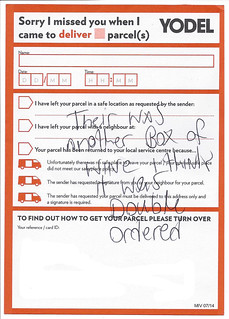
The delivery activity regarding the remainder of the order took on a bizarre turn of events culminating in a strange delivery note from Yodel… Sorry I missed you when I came to deliver parcels “Their was another box of wine I think it was Double ordered”. We were left wondering what on earth that meant… Mr C phoned up Yodel to find out and was told he had refused delivery at 8.37. How odd we were both in the house at that time and neither of us noticed anyone trying to deliver anything!!
The next day the supplier contacted Mr C by email, asking why he had refused the delivery, to which he replied:
Hi S,
Thanks for getting in touch.
To be honest I’m very confused by the delivery arrangements for this order.
On Wednesday 3rd December, I ordered a lot of wine, some of which is for gifts, and paid for a Saturday delivery.
On Saturday 6th, one box of wines arrived. Then I received an email from Naked Wines advising that some of my consignment had missed the courier’s collection slot on Friday 5th. I replied to Naked Wines asking for the delayed part of my order to be delivered on a Saturday and received confirmation that this would be arranged.
On Monday 8th December, two more boxes of wines arrived though one was subsequently removed by the Yodel driver for delivery to the correct (i.e. another) household!
On Tuesday 9th December, I came home to find that Yodel had left a card upon which was handwritten, “Their was another box of wine. I think it was double ordered”. I contacted Yodel that evening to find out what this might mean, only to be told that I had refused delivery at 08:37 that morning. I had not. Yodel said that they would request redelivery for Wednesday 10th December.
On Wednesday 10th December, your email below arrived (though no wine as yet – Yodel apparently deliver until 9pm).
So… Yes please, I would still like the wine that someone at Yodel refused on my behalf and without asking. A Saturday delivery would be best but given the chaos that all couriers appear to be experiencing at the moment, any day of the week will do.
![]()
Regards,
Mr C.
12 Comments CherryPie on Dec 13th 2014
8 Comments CherryPie on Dec 12th 2014
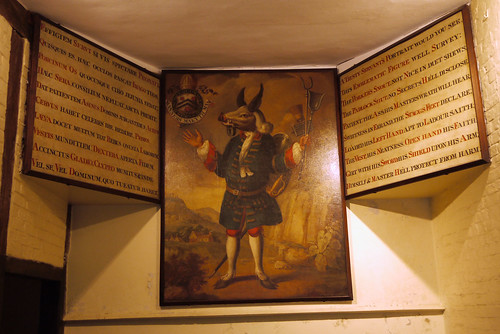
The Language and Meaning of the College Motto:
‘Manners makyth man’ is the motto of both the institutions founded by William of Wykeham, New College and Winchester College. Although no contemporary record attests to this, it is often thought that Wykeham devised it himself and appended it to his coat of arms.1 We do not know when he first used either the arms or the motto, but his seal as Archdeacon of Lincoln displays the arms and he was appointed to this position in 1361. Neither is likely to predate his rise to prominence as Clerk of Works and Surveyor to Edward III in the late 1350s, and the motto, if indeed composed by him as a motto, cannot predate the arms. In English heraldry, however, mottoes are personal, they do not normally form part of a grant of arms, and their use with the coat is accordingly optional. The absence of the motto from the seal does not,therefore, necessarily indicate that the motto had not yet been devised. In 1367,Wykeham was appointed Bishop of Winchester, by virtue of which he also became Chaplain to The Order of the Garter at Windsor and entitled to the use of the famous motto, Honi soi qui mal y pense. He could hardly have felt a need to add to this a superfluous one of his own with which to clutter his arms. We may accordingly date Wykeham’s creation of his motto most probably to the period between the late-1350s and 1367.
10 Comments CherryPie on Dec 11th 2014
10 Comments CherryPie on Dec 10th 2014