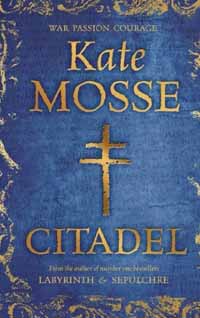
 Synopsis (from book cover):
Summer, 1942. A spirited and courageous young woman, Sandrine, finds herself drawn into the world of the Resistance in Carcassonne under German Occupation. Her network – codenamed ‘Citadel’ – is made up of ordinary women who risk everything to fight the sinister battles raging in the shadows around them. as the war reaches its violent and bloody conclusion, Sandrine’s fate is tied up with that of three very different men. But who is the real enemy? Who is the real threat? And who is the true guardian of the ancient secrets that for generations have drawn people to the foothills of the Pyrenean mountains?
This is the story of ’Citadel’ – an epic tale of passion, loyalty, courage and betrayal.
Review:
This is the third and final book in Kate Mosse’s Languedoc trilogy, the previous two books being Labyrinth and Sepulchre. Labyrinth was set in the walled city of Carcassone, Sepulchre was set in Rennes les Bains and Citadel is set in the Bastide, the city just outside the walled city of Carcassonne.
I found the setting particularly enjoyable, having visited the places on my holiday to France last year. For me the book was a page turner. It crosses two time lines, the period of world war two and the much earlier period of AD 342.
Like the first two books in the series, the two time lines eventually connect together. The descriptive writing takes the reader back to what it must have been like during the war time occupation. It tells of the resistance and in particular the role of women in that movement. I won’t say any more, I don’t want to spoil the plot for anyone who has a desire to read the book.
Although the trilogy is complete I hope that Kate writes another novel based in the Midi area of France. I thoroughly recommend the series and now feel the urge to read them from the beginning again. Now where did I put Labyrinth…
- You can read my review on Sepulchre here.
Tags: Book Review, Books, Fiction, Kate Mosse

The prompt for this weeks theme was:
With ‘Vintage’ we are aiming to capture the feeling of dated, old, or classic. An alternative to that would be to edit a photo to give it a vintage feel.
The ‘Vintage’ gallery can be found here.

Tags: 52 Photos Project, Car, Heritage Motor Museum, Kestrel, Riley, Riley Nine

Long time friends and readers will know how much I enjoy walled gardens and will understand why I couldn’t resist exploring the walled garden at Shugborough before I left the estate.


Tags: Garden, National Trust, Shugborough Estate, The walled garden, Walled Garden

Unfortunately on the day I visited Shugborough the tower was closed so I was unable to see the interior. This is what the guide book has to say about the tower:
The Tower of the Winds was completed in 1765 and is based on the Temple of the Winds in Athens. the Greek original derived its name from the depiction of each of the winds as reliefs at the top of each octagonal side.
Shugborough’s tower stood at one time at the edge of an ornamental lake and was flanked by two bridges. At the other end of the lake it was faced by an elegant Chinese Pagoda. Sadly the pagoda was lost during severe flooding in the late eighteen century and the lake was drained in order to prevent such a disaster recurring.
At one time the basement of the building was used as a dairy and the upper floor is believed to have been used as a gambling den by the 1st Earl in the mid-19th century.
Tags: National Trust, Shugborough Estate, The Tower of the Winds
…we see the canal that divides Shugborough from the village of Great Haywood.


Tags: Barge, Canal, Great Hayward, Shugborough

I am now taking you on a little detour just outside Shugborough across the Essex Bridge:
The Essex Bridge links Shugborough to the village of Great Hayward at the point where the rivers Trent and Sow join.
It is believed to be the longest packhorse bridge ever constructed and was built in the late 16th century. The financing of the project was funded by the Earls of Essex who used the bridge to access the hunting forest of Canks Wood – now Cannock Chase – from their home at Chartley Castle a short distance away. Originally it boasted 42 arches but it is believed the bridge was shortened in size in the early 19th century when a new channel for the River Sow was dug. Today it spans over 100 yards and has 14 arches.*

*From the Shugborough guide book.
Tags: Bridge, National Trust, Packhorse Bridge, Shugborough Estate, The Essex Bridge, We
Imagination is everything. It is the preview of life’s coming attractions.
Albert Einstein (1879 – 1955)

Tags: Attingham Park, Cherie's Place Thought, Flower, National Trust