Random thoughts and photos of my journey through life…
8 Comments CherryPie on Feb 6th 2016

The main purpose of the boat is the transport of passengers and boat rides for tourists. Given the design of the main part of the boat, which measures 30m2, the latter can be used and adjusted for different activities.
Basic Data:
Type: boat with flat bottom construction, made of solid larch and oak wood
Length: 10 m
Width: 4,4 m
Capacity: 48+2
Weight (without passengers): 7500kg
Weight (full): 11500kg
Engine: E-Tec Evinrude 2×25 Hp
Consumption: at normal speed 1 litre/hour/engine
Steering: last third in the middle of the boat
Toilet and bar at the back of the boat.
Entrance: in the front, on the left and right


Information about the construction:
Time needed for construction: 3500 working hours
Usage of wood: 7 m3 of wood, 350 m2 Okoume plywood
Screws: 15 000, Zink- Nickel
Polyurethane glue: 40 kg
Epoxy glue: 55 kg
Fiberglass: 80 m2
Polyurethane paint: 50 l
Alkyd varnish: 27 l
Alkyd paint: 15 l
Electrical wires: more than 500m

16 Comments CherryPie on Feb 4th 2016

The Cobbler’s Bridge was probably the oldest bridge of medieval Ljubljana. It connected the banks of the Ljubljanica between Tranča and the present Jurčičev trg (Jurčič square). The old wooden bridge, which was probably partly a drawbridge, was set up in the 13th century. Soon shacks were set up on it. As shoemakers had their workshops by the bridge, it got the popular name the Shoemaker’s or Cobbler’s Bridge. In 1867 the wooden bridge was replaced by one of cast-iron, an exceptional product of the ironworks from Dvor pri Žužemberku. The arch bridged the Ljubljanica for 65 years. The iron bridge, not distinguished enough and too narrow for the town core, was moved to the edge of the hospital between the wars.
A wide concrete platform grew above the Ljubljanica according to the designs of Jože Plečnik in the years 1931-1932. The architect designed a square above the water and protected it by enclosures with cylindric balustrades. Above them rise six pairs of pillars, which are the remains of the originally planned roof. The middle of the bridge is accentuated by two candelabras above the bearing of the bridge.
The viewing square rests on a single bearing in the riverbed. The architect had the banks filled in, so that the former stairs from the bridge to the embankment could be avoided. The surface of the bridge pours over to the banks in a paved carpet. Between the Shoemaker’s Bridge and the Three Bridges (Tromostovje), Plečnik arranged a lower terrace and intermediate “washboards”, where symbolic washerwomen, the weeping willows, bend over to the water.
In 1991 the severely damaged and corroded concrete enclosures were replaced by new ones according to Plečnik’s original plans. The pillars unfortunately do not have as refined adornments of the capitals as the originals, which were transported to the Architectural Museum. The bridge was statically reinforced, the upper surface was re-asphalted, while the accesses were paved with blocks. On the bridge one can often encounter street vendors, and in the summer sometimes even comedians.


6 Comments CherryPie on Feb 3rd 2016
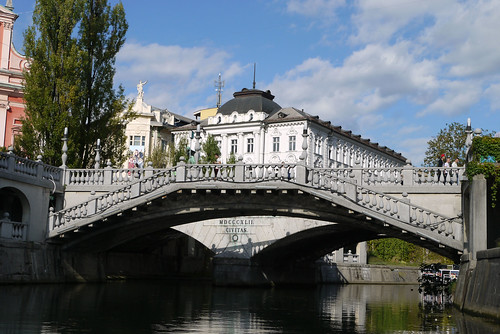
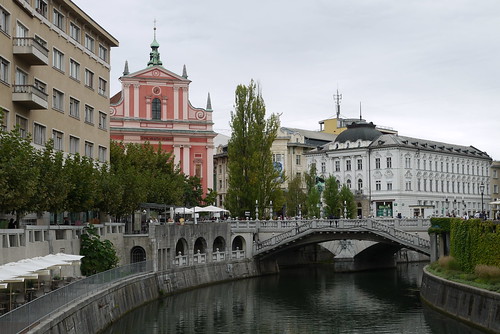
If the capital city has one immediately recognizable landmark, it is probably the Triple Bridge, the three-lane crossing designed in 1929 by the city’s most prolific architect, Joze Plecnik. Faced with the problem of how to widen the city’s main crossing point to accommodate increasing traffic levels, Plecnik decided to retain the 19th-century bridge in the middle, adding two angled side bridges for pedestrians. It was an inspired piece of town planning, turning Presernov trg into the focal point of the city and bringing life to both banks of the river.*
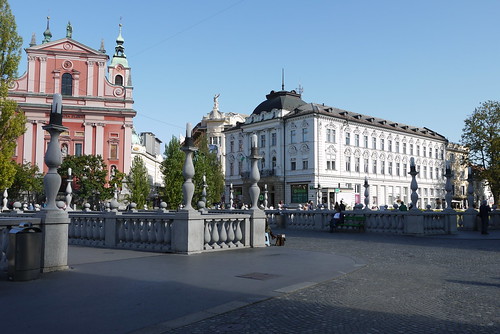
The bridge is embellished with the kind of decorations typical of Plecnik, with stone baubles sprouting from the parapets alongside curvy lampstands tipped with buds of milk-coloured glass. The elegant ballustrades bring a Venetian sense of style to the whole ensemble.*
*From the Eyewitness Guide to Slovenia
14 Comments CherryPie on Feb 1st 2016
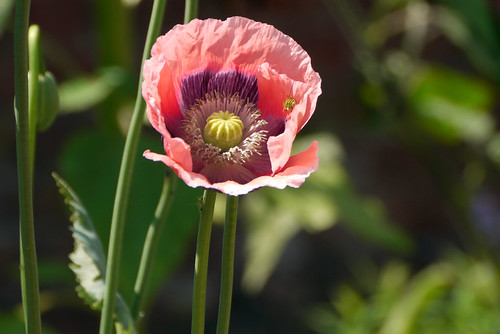
I hope you find joy in the great things of life – but also in the little things. A flower, a song, a butterfly on your hand.
Ellen Levine
10 Comments CherryPie on Jan 31st 2016
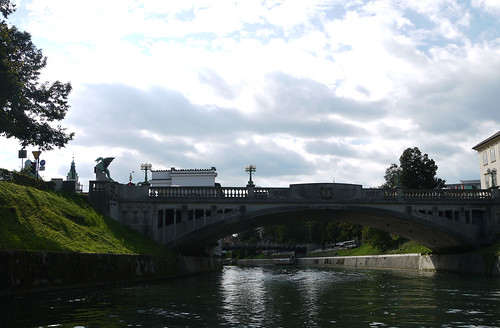
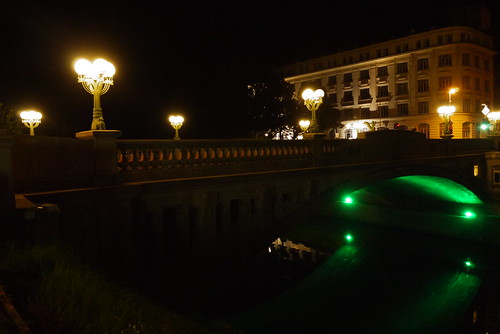
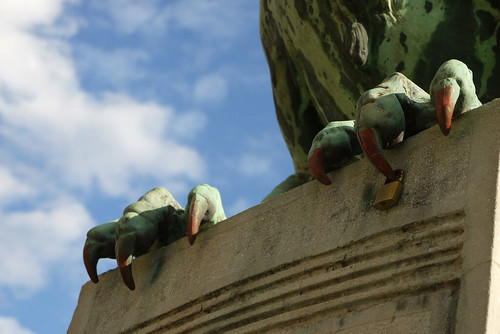
Located just beyond the market’s eastern boundary the Dragon Bridge was the first major Art Nouveau project to be built in the city. Designed by the architect Jurij Zaninovic, it was built in 1901 to mark the 60th birthday of Austro-Hungarian Emperor Franz Josef I. The bridge gets its name from the bronze dragons that stand guard over its ends. It is said that the legendary voyagers, Jason and the Argonauts, fought with and killed a dragon in the marshes south of Ljubljana before continuing on their journey towards the Adriatic.*
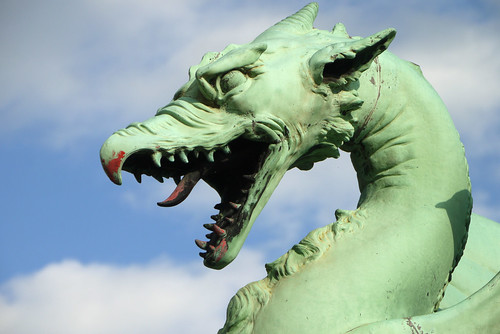
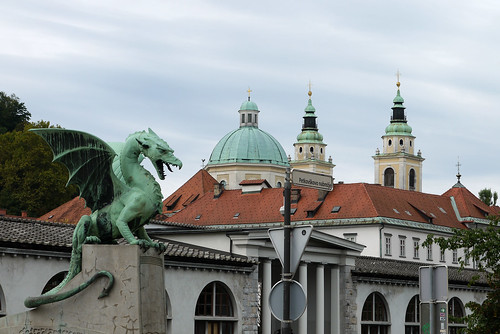
Rising from the bridge’s parapet is a line of Art Nouveau lampposts, decorated with griffin motifs and crowned with full fruit-like clusters of glass globes. A plaque halfway along the bridge honours Ivan Hrbar (1851 – 1941), the mayor of Ljubljana who oversaw the bridge’s construction. The western end of the bridge provides a fine view of Ljubljiana’s market halls, with the twin towers and dome of the cathedral rising in the distance.*
*From The Eyewitness Travel Guide to Slovenia.
8 Comments CherryPie on Jan 29th 2016
…there be Dragons!!
12 Comments CherryPie on Jan 28th 2016