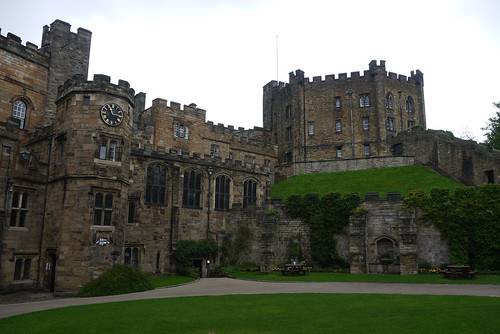
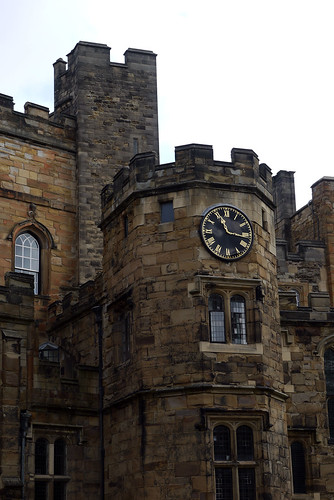
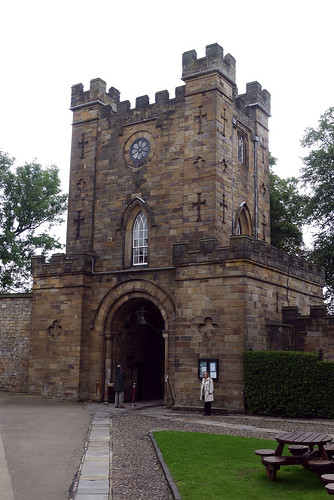
For some 750 years Durham Castle was the ceremonial palace of the Prince Bishops of Durham. Since the 1980s it has been the home of the University College, the foundation College of the University of Durham.
Within the castle are many interesting features including the Great Hall and the Black Staircase, but the part of the castle that interested me the most was The Norman Chapel:
The chapel features an unusual array of carvings, some thought to show religious scenes and values, others simply decorative. One of its capitals depicts a man with two dogs hunting a stag which may be a representation of St Eustace, who converted to Christianity when he saw an apparition of Jesus appear between the horns of the stag he was hunting. Others include the earliest known representation of a mermaid in England, as well as leopards, a snake and a green man.*
In particular I was intrigued by the thought of the mermaid representation being the first in England.
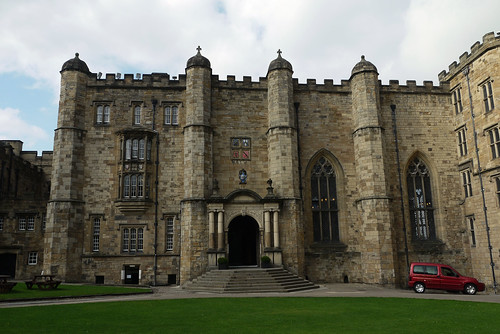
Grey towers of Durham
yet will I love thy mixed and massive piles
Half Church of God, half castle ‘gainst the Scot
And long to roam these venerable aisles
With records stored of deeds long since forgot.’
Sir Walter Scott (From Harold the Dauntless)
*Durham World Heritage Site, A Guide to the Castle and Cathedral – Published in 2013 by Durham World Heritage Site.
Tags: Durham, Durham Castle, Northumber- land, Sir Walter Scott, Vacation
I have had another busy weekend. On Saturday afternoon I had a jaunt out to Chester to track down just the right present for a friend who has recently become a gentleman of a certain age. The present was obtained, leaving me time to peruse M&S looking for a pair of trousers and some tops for my next holiday. I know it must seem like I have been on holiday for most of the year 
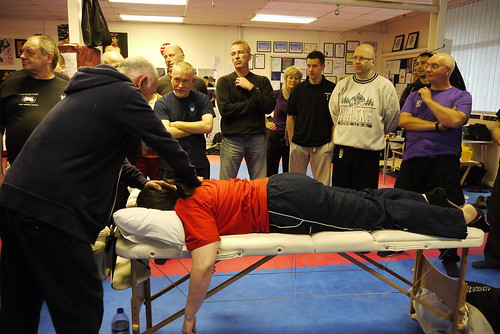
Yesterday I spent the day watching the demonstration and practice of martial medicine. The demonstration was taking place at a friend’s Dojo and he had invited me along (with my camera) to watch.
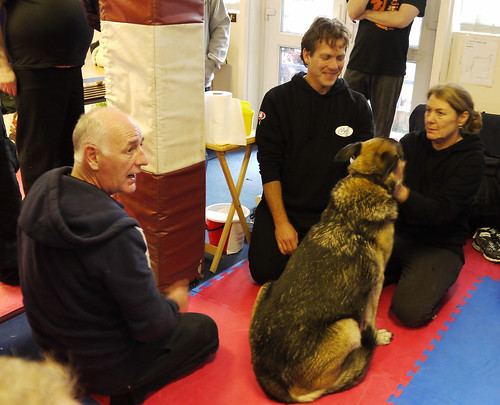
The talks and demonstrations were fascinating. Some of the attendees had their minor ailments treated. This included one man that had had a shoulder injury many years ago, putting it out of line. After he had received a combination of Japanese acupuncture and physiotherapy everyone could see a marked difference in the shoulder. We were even treated to a demonstration of acupuncture on an Alsatian dog which took it very well considering a group of people were crowding round as the needles were inserted.
The importance of good nutrition and the relationship between martial arts and martial medicine was explained and how they are broadly equal and opposite.
There is a fine line between killing & curing/healing & hurting!
The display of martial arts towards the end of the day looked rather painful as people were flipped over by their wrists and toes. At this stage I was glad I was only a spectator although one of the students insisted that I tried out one technique that made my arm go floppy. It was a very strange effect and sensation.
There were many other talented people in the room including some that practiced in acupuncture, one person even specialised in equine acupuncture.
Tags: Andrew Young, Bujinkan Onmyo Dojo, Chris Roworth, Life, Martial Arts, Martial Medicine
Love one another and help others to rise to the higher levels, simply by pouring out love. Love is infectious and the greatest healing energy.
Sai Baba
Tags: Bees, Cherie's Place Thought, Cragside, Flowers, National Trust, Vacation
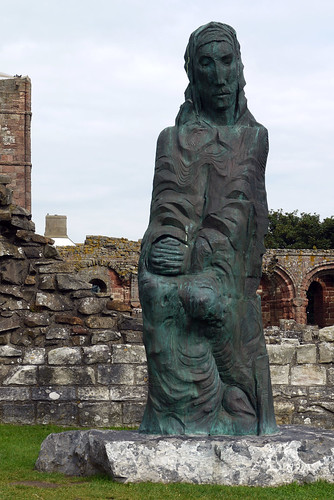
…Cuthbert of Farne.
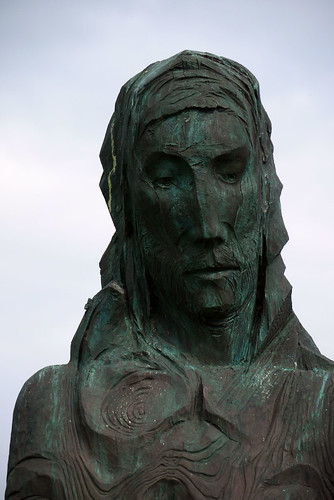
Cuthbert became prior of Lindisfarne in 664, but decided to move to a quieter life of solitude on the island of Inner Farne:
Lindisfarne Priory on Holy Island is one of the most important early centres of Christianity in Anglo-Saxon England. Founded in 635 and home to a small number of monks, it was to become a shrine when the body of Cuthbert was exhumed 11 years after his burial and found undecayed. Cuthbert was an exceedingly Holy man who became the prior of Lindisfarne in 664 but left for a life of solitude on the island of Inner Farne. He became bishop of Lindisfarne in 685. Fleeing from the Viking raids, the community of monks left Lindisfarne with the body of Cuthbert in 875, re-establishing St Cuthbert’s shrine at Chester-le-street and then in Durham in 995.
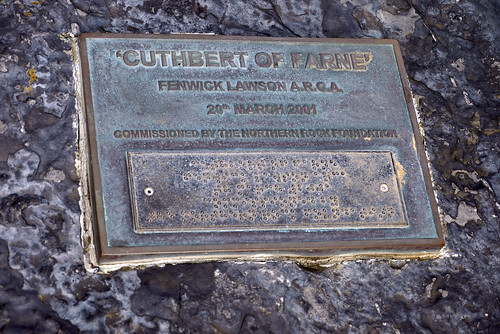
Fenwick Lawson’s original sculpture, ‘Cuthbert of Farne’ was carved from an elm tree in 1983 and stood in the cloisters of Durham Cathedral where it was seen by many millions of visitors. In 1999, the Northern Rock Foundation commissioned the artist to cast Cuthbert of Farne in bronze. This sculpture depicts a contemplative Cuthbert, reflecting his religious life and desire for solitude. His interlaced hands echo the stillness and peace he sought, whilst an eider duck broods in sanctuary at his feet. Lindisfarne itself is also portrayed, with echoes of the many rugged elements of the island on which he lived.*
More C inspiration can be found in the gallery.
*From English Heritage guidebook 2002 and promotional leaflets 2013.
Tags: 52 Photos Project, Cuthbert of Farne, English Heritage, Fenwick Lawson, Lindisfarne Priory, Northumber- land, Sculpture, St Cuthbert, Statue, Vacation
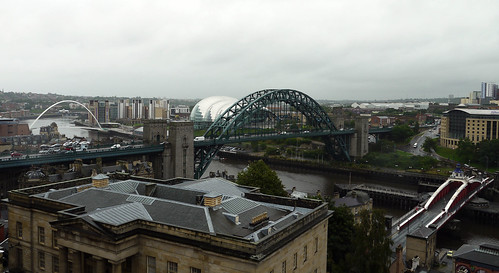
In the 19th century, cannon were mounted on the rooftop and fired on ceremonial occasions.
One was used regularly as the ‘noon gun’, firing at the midday in response to a telegraph signal from Greenwich Observatory in London. After a number of accident – in one of which a gunner was killed – the practice of firing the cannon was eventually discontinued in the 1850s and the guns were later removed.*
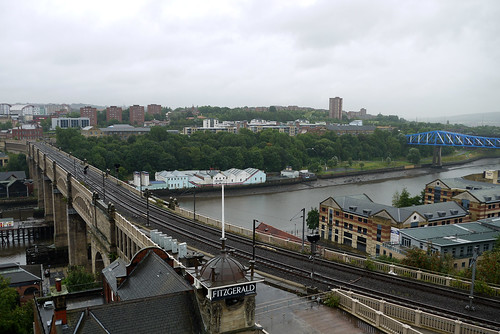
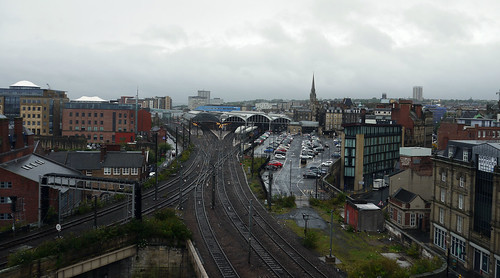
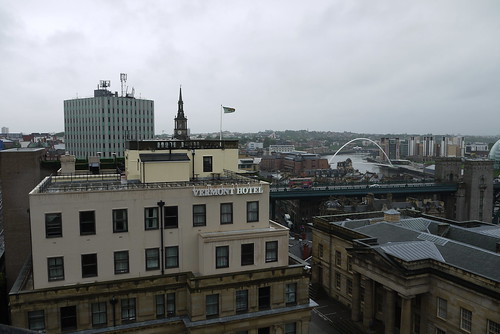
*Information from Newcastle Castle guidebook (Society of Antiquaries of Newcastle upon Tyne).
Tags: Station, The High Level Bridge, The Hotel Vermont, The Millennium Bridge, The Moot Hall, The Sage, The Swing Bridge, The Tyne Bridge, Vacation
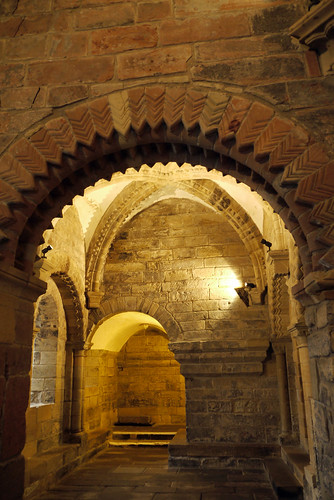
The chapel lies below the main entrance stairway. In the middle ages it could only be entered from the outside through a small door to the left of the stairs. The chapel consists of a small nave set at right angles to the chancel, and was partly restored by John Dobson in 1848. It is now entered from within the keep by a doorway cut through the medieval masonry.

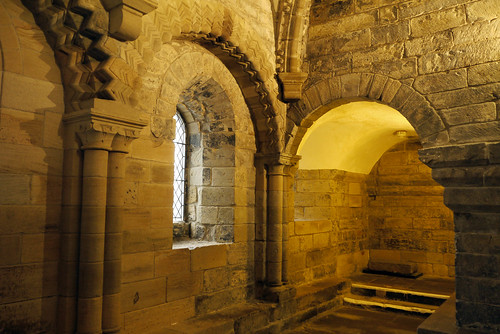
Tags: Chapel, Newcastle, The Castle Keep, Vacation
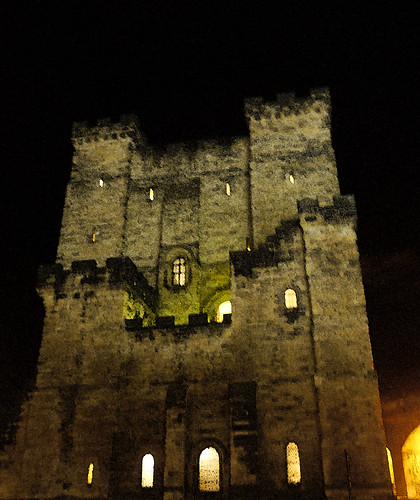
The castle at Newcastle is situated on a steep sided promontory overlooking the River Tyne.
It is a naturally defensible site, which archaeological excavations show has been occupied for nearly 2000 years. Flint flakes and a stone axe head hint at prehistoric activity, and the grooves left by early ploughs – ard marks – have been found in the clay subsoil.
From the mid-2nd century until the beginning of the 5th century a Roman fort – Pons Aelius – stood here, guarding the river crossing below. The name refers to the Roman bridge (pons) across the River Tyne, and to its builder, the Emperor Hadrian, whose family name was Aelius. The site of the bridge was probably close to the present Swing Bridge.
The castle keep as we see it today is the product of a number of restorations over the years:
Despite these changes the keep remains one of the best examples of its type in the country. The names used for the rooms in the keep in the medieval period are unknown: those used today were given by antiquarians in the 19th century. The keep has been open as a ‘curiosity’ or visitor attraction since 1812*
*Information from Newcastle Castle guidebook (Society of Antiquaries of Newcastle upon Tyne).
Tags: Newcastle, Photoshop Elements, The Castle Keep, Vacation